

AWS introduced Strands Agents as an open-source SDK with a model-driven loop
AWS introduced the open-source Strands Agents SDK on May 16, 2025, framing model-led planning, tool calls and reflection as an alternative to prewritten agent workflows.
Historical reporting: AWS announced Strands Agents on May 16, 2025 as an open-source SDK. The launch article describes a model-driven agent loop, tools and provider interfaces; current documentation is later context only. The record does not prove an agent is reliable, that a provider behaves identically, or that a workflow may take consequential action without application controls.
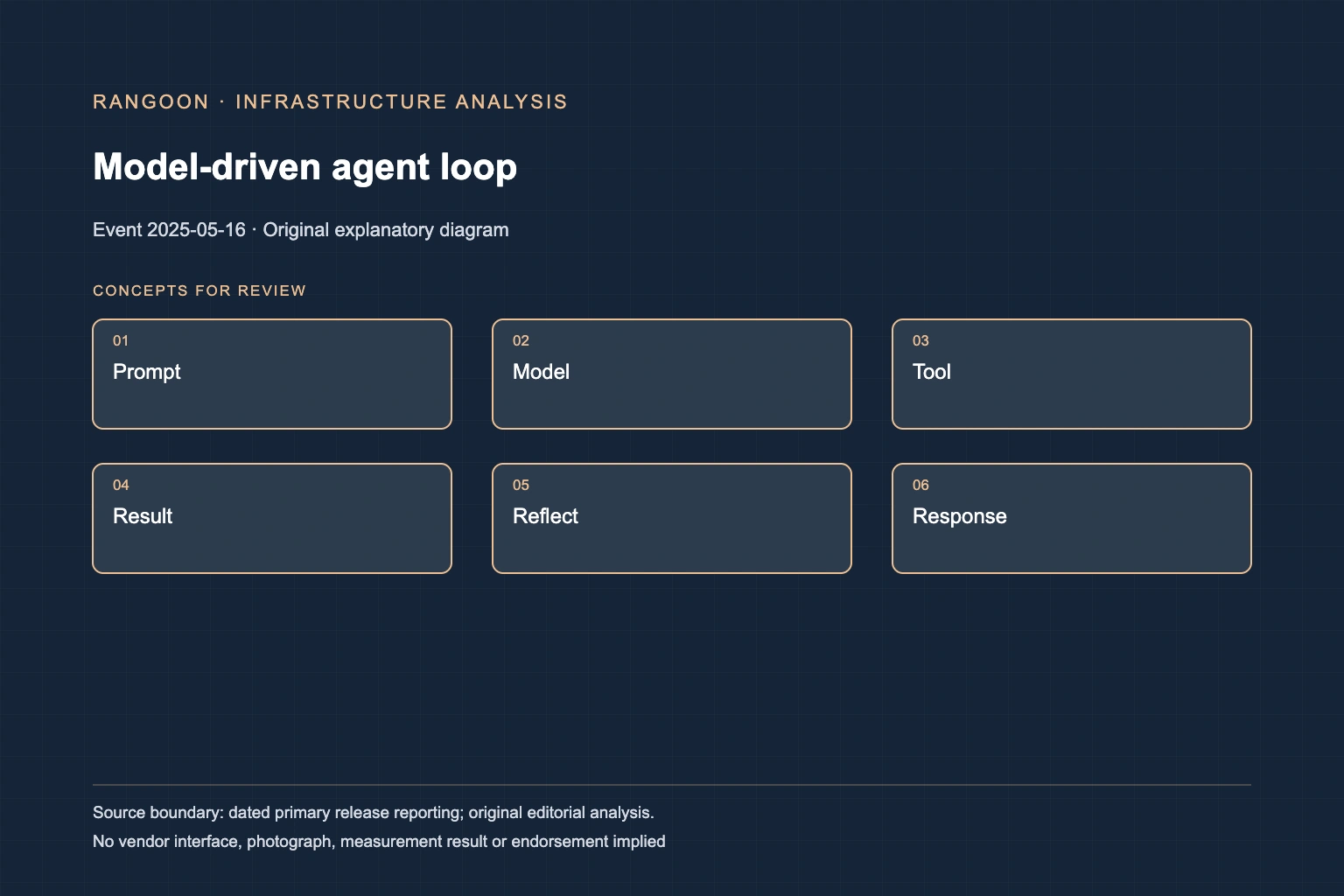
Key takeaways
- Strands launched as an open-source SDK that gave model reasoning a central role in choosing tools and next steps.
- The SDK described a loop, not a guarantee that plans, tool arguments or reflection are correct.
- Model-provider flexibility still leaves tool permissions, state and evaluation to the application.
AWS presented Strands as an open-source agent SDK[source 1]
On May 16, 2025, AWS published its introduction to Strands Agents, calling it an open-source SDK for building AI agents. The announcement contrasted the SDK with approaches where developers prescribe a complex workflow in advance, saying models could plan, call tools and reflect. That is a design choice about where orchestration logic lives. It does not establish that a model will choose a safe plan, understand a business rule, or receive authority to act in a connected system.
The launch made the agent loop a visible engineering boundary[source 1][source 2]
The post described an agent loop in which a model receives a prompt and available tools, decides on a next action, observes a result and continues until it returns a response. This is a useful decomposition because the prompt, tool schema, tool result and stopping condition can fail differently. The announcement’s claim is that Strands provided an SDK pattern for that loop. It is not evidence that an individual tool call is authorized, idempotent, traced correctly or recoverable after a partial failure.
Provider interfaces and tools did not remove application-specific controls[source 1][source 2]
AWS said Strands could work with Bedrock and other model providers, and described tools as a way to connect an agent to capabilities beyond text generation. Provider choice can affect formats, latency, model behavior and policy settings, while a tool can turn a response into a data read or external action. The distinct later documentation explains those interfaces, but cannot change the May launch date or make a universal compatibility promise. A deployer still owns credentials, input validation, output review and action boundaries.
The May event established an SDK announcement rather than a deployment result[source 1][source 2]
Strands was notable because AWS put a model-driven loop, tools and extensibility into a named open-source SDK. The dated launch supports that narrower product history. It does not support a comparative claim that model-led orchestration is better for every task, nor does it prove production use, cost, data handling or security outcomes for a particular customer. This article does not project later packages, model support or documentation back into the May event. For an implementation, the important question is not whether a model can call a tool, but which calls are permitted, what evidence accompanies the result, and how a failed or repeated call is contained. Those controls remain application work outside an SDK announcement. Teams also need to record the selected model and tool version, because a changed provider response can change a plan without a source-code edit. The framework gives a structure for building; it does not replace release discipline.
Teams also need to record the selected model and tool version, because a changed provider response can change a plan without a source-code edit. The framework gives a structure for building; it does not replace release discipline. It also does not select data-retention periods, decide whether a tool may see customer information, or resolve who owns an incorrect action after a handoff.
Sources
Continue reading
Related reading
 News analysisCloudflare introduced its Agents SDK for stateful agent applications on Workers3 min read
 News analysisAWS introduced a bundled next-generation Amazon Connect across the contact lifecycle3 min read
 News analysisAmazon Bedrock moved multi-agent collaboration from preview to general availability3 min read