

The 2025 AI Diffusion Rule record turned on publication, a planned date and rescission
BIS published the Framework for Artificial Intelligence Diffusion in January 2025; Commerce announced its rescission on May 13 before planned compliance requirements took effect.
Historical reporting: BIS lists the Framework for Artificial Intelligence Diffusion as published January 15, 2025, with a January 13 effective date, and Commerce announced rescission May 13, 2025. This article does not determine export-control applicability or current legal obligations.
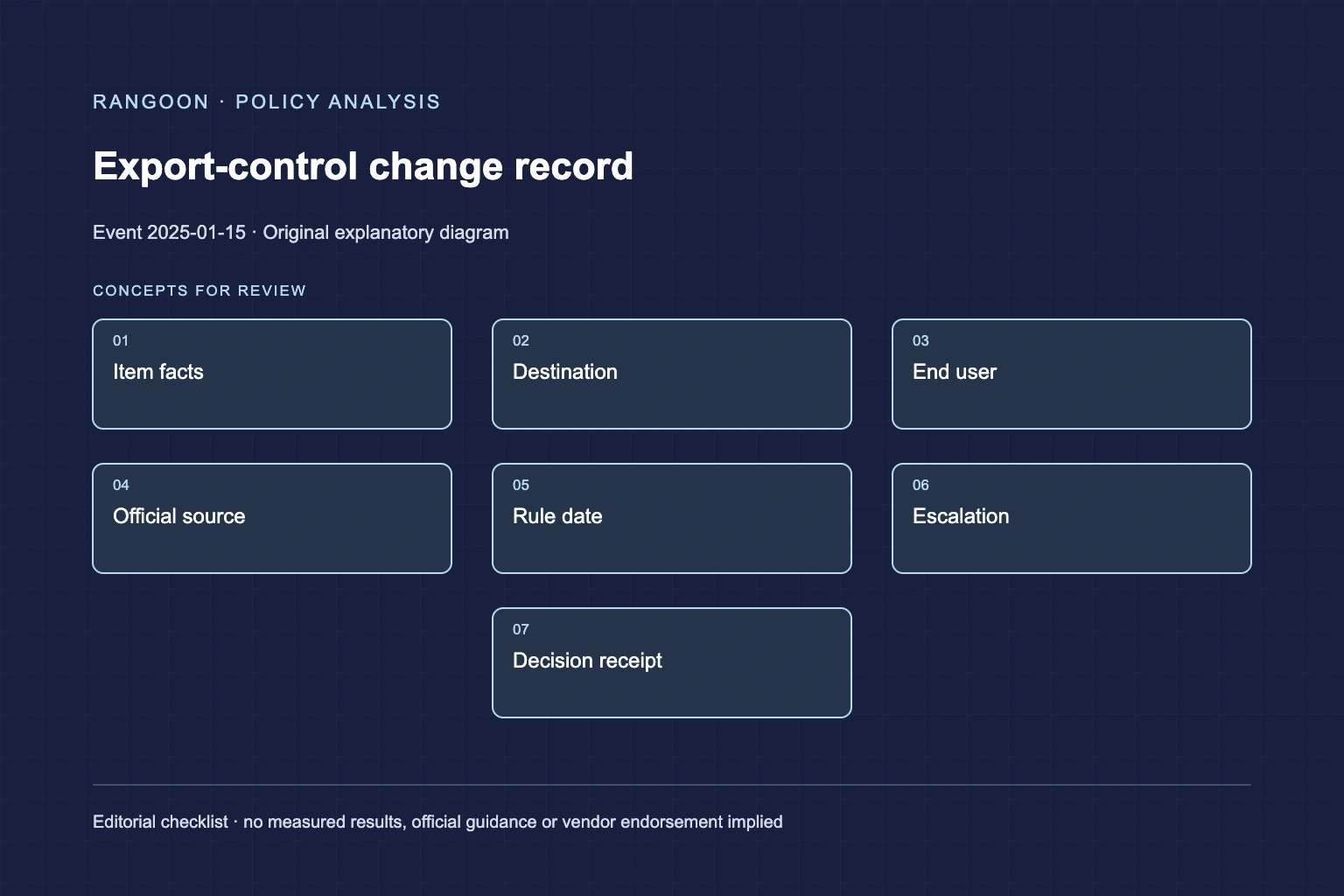
Key takeaways
- The rule’s January effective date, January publication and planned May compliance date are separate dates.
- The May 13 rescission announcement is not evidence about every other export-control rule.
- Export-control analysis needs product, destination, end-use and end-user facts current at the decision time.
The historical record contains several dates, not one[source 1][source 2]
BIS’s Federal Register notices index lists “Framework for Artificial Intelligence Diffusion” with a January 13, 2025 effective date, January 15 publication date and May 15 compliance date. This article uses January 15 as its event date because it is the cited source’s published date. The January 13 effective date and January 15 publication should not be silently merged; each can matter to a timeline.
On May 13, 2025, the Department of Commerce announced rescission of the Biden Administration AI Diffusion Rule and said its compliance requirements had been set to take effect May 15. The department also said BIS planned a regulation formalising the rescission and would issue a replacement rule in the future. Those statements establish the announced historical action, not a complete present export-control analysis.
A rule label does not decide a transaction[source 1][source 2]
Export-control questions depend on facts that a headline cannot provide: item classification, technical parameters, destination, end user, end use, intermediary role, licence exceptions, ownership and the rules in force at the relevant time. The January and May materials concern one named framework. They do not establish that all chip, model, cloud or technology transfers were unrestricted or newly controlled.
Keep a transaction file with the date of the proposed transfer, product or service description, classification evidence, counterparties, destination, screening results, relevant official sources and the approving owner. Where the facts or applicable rule are uncertain, stop for qualified export-control review. This is a process recommendation, not a classification or legal conclusion.
Analysis: model a regulatory change as a configuration change[source 1][source 2]
A regulatory change can invalidate an assumption in a system or commercial workflow. Treat it as a controlled change: identify which transactions, controls, customer notices, contracts, screening rules and training materials used the old assumption; preserve the source; and record the decision that changed each control. Do not overwrite a prior record in a way that makes the timeline unreadable.
Then test the guardrails. A screening route should reject a transaction with unknown destination or incomplete end-use data, and escalation should not be bypassed by a sales deadline. The test proves only the control’s behaviour under stated conditions; it does not decide whether a real-world transaction is lawful.
Analysis: rescission reporting cannot substitute for current advice[source 1][source 2]
This article records an official January publication and a May 13 rescission announcement before the stated May 15 compliance date. It does not assert current BIS policy, a later replacement rule, enforcement posture or transaction eligibility. These matters change and require current official sources and specialised advice.
A good historical timeline makes that limit clear. It preserves the exact rule title, publication and announcement dates, but it sends live decisions to the current regulations and responsible authorities.
Sources
Continue reading
Related reading
 News analysisNIST, NSA and CISA publish voluntary SI incident-readiness practices3 min read
 News analysisAnthropic expanded AI for Science credits: preserve research evidence beyond access3 min read
 News analysisAI Cyber Defense Act proposal separates model-theft defenses from defensive AI standards3 min read