

Boston Dynamics unveiled Atlas as a product at CES, with manufacturing underway and future deployments scheduled
Boston Dynamics unveiled the product version of Atlas on January 5, 2026, saying manufacturing had begun and 2026 fleet deployments were scheduled for Hyundai and Google DeepMind.
Historical reporting: Boston Dynamics unveiled the product version of Atlas at CES on January 5, 2026. Its announcement says manufacturing would begin immediately and that 2026 deployments were scheduled for Hyundai and Google DeepMind; Hyundai’s CES strategy release separately says Atlas was planned for sequencing work at HMGMA by 2028. The sources establish a product launch, stated production start, scheduled deployments and a future factory plan. They do not establish completed deployment, fleet-scale operation, independent performance results, a safety certification, or a deployment at HMGMA on the announcement date.
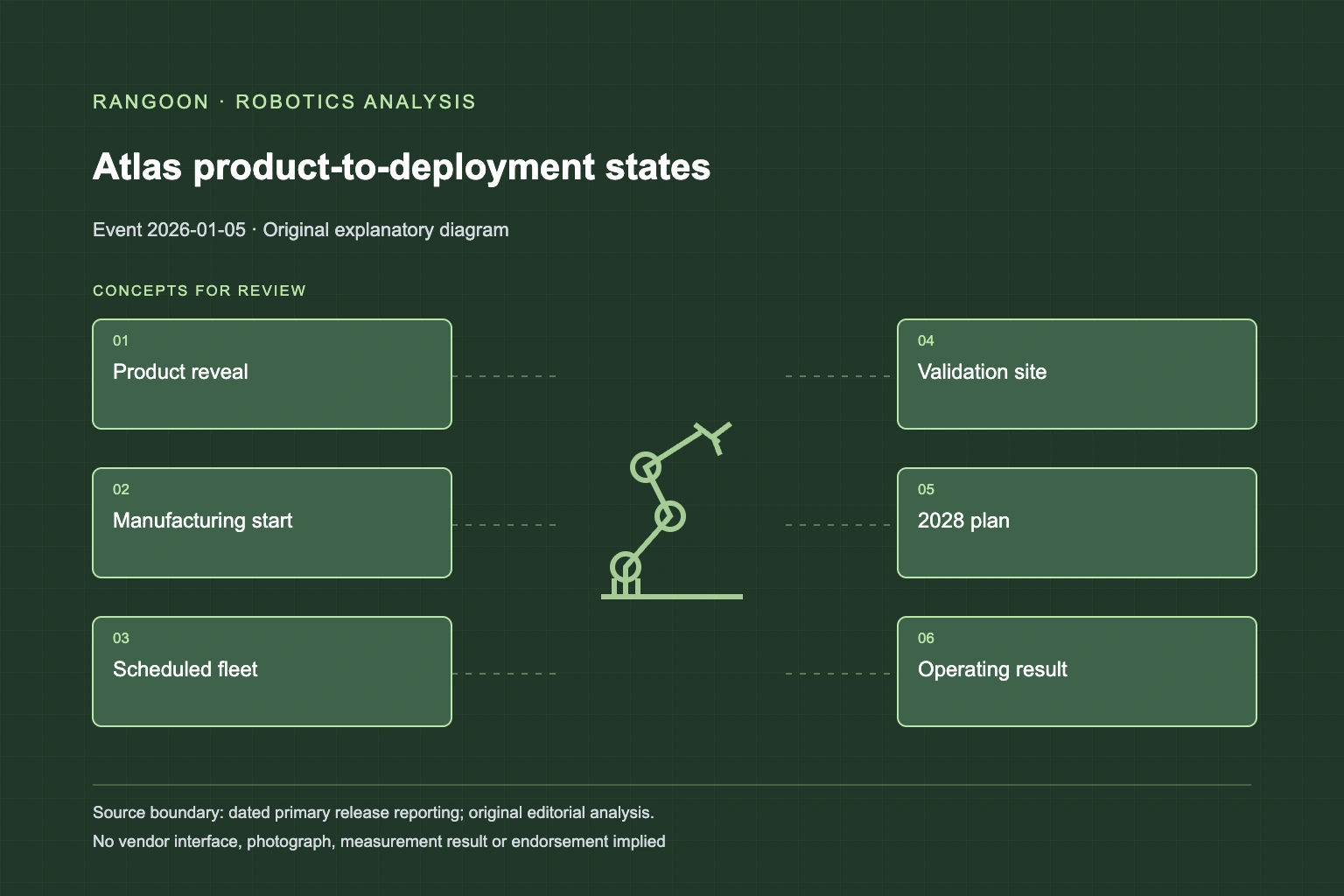
Key takeaways
- Boston Dynamics launched the product version of Atlas at CES on January 5, 2026.
- The company said manufacturing had begun and described Hyundai and Google DeepMind deployments as scheduled for 2026.
- Hyundai’s HMGMA sequencing statement was a future 2028 plan, not evidence of completed factory operation.
Boston Dynamics introduced the product version of Atlas at CES[source 1][source 2]
Boston Dynamics unveiled the product version of Atlas at CES on January 5, 2026. The company said the fully electric humanoid had been revealed during Hyundai’s CES media-day presentation and described the event as a move from prototype work to a product offering for industrial tasks. That is the core historical event. A product reveal and an announced production start establish a different status from an earlier research demonstration, but they do not show that the robot was already operating at customer sites. The release names forthcoming deployments and manufacturing plans, not completed customer acceptance or a finished operating history. It also does not publish a price, a general order channel, or a standardized comparison with other industrial robots. The careful account is that Atlas was introduced as a product with a stated industrial direction, while performance and deployment claims remain dependent on subsequent records.
The company said manufacturing had begun while scheduled deployments remained future events[source 1]
Boston Dynamics said it would begin production of Atlas immediately at its Boston headquarters and that its 2026 deployments were fully committed, with fleets scheduled to ship to Hyundai’s Robotics Metaplant Application Center and Google DeepMind in the following months. These are specific status statements, but their verbs matter. Manufacturing beginning is not a shipment receipt, and a scheduled fleet is not evidence that a customer had completed installation or use. The announcement does not disclose fleet size, unit acceptance criteria, throughput, maintenance terms, or task-level service targets. It also does not establish that every deployment had the same hardware, control stack, or use case. The source supports a precise production-and-schedule story: the product launch was paired with an announced start of manufacturing and named future deployments, not a claim of widespread completed operation.
Hyundai described a future sequencing application at HMGMA with a 2028 deployment horizon[source 2]
Hyundai’s CES release independently places Atlas within a broader AI-robotics strategy and says the robot was to be deployed at HMGMA by 2028 for sequencing tasks. That counterparty statement names an intended manufacturing use and a future time boundary. It does not say Atlas was running sequencing work at HMGMA in January 2026. Hyundai also discusses an application center, data-driven production and validation systems, and collaboration across group companies. Those are program and planning details, not completed safety, productivity, or labor results. The distinction matters because a roadmap can coordinate manufacturing, validation, and applications over years. It should not be retroactively read as a proof that a particular workcell had finished validation or that a future target had already been achieved at the date of the CES announcement.
Product status, scheduled deployment and factory plans require separate evidence from operating results[source 1][source 2]
The CES materials make a significant status change visible: Boston Dynamics presented Atlas as a product and stated that manufacturing was starting. But a product launch does not substitute for a deployment record, a safety decision, or a production KPI. Neither primary source publishes third-party task benchmarks, incident data, a detailed human-supervision protocol, or a public certification for collaborative operation. The same limitation applies to the stated 2026 schedules and Hyundai’s 2028 plan. Each is useful dated evidence of an intended next step, not proof of a completed outcome. The archive therefore separates four layers: product reveal, manufacturing start, scheduled deployments, and planned HMGMA use. A later source can establish any one of those future states when it occurs, without overwriting the careful status boundary of the January 2026 announcement.
Sources
Continue reading
Related reading
 News analysisMercado Libre and Agility announced a Digit agreement beginning with a Texas fulfillment facility3 min read
 News analysisHyundai Mobis publicly detailed an Atlas actuator-supply framework after CES3 min read
 News analysisApptronik announced a $350 million Series A for Apollo development and planned scaling3 min read