

Hyundai Mobis publicly detailed an Atlas actuator-supply framework after CES
Hyundai Mobis published a January 8, 2026 account of a CES framework with Boston Dynamics to supply Atlas actuators when the humanoid enters mass production.
Historical reporting: Hyundai Mobis publicly posted its collaboration account on January 8, 2026. The page’s body says the framework was announced at CES on January 7 and concerns supplying actuators for the next-generation Atlas humanoid. Boston Dynamics’ January 5 product announcement independently identifies Hyundai Mobis as Atlas’s actuator supplier. This article treats January 8 as the dated public-disclosure event and January 7 as the underlying CES framework date claimed by the Mobis page. The sources establish a component-supply framework and stated mass-production intent, not a delivered production contract quantity, a completed Atlas deployment, a supply-chain performance result, a safety certification, or a final bill of materials.
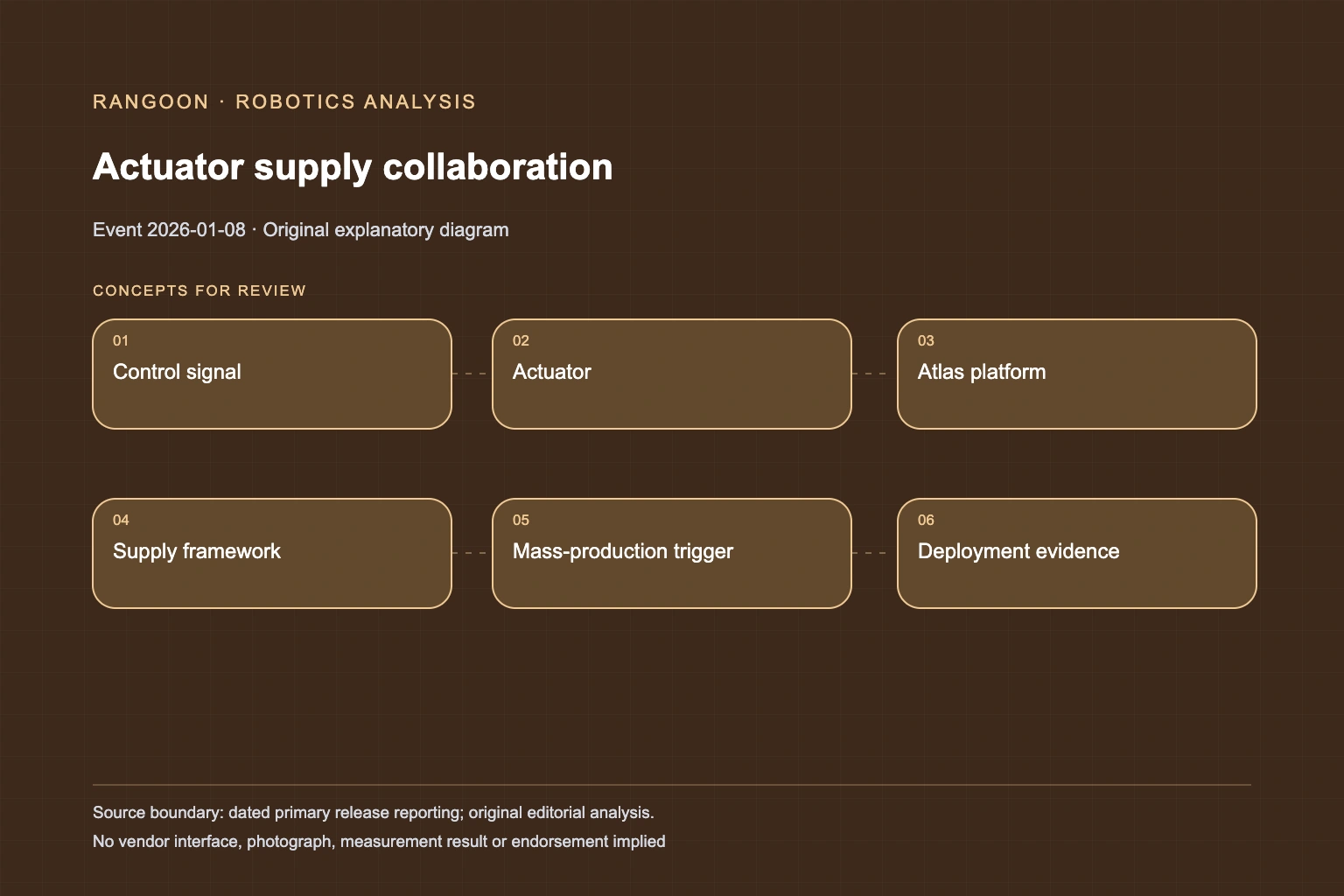
Key takeaways
- Hyundai Mobis publicly detailed the Atlas component framework on January 8; its account places the CES framework announcement on January 7.
- The framework was a component-supply collaboration distinct from Atlas’s January 5 product reveal.
- The disclosures did not state delivered units, supply volume, Atlas deployment results or a completed production ramp.
The January 8 disclosure described a CES component-supply framework for Atlas[source 1][source 2]
Hyundai Mobis publicly posted its account on January 8, 2026. Its body says the company announced a strategic collaboration framework with Boston Dynamics at CES on January 7 and would supply actuators for the next-generation Atlas humanoid. Boston Dynamics’ January 5 product announcement independently identifies Hyundai Mobis as the actuator supplier. The dated public-disclosure event is therefore January 8, while the CES framework date reported inside that disclosure is January 7. This is a robotics component relationship: it connects an automotive-parts manufacturer’s actuator work to Atlas’s future production path. It is not a public receipt for finished Atlas units or a completed deployment at a customer facility. The sources do not disclose a binding unit count, delivery schedule, price, final engineering specification, or signed long-term quantity.
The sources describe actuators as a subsystem without publishing the Atlas control architecture[source 1][source 2]
Hyundai Mobis describes actuators as components that convert control signals into physical movement and says it would use automotive component design and mass-production experience to enter the robot-actuator market. Boston Dynamics’ partner record similarly ties the collaboration to actuator development and a reliable component supply chain. These materials establish the companies’ stated subsystem focus. They do not provide a complete Atlas actuator design, controller interface, material specification, dynamic performance curve, fault response, or maintenance schedule. Nor do they establish that an actuator supply relationship determines the behavior of the entire robot. A humanoid product still depends on sensing, planning, software, integration, safety processes, and a task environment. The archive therefore identifies the January partnership as an actuator-supply and manufacturing-collaboration announcement, without inventing a full physical architecture or claiming that the subsystem had already been delivered at scale.
Mass-production language describes an intended transition, not delivered component volume[source 1][source 2]
The Hyundai Mobis announcement says the framework would support Atlas when it enters mass production and says the collaboration could accelerate mass-production plans. Those are future-oriented statements. A plan to build a large-scale actuator manufacturing system is not a report of a completed line, qualified supplier output, or delivered production volume. The sources also refer to broader Hyundai Motor Group ambitions for robots, but they do not disclose an audited forecast, an achieved annual capacity, or a purchase-order ledger. This distinction prevents a common overstatement: a partnership can be commercially meaningful before its output is measurable. The historical record is that the companies publicly established a component collaboration in January 2026 and associated it with a future mass-production path. Proof of deliveries, capacity, cost reduction, or quality performance requires later dated evidence from actual production.
A component partnership does not certify a robot or settle deployment outcomes[source 1][source 2]
The January releases do not establish whether Atlas met a particular robotics-safety standard, completed a factory task, or produced a reliable outcome in a real workcell. They also do not quantify the effect of an actuator supplier on robot cost, uptime, workforce design, or industrial throughput. The companies frame their relationship as a route to a more reliable and scalable supply chain, but those are stated aims rather than an independent assurance result. The sources contain no public task benchmark, incident record, completed fleet-installation report, or evidence that a planned customer deployment had occurred. The archive preserves the narrow partnership fact and separates it from performance claims about Atlas itself. Later operation can be documented if and when a partner provides a dated deployment record with specific task, time, and measurement evidence.
Sources
Continue reading
Related reading
 News analysisMercado Libre and Agility announced a Digit agreement beginning with a Texas fulfillment facility3 min read
 News analysisBoston Dynamics unveiled Atlas as a product at CES, with manufacturing underway and future deployments scheduled3 min read
 News analysisApptronik announced a $350 million Series A for Apollo development and planned scaling3 min read