

Cohere’s Command A Vision added image inputs with explicit request and tool-use limits
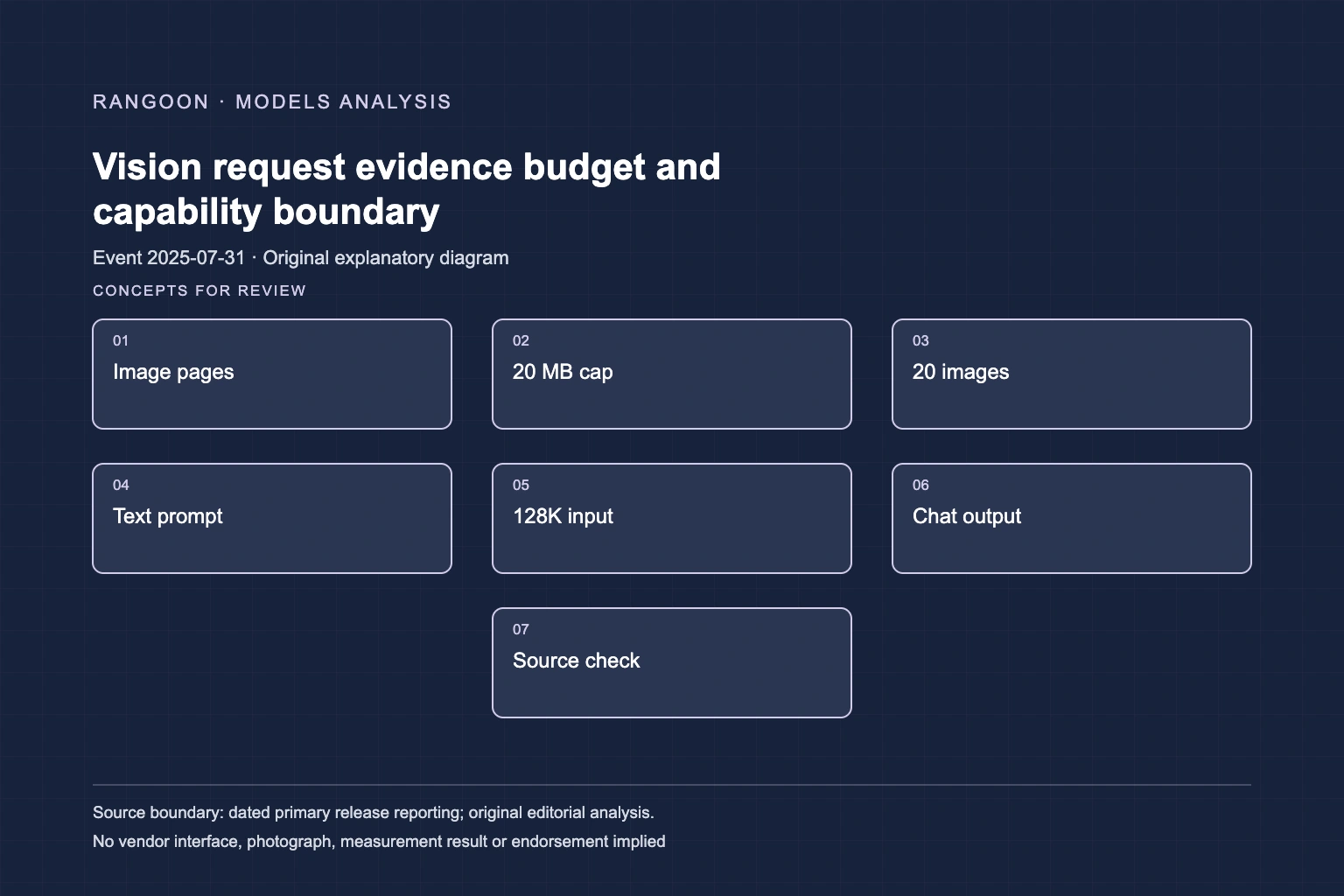
Cohere released Command A Vision on July 31, 2025, adding image and text processing with a 128K-token context window and image-request limits.
Historical reporting: Cohere released Command A Vision on July 31, 2025. Its dated release notes specify the model identifier, 128K input context, 8K maximum output, and up to 20 images or 20 MB in one request. The maintained vision documentation supplies later capability and access context only; its stated lack of tool use and image generation should not be read backward as a complete launch-day contract.
Key takeaways
- Command A Vision put text and image inputs behind Cohere’s chat interface with a stated 128K input window.
- The release capped a request at 20 images or 20 MB, making payload selection part of application design.
- Image understanding does not make a vision model an image generator or a tool-using agent.
The July release specified a vision model, a chat path and hard payload bounds[source 1]
Cohere’s July 31, 2025 release notes introduced Command A Vision under the identifier command-a-vision-07-2025. The notes described a model that accepts text and image inputs through the Chat API, with 128K tokens of input context and a maximum output of 8K tokens. They also set a request limit of 20 images or 20 MB of total image data.
Those limits are product-interface facts, not a score for document understanding or visual reasoning. They say a caller must budget image payloads and text together, but they do not establish how a particular scan quality, language, chart style, or page layout will perform. Applications still need to test scheduling and model behavior within those declared bounds.
A mixed image-and-text request needs a deliberate evidence budget[source 1][source 2]
For a document question, screenshots, rendered pages, captions, and instructions all become input material. More pages can preserve visual context such as tables or diagrams, while cropping and selection can reduce irrelevant pixels and leave room for the question and response. The release’s image-count and byte caps make that tradeoff explicit even though they do not prescribe one document-processing pipeline.
A later maintained Cohere page describes the model for chart, table, OCR, document-question-answering, and object-detection uses. That is current documentation context; it does not prove a launch-day accuracy level or remove the need to test source resolution, rotation, incomplete pages, and adversarial or ambiguous content.
Vision input expands interpretation, while preserving capability boundaries[source 1][source 2]
A vision-language model can turn a question and visual evidence into generated text, but it is still making an inference from the supplied representation. Image compression, optical-character-recognition uncertainty, fine print, and visual ambiguity can affect the answer before ordinary language-model errors are considered. A workflow that needs a factual record should retain the original document and check important claims against it.
The maintained Command A Vision documentation says the model does not support tool use or image generation. Those present-documentation boundaries help avoid treating every multimodal endpoint as an autonomous agent or a media-production system, but they are not offered here as undisclosed July launch features.
A release name does not prove a finished document-automation result[source 1][source 2]
Cohere’s dated notes record an available model identifier and API-facing limits. They do not show which files a customer sent, how an application stored them, whether a human reviewed outputs, or what error rate a deployment achieved. Those questions sit outside a model release and need task-specific evidence.
The historical event is therefore Command A Vision’s July release with its stated interface bounds. It does not prove reliable extraction from every PDF, an automatic compliance decision, an image-generation capability, or access conditions for a later production account.
Sources
Continue reading
Related reading
 News analysisCohere released Aya Vision as an open-weight multilingual vision-language family3 min read
 News analysisMedGemma 1.5 expanded a 4B model toward volumes, slides and longitudinal imaging inputs3 min read
 News analysisLiquid AI released LFM2-VL as compact vision-language models for edge deployment3 min read