Cursor 2.0 framed parallel coding agents as a worktree coordination problem
Cursor announced version 2.0 on October 29, 2025 with Composer, a multi-agent editor, browser tooling and enterprise controls.
Historical reporting: Cursor published its 2.0 announcement and changelog on October 29, 2025. Supplier performance and reliability statements are not independently verified here.
Key takeaways
- Parallel agents need isolated working copies and a merge queue.
- An agent browser needs explicit target and postcondition checks.
- Admin controls work only when repository policy still decides release.
Cursor described an agent-first interface with isolated copies[source 1][source 2]
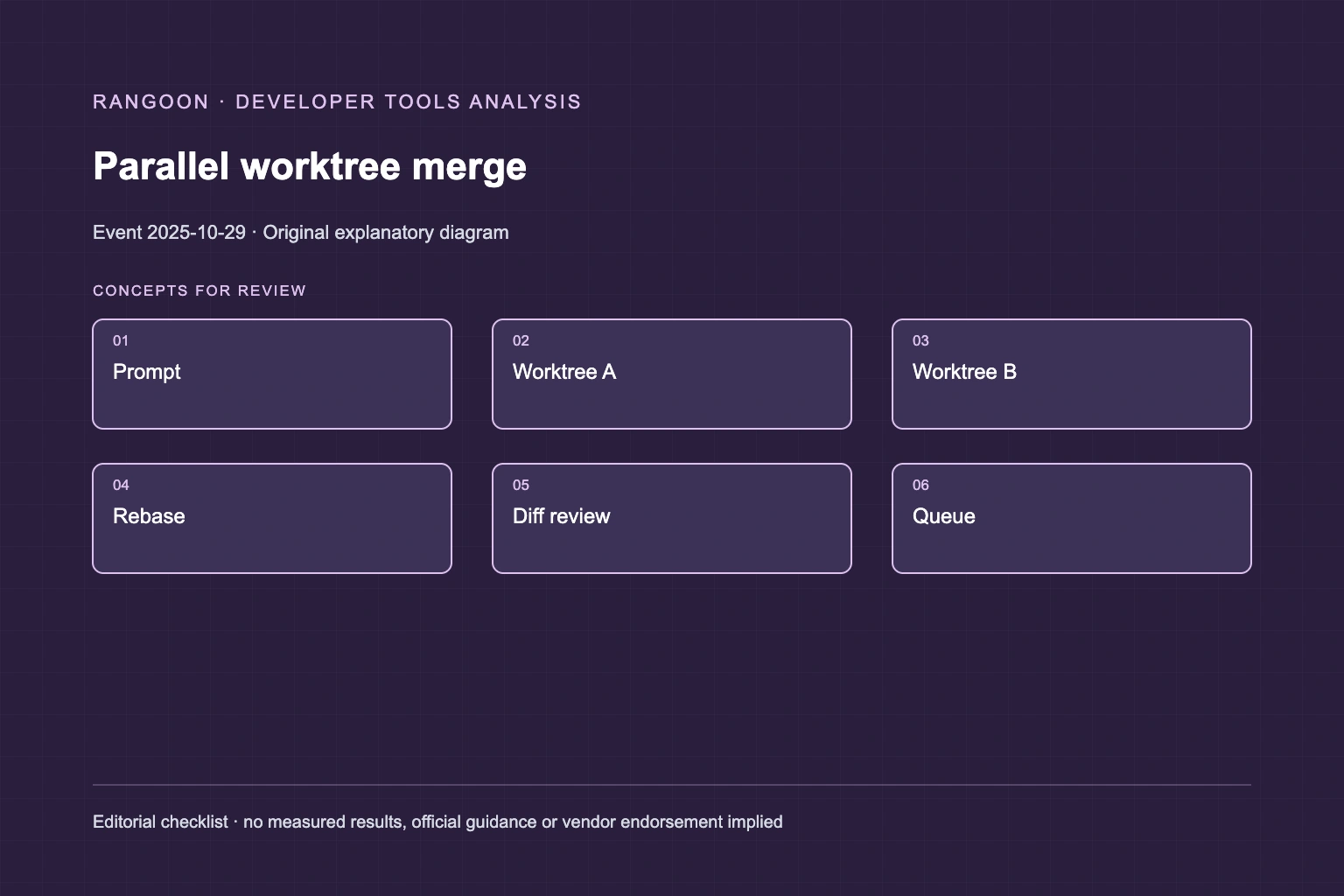
On October 29, 2025 Cursor announced version 2.0 and Composer, its first coding model, alongside an interface for multiple agents. The matching changelog says up to eight agents could operate from one prompt using git worktrees or remote machines to avoid file conflicts, and it lists browser general availability and enterprise settings. These sources record a product design: parallel work was presented as isolation plus review, not as simultaneous edits to one checkout.
Worktree isolation reduces collisions but does not decide integration order[source 1][source 2]
A worktree gives each task a distinct filesystem view and commit history. It cannot decide whether two individually correct changes alter the same API, lockfile, migration or test fixture incompatibly. Before launching parallel work, allocate file ownership and ask each agent to identify dependencies it did not change. Browser automation requires a second boundary: the target URL, selected element and expected postcondition should be captured before a click is treated as successful verification.
Review should compare independent outputs against one stable base[source 1][source 2]
Keep one protected base revision and make every agent name it in its receipt. Rebase or replay a change only after its tests pass against the current integration branch; then rerun the narrow behavior check that the task was meant to protect. Queue agent pull requests by shared dependency, not by completion time. For enterprise controls, inventory the actual terminal, network and git policies in force, because an editor-level setting is only one layer of the execution environment.
Analysis: concurrency produces a coordination bill[source 1][source 2]
Editorial analysis: parallel coding is most useful when the work can be partitioned into independent tests, modules or documentation slices. The cost shifts into triage: someone must reject duplicated approaches, reconcile interfaces and decide which green test evidence is meaningful after rebasing. Treat parallel agents like temporary contributors with deliberately small ownership, rather than a mechanism that converts eight proposals into one approved release.
Cursor’s 2.0 post introduced Composer as its first coding model and said it was trained with codebase-wide semantic search for large repositories. Cursor described most turns as completing in under 30 seconds and claimed a speed comparison; those are supplier performance statements, not local benchmarks.
The release also presented a multi-agent interface, while its changelog described up to eight agents working from one prompt through git worktrees or remote machines, plus browser general availability and enterprise settings. That makes selection an integration operation: each worktree can isolate filesystem edits, but the reviewer still must compare agents’ assumptions about shared APIs, lockfiles and tests. Browser assertions should retain a target URL and DOM or screenshot evidence.
Enterprise audit logs are most useful when they preserve denied commands as well as allowed ones, so policy decisions are distinguishable from model errors.
Sources
- Cursor: Introducing Cursor 2.0 and Composer (October 29, 2025)
- Cursor changelog: New Coding Model and Agent Interface (October 29, 2025)
Continue reading