

Cursor 1.0 turned code review and background execution into one editor release
Cursor’s June 4, 2025 1.0 release combined BugBot review, broader Background Agent access, project memories and one-click MCP setup.
Historical reporting: Cursor published its 1.0 changelog on June 4, 2025. The story records the release scope; it does not claim present-day availability, pricing or reliability.
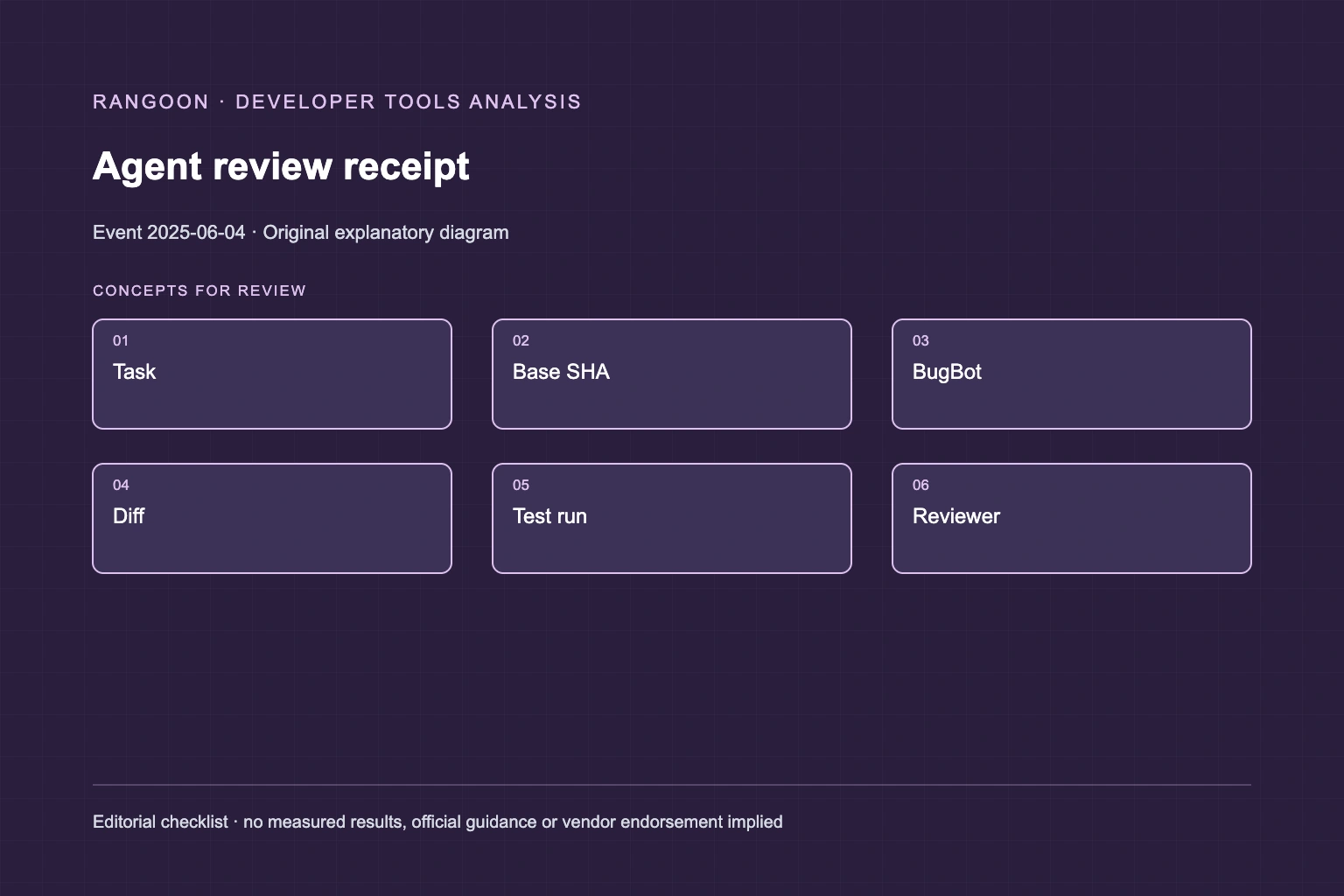
Key takeaways
- Review comments need the same ownership rules as human review.
- Remote agent output should arrive as a diff plus a test receipt.
- MCP installation convenience does not replace connector review.
A 1.0 release concentrated several workflow surfaces[source 1][source 2]
Cursor’s June 4 changelog called the release Cursor 1.0 and listed BugBot, general availability of Background Agent, memories, Jupyter agent editing and one-click MCP setup. Its June pricing follow-up is a second dated record that explains a move from request counting toward compute-based usage. Together they show a product widening from inline assistance to asynchronous work, review and external-tool connection. They do not establish that every plan, model or integration had identical access.
The important boundary was between proposed code and accepted code[source 1][source 2]
BugBot’s release description says it comments on pull requests, while Background Agent works remotely and MCP setup can add authenticated servers. Those features place three different artifacts beside one another: a review finding, an agent-authored change and a tool connection. A delivery team should keep them separable. The reviewer needs the precise diff and reproduction path; the tool owner needs the server identity, grants and data boundary; the merge owner needs a human decision recorded outside the agent transcript.
A useful receipt names the task, revision and test result[source 1][source 2]
For a background task, preserve the commit base, exact prompt, files changed, commands run, exit codes and unresolved questions. Treat a review comment as a finding until someone verifies it against the repository, rather than as evidence of a defect. For an MCP installation, capture the server URL, authorization mode and permitted methods before a contributor starts work. These records make a later rollback or incident investigation possible without relying on remembered chat context.
Analysis: speed should make review narrower, not optional[source 1][source 2]
Editorial analysis: Cursor 1.0’s combination of remote work and review makes a narrow task boundary more valuable. Teams can gain iteration speed by assigning a bounded change, but should require the agent to stop at tests, generated files or configuration it cannot justify.
A two-person review can focus on behavior and permissions when the agent receipt already identifies its command history. That is a local operating rule, not a claim about Cursor’s defaults.
Cursor 1.0 made several distinct mechanisms visible at once. BugBot left a GitHub pull-request comment and offered a “Fix in Cursor” link with a prefilled editor prompt. Background Agent became available through the cloud icon or Cmd/Ctrl+E for users without privacy mode, while notebook editing could create and edit multiple Jupyter cells and initially supported Sonnet models.
Memories were a beta, stored per project and per individual, and managed through Settings; one-click MCP setup was a separate connector installation path. These details create different records: a review comment, remote task, notebook cell edit, saved project fact and external server connection. Keep their owners separate.
A BugBot finding needs a reproduction; an MCP connection needs its server identity and methods; a remembered fact needs a current repository check. The June pricing follow-up is usage context, not evidence that all product surfaces had identical access.
Sources
- Cursor changelog: 1.0 (June 4, 2025)
- Cursor: Clarifying our pricing (July 4, 2025)
Continue reading
Related reading
 News analysisCursor 2.0 framed parallel coding agents as a worktree coordination problem3 min read
 News analysisOpenAI introduced SWE-Lancer to test coding agents against freelance software work3 min read
 News analysisGLM-4.7 made preserved thinking a named control for multi-turn coding agents3 min read