

Databricks put Lakebase, a managed Postgres service, into public preview for AI applications
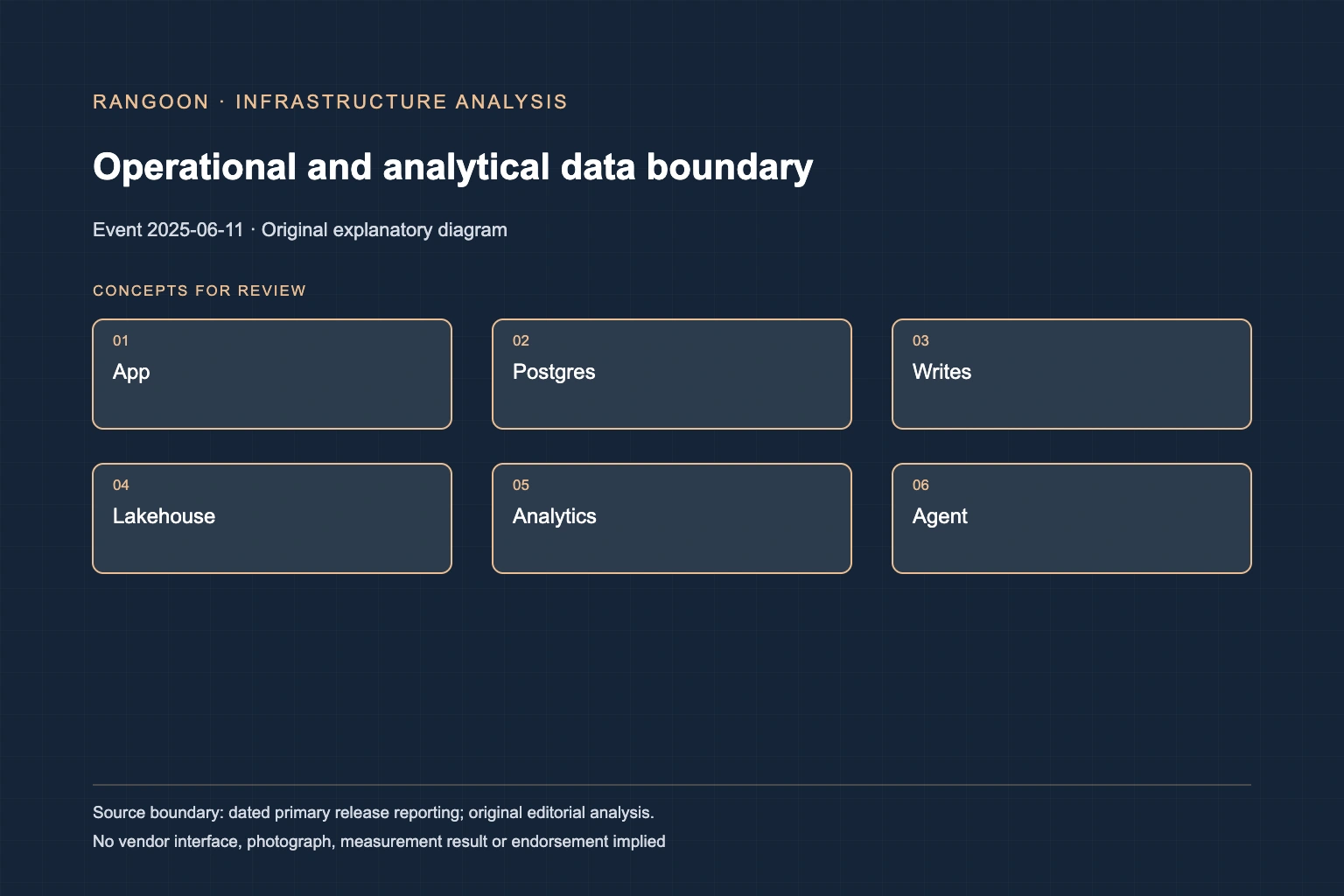
Databricks announced Lakebase on June 11, 2025: a fully managed Postgres service in public preview, positioned to connect operational workloads with its lakehouse platform.
Historical reporting: Databricks announced Lakebase on June 11, 2025 and said it was in public preview. The launch records describe a managed Postgres service, separation of compute and storage, and integration claims around the lakehouse. They do not establish general availability, a universal latency result, migration outcome, price, regional coverage, or an agent capability delivered to every account.
Key takeaways
- Lakebase entered public preview as a managed Postgres service, rather than a completed general-availability rollout.
- The launch joined operational data to Databricks’ lakehouse narrative, but did not erase application ownership of schema, access and failure handling.
- Autoscaling and integration were vendor-described product properties; workload results still depended on configuration and demand.
The June announcement established a preview product and a database category claim[source 1][source 2]
On June 11, 2025, Databricks announced Lakebase at its Data + AI Summit and described it as a fully managed Postgres database for data applications and AI. The contemporaneous press release says the service was available in public preview. That status matters: a preview gives developers a route to evaluate a product, but does not by itself promise production readiness, a fixed support commitment, or availability in every cloud and region.
Databricks framed Lakebase as an operational database layer for its Data + AI Platform. The announcement connected it to applications, agents and current operational data, while the product blog used the term lakebase for a broader category of operational databases. Those descriptions set the launch framing. They do not show that a customer had moved a workload, that an agent had received safe authority, or that a database design had become simpler in a specific deployment.
The written launch materials tied managed Postgres to separated compute and storage[source 1][source 2]
The press release said Lakebase was powered by Neon technology, while the product article described an architecture built around open-source Postgres and separated compute from storage. In practical terms, those are product-design claims about how a managed service could provision and scale. They are not a substitute for checking compatibility, extensions, backup behavior, connection limits, recovery objectives or the migration path of an existing PostgreSQL application.
Databricks also said continuous autoscaling would support agent workloads. An autoscaling claim is not a measured promise for a particular query, transaction pattern or concurrent client count. Agents can turn a burst of decisions into bursts of reads and writes, so the operational question includes data-model constraints, idempotency, quotas and observability. The event supports reporting that Lakebase was introduced with that architecture; it does not support a blanket performance conclusion.
The intended connection was between operational work and analytical data, not a merged security boundary[source 1][source 2]
The launch narrative emphasized reducing separation between operational and analytical systems. Databricks said Lakebase would integrate with the lakehouse so teams could serve data and features, operate applications and analyze operational data in one platform. That is a useful product direction for teams that otherwise copy data between systems. It does not mean every table should be exposed to an application, or that existing data-retention, authorization and change-control decisions disappear.
A single platform story can also hide useful distinctions. Transactional workloads need predictable write semantics and recovery behavior; analytics needs governed access to data at an appropriate freshness boundary. The two June records describe the vendor’s effort to connect those workloads. They do not document a customer-specific contract between them. A team still needed to decide which records were operational, which data could be analyzed, and where a service could safely read or write.
This was a public-preview launch, so later product state needs its own evidence[source 1][source 2]
Lakebase was news because Databricks added a managed Postgres offer to a platform better known for lakehouse data and AI tooling. The dated materials make the preview status, the Postgres basis and the claimed lakehouse integration clear. They also make no fixed claim here about cost, service-level terms, supported extensions or generally available status. Those details can change after a preview and need a separately dated product record.
This account stays with the June 11 event. It does not back-project later documentation, customer stories or feature additions into the launch. It also does not treat a database feature as evidence that an autonomous application is reliable. The narrow historical conclusion is that Databricks publicly previewed Lakebase as a managed Postgres service for data applications and AI, with an architecture intended to connect operational and lakehouse data.
Sources
Continue reading
Related reading
 News analysisCloudflare’s Markdown for Agents made content negotiation an AI-reading interface3 min read
 News analysisZendesk’s 2025 Resolution Platform joined service agents, knowledge, actions and QA3 min read
 News analysisWriter launched AI HQ with a beta Agent Builder and observability tools3 min read