

The DeepSeek-R1 paper made the training path part of the story
DeepSeek submitted its DeepSeek-R1 paper to arXiv on January 22, 2025. Its account of reinforcement learning and distillation called for claim-by-claim model evaluation.
Historical reporting: arXiv records the DeepSeek-R1 paper submission as January 22, 2025. DeepSeek’s public repository is cited for the accompanying model materials; analysis below is editorial and does not conflate that paper date with other releases.
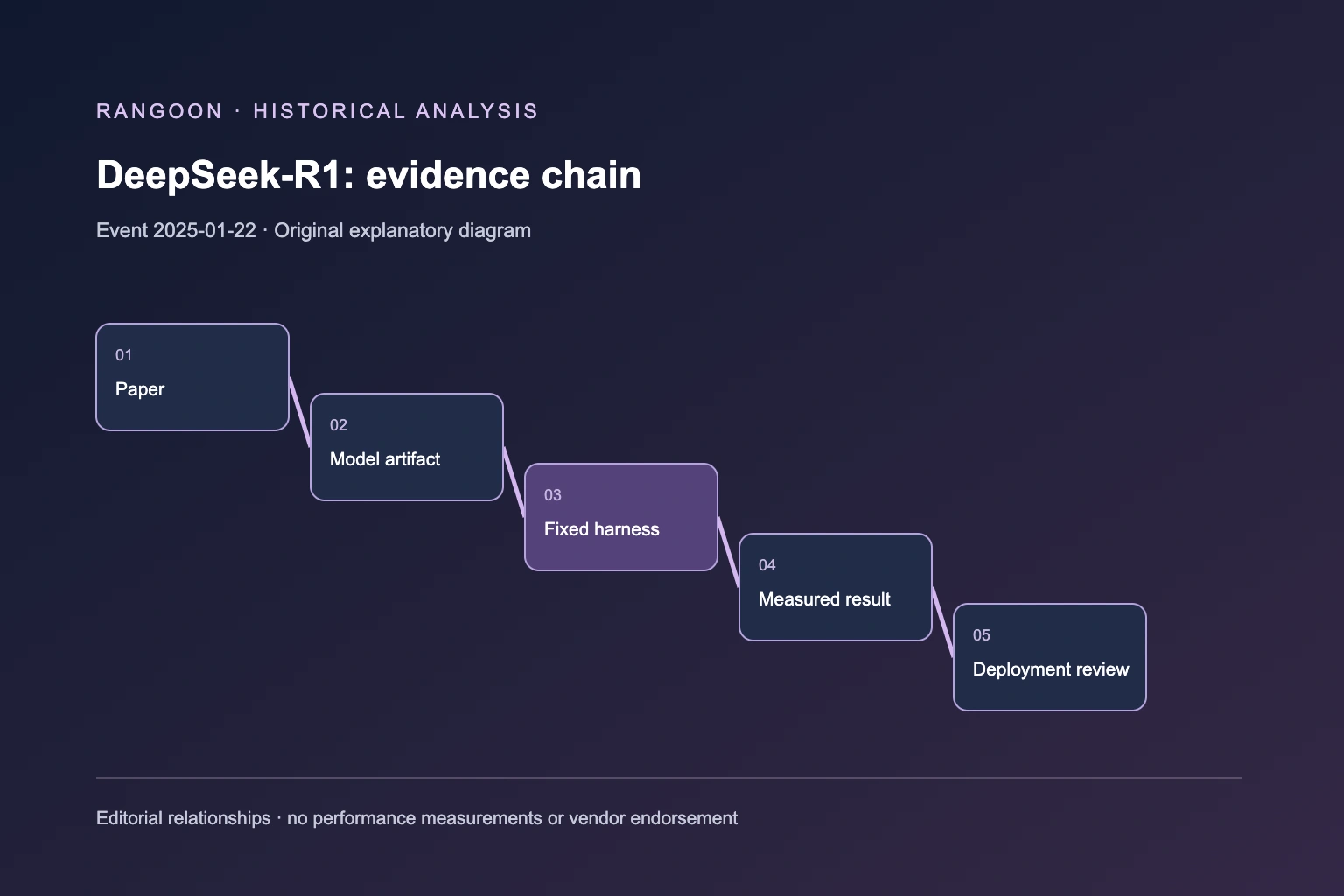
Key takeaways
- The January 22 event was an arXiv paper submission, a distinct historical fact from any product or repository release date.
- The paper separates R1-Zero’s reinforcement-learning-first result from DeepSeek-R1’s cold-start and multi-stage training path.
- A reported benchmark comparison is evidence under a stated evaluation setup, not a universal deployment guarantee.
The January 22 paper event[source 1]
On January 22, 2025, the paper ‘DeepSeek-R1: Incentivizing Reasoning Capability in LLMs via Reinforcement Learning’ was submitted to arXiv as 2501.12948. The abstract introduced DeepSeek-R1-Zero and DeepSeek-R1 as first-generation reasoning models. It described R1-Zero as trained through large-scale reinforcement learning without supervised fine-tuning as a preliminary step, while noting readability and language-mixing challenges.
The paper then described DeepSeek-R1 as using cold-start data and a multi-stage training process before reinforcement learning. It also said DeepSeek released R1-Zero, R1, and six dense distilled models based on Qwen and Llama. This retrospective uses the arXiv submission date exactly. It does not substitute a different January date from a news cycle or repository update.
Editorial analysis: keep materials and claims separate
The DeepSeek-R1 repository provides public model materials and implementation-facing information. The arXiv paper provides a research account of the stated training route and reported results. These sources can be read together, but they answer different questions. A repository can help establish how a team might obtain or inspect artifacts; it does not independently reproduce a paper’s methodology or verify every comparison in a new environment.
That distinction is especially useful for reasoning-model reporting. The paper’s comparisons are made within its evaluation framing. A deployment may differ in prompt structure, tokenizer behavior, quantization, hardware, tool loop, test data, or safety controls. None of those variables become equivalent merely because the model name is shared.
Editorial analysis: build a claim ledger
A practical review starts by splitting vendor or paper statements into testable claims. Record the precise model artifact, revision, runtime, prompt format, decoding settings, task set, metric, and comparison target for each one. Then mark whether the claim is directly reproduced, directionally observed, not tested, or not applicable. This avoids a single headline score becoming a loose assertion about every engineering task.
Reasoning traces deserve their own boundary. A team may need the final answer and an audit of tool actions without storing or exposing every intermediate token. Define what evidence is necessary for the decision at hand, how long it is retained, and who can inspect it. A model’s apparent deliberation is neither a substitute for validation nor a blanket reason to collect sensitive material.
Editorial analysis: compare under a fixed harness
Use a fixed, versioned harness when comparing a candidate reasoning model with an incumbent. Include tasks with verifiable answers, structured-output checks, tool-use constraints, and cases where the safe response is to stop or request clarification. Measure completion quality, error modes, latency, token use, and any human correction needed; keep the inputs approved for the evaluation environment.
The paper submission remains valuable historical evidence about DeepSeek’s stated approach. It does not remove the need to verify a particular artifact under a particular workflow. Separate the paper date, model-material date, test execution date, and deployment decision so future readers can tell exactly what each record proves.
Sources
Continue reading
Related reading
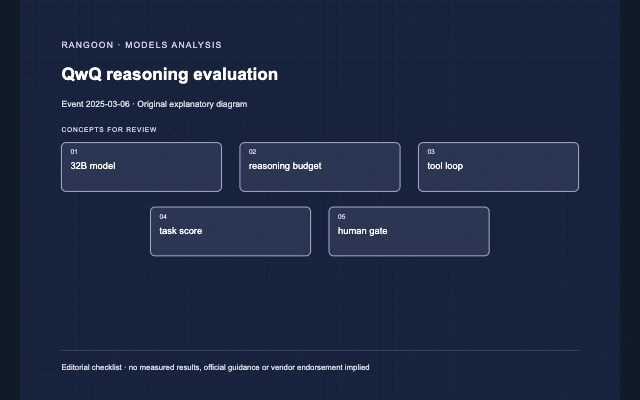 News analysisQwQ-32B made reinforcement-learning claims a harness question3 min read
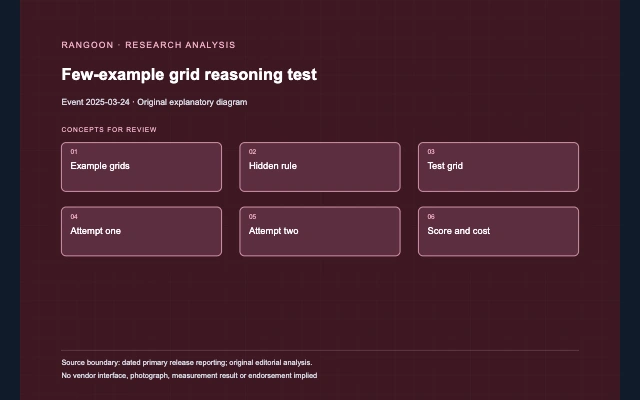 News analysisARC-AGI-2 added calibrated task sets and a cost axis to its reasoning challenge3 min read
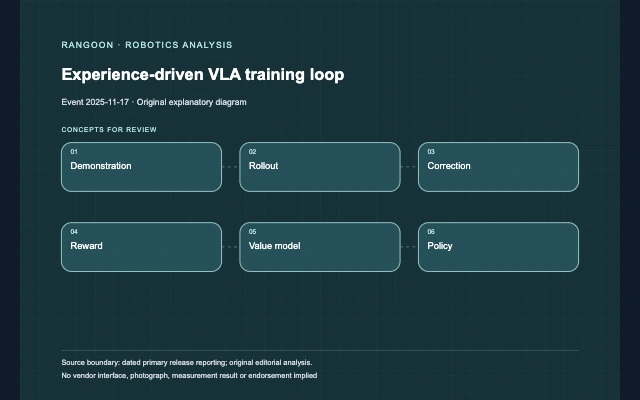 News analysisPhysical Intelligence’s π*0.6 used deployment experience and corrections as VLA training inputs3 min read