

QwQ-32B made reinforcement-learning claims a harness question
Qwen released QwQ-32B on March 6, 2025 and described a 32B reasoning model with agent-facing capability claims. Its comparisons need the stated tasks, budgets, and scaffolding.
Historical reporting: Qwen’s March 6, 2025 QwQ-32B post introduced the 32B reasoning model; its model card supplies a separate artifact record. The analysis below is original editorial analysis; it does not claim present availability, performance, or support.
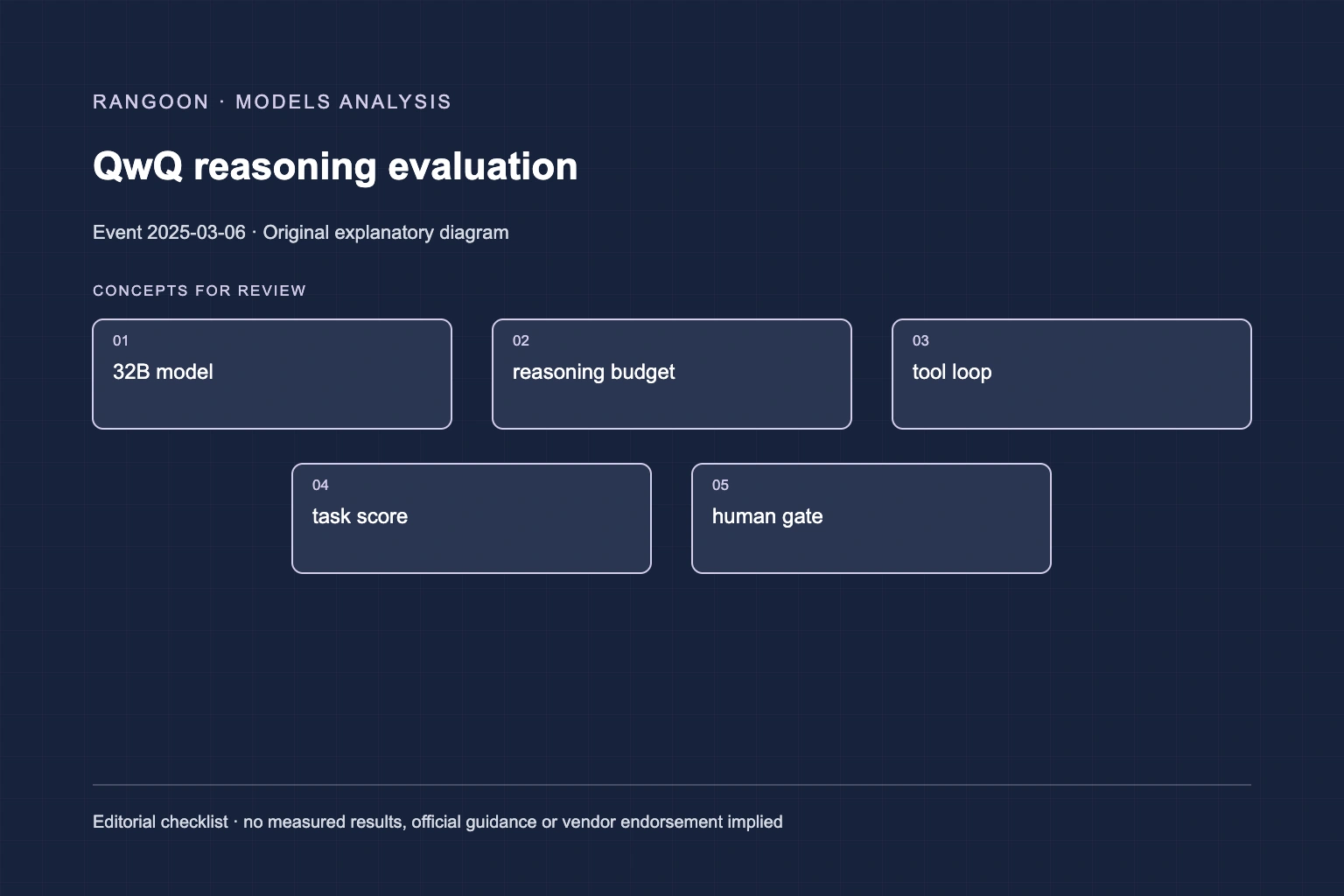
Key takeaways
- On March 6, 2025, Qwen announced QwQ-32B, describing a 32-billion-parameter reasoning model and attributing its result to large-scale reinforcement learning on a strong pretrained base.
- A reasoning model can spend different amounts of text and compute on the same task.
- QwQ-32B’s March 2025 release documents Qwen’s stated model and reported comparisons. It does not demonstrate current service behavior or a universal agent-success rate.
What Qwen released[source 1][source 2]
On March 6, 2025, Qwen announced QwQ-32B, describing a 32-billion-parameter reasoning model and attributing its result to large-scale reinforcement learning on a strong pretrained base. The post compared it with larger models on stated reasoning evaluations and said the release included agent-related abilities. Those are vendor claims tied to a named model and comparison setup.
The QwQ-32B model card is a distinct primary document: it identifies the downloadable artifact and its declared usage material. It does not independently reproduce the launch post’s benchmark harness, establish an agent’s success on a different tool environment, or make a long response automatically correct.
Editorial analysis: measure reasoning budgets
A reasoning model can spend different amounts of text and compute on the same task. An operator should log hidden or visible reasoning controls where exposed, completion length, wall time, tool calls, retries, and final-answer correctness. A single benchmark score cannot substitute for this workload profile.
For tool use, test the full loop: prompt interpretation, argument construction, tool response reading, correction after an error, and final abstention when evidence is missing. A model may reason well over a static question yet fail at a contract boundary in an agent runtime.
Editorial analysis: separate task score from system behavior
Keep math, code, research, and tool-use fixtures distinct. Each has different failure modes: exact answers, executable changes, citation grounding, and action selection should not be compressed into one pass rate. Preserve the scorer and expected result with the prompt.
Vendor comparisons can guide candidate selection, especially when their datasets and settings are stated. They become operational evidence only after a team runs an equivalent or relevant harness with its own constraints and records the result.
Editorial analysis: make escalation explicit
Set budgets before deployment: maximum turns, maximum tool calls, required verification, and conditions that force a human review. The model’s ability to generate a long chain of reasoning does not itself authorize an external action.
Retain failed traces as well as successful ones. They reveal whether the weakness came from planning, an unavailable tool, malformed output, or an incorrect assumption, and they make later model comparisons meaningful.
Editorial analysis: retain the release boundary
QwQ-32B’s March 2025 release documents Qwen’s stated model and reported comparisons. It does not demonstrate current service behavior or a universal agent-success rate.
Consider a hypothetical triage agent asked to inspect a failing test and choose between reading a file, running a narrow command, or escalating because the repository is missing. A long reasoning trace is useful only if the final action follows the allowed policy and the result is checked. Measure decision accuracy, unnecessary actions, and recovery after a tool error separately from a puzzle-style answer. A model can obtain a correct explanation while selecting an unsafe command, or expend a large budget on a task that a deterministic linter would finish faster. QwQ-32B’s stated reasoning orientation makes this a useful evaluation boundary: compare it with a constrained policy and observed traces, not with an assumption that more deliberation always improves an agent.
Sources
- Qwen: QwQ-32B (March 6, 2025)
- Qwen QwQ-32B model card
Continue reading
Related reading
 News analysisThe DeepSeek-R1 paper made the training path part of the story3 min read
 News analysisQwen released Qwen3 Embedding and Reranking models with dual-encoder and cross-encoder retrieval paths3 min read
 News analysisPhysical Intelligence’s π*0.6 used deployment experience and corrections as VLA training inputs3 min read