

ElevenLabs launched Eleven v3 as an alpha for expressive speech, with real-time use still out of scope
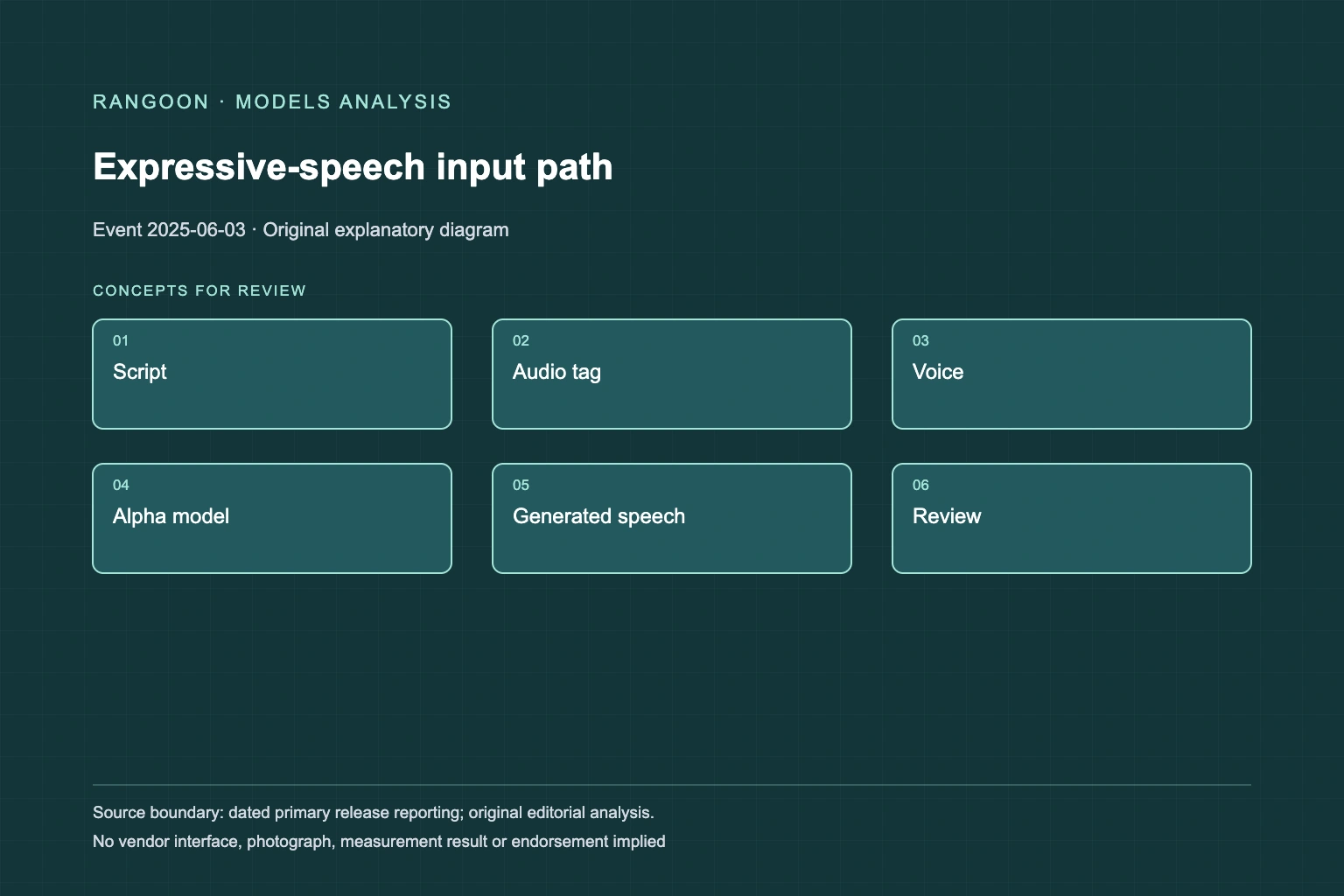
ElevenLabs announced Eleven v3 (alpha) on June 3, 2025, adding audio tags, multi-speaker dialogue and 70-plus language support while retaining stated latency limits.
Historical reporting: ElevenLabs announced Eleven v3 (alpha) on June 3, 2025 as a research preview. Its announcement described 70-plus languages, inline audio tags and multi-speaker dialogue, while advising users to remain on v2.5 Turbo or Flash for real-time and conversational work because v3 had higher latency and lower reliability. The launch page contains later status text saying v3 left alpha; that later outcome is not back-projected into June. Current documentation describes the model ID and API endpoints, but it is later maintained context rather than launch proof.
Key takeaways
- The June event released an alpha research preview, not a general-availability designation for every product surface.
- Audio tags and dialogue were input controls whose effect could vary with voice, context and prompt design.
- ElevenLabs explicitly separated expressive generation from low-latency real-time and conversational use at launch.
The release status was alpha research preview, not general availability[source 1]
On June 3, 2025, ElevenLabs announced Eleven v3 as an alpha research preview for text-to-speech generation. The company described more than 70 languages, multi-speaker dialogue and audio tags for directions such as emotion, delivery and non-verbal reactions. Alpha is an important part of the factual record. It indicates that the vendor was exposing a new capability while still positioning it as an earlier release stage, rather than demonstrating a settled service boundary for every customer, workflow or integration. A later notice on the same page says Eleven v3 is no longer in alpha, but that later statement does not change the June event. Historical coverage should retain the version name and release status that applied on the announcement date.
The launch separated expressiveness from low-latency conversation[source 1]
The announcement said Eleven v3 required more prompt engineering than prior models and recommended v2.5 Turbo or Flash for real-time and conversational cases because v3 had higher latency and lower reliability. That limitation is as significant as the feature list. It means a product team could not responsibly translate the launch into a claim that the new alpha was the right engine for live agents, calls or interactive dialogue. An expressive offline or edited generation task has a different latency budget from a turn-taking system. The June record supports the availability of a new alpha workflow and the vendor’s stated tradeoff; it does not establish a universal quality ranking, a completed call-center deployment or a real-time service guarantee.
Later API documentation describes the model without changing the launch scope[source 1][source 2]
ElevenLabs’ maintained documentation now identifies the model as `eleven_v3` and describes speech and dialogue endpoints, language coverage and audio tags. That documentation is useful to distinguish a model identifier from the marketing label and to see that the provider later documented API routes. It is not evidence that public API access and Studio support were complete on June 3: the launch post said API access and Studio support were still coming soon, with early access through sales. Nor should current documentation be used to treat v3 as a permanent flagship. The historical conclusion is limited to the alpha release and its stated controls and constraints; later service maturity, replacement models and availability must retain their own dates.
Sources
Continue reading
Related reading
 News analysisMicrosoft’s VibeVoice release put long-form multi-speaker TTS into an open research framework, then exposed its misuse boundary3 min read
 News analysisNVIDIA positioned Parakeet v2 as an English speech-recognition research model, not a universal transcription result3 min read
 News analysisKyutai released Pocket TTS as a 100M CPU-oriented voice-cloning model3 min read