Kyutai released Pocket TTS as a 100M CPU-oriented voice-cloning model
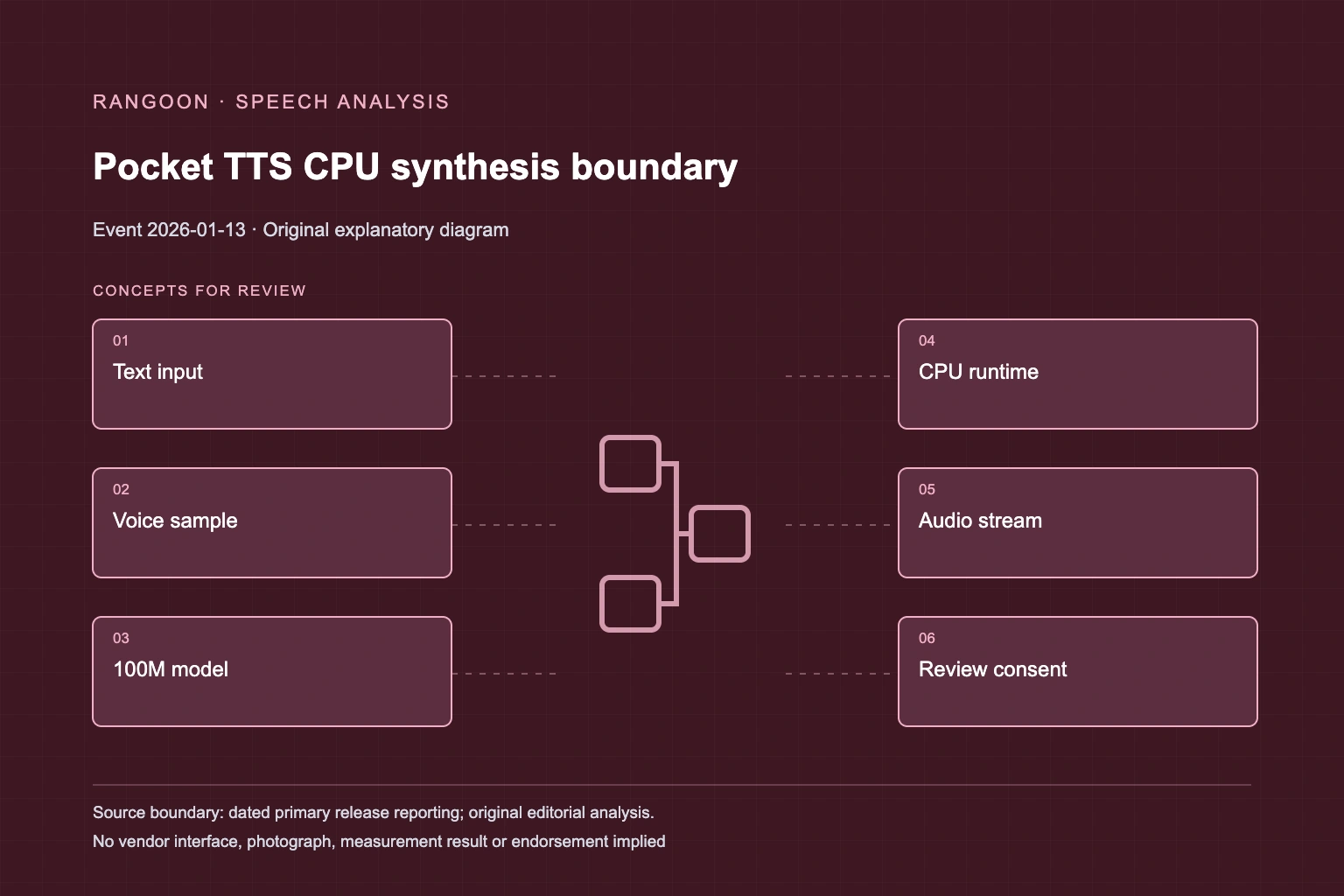
Kyutai’s January 13, 2026 Pocket TTS release described a 100M-parameter English text-to-speech model with voice cloning, MIT licensing and stated laptop CPU operation.
Historical reporting: Source 0 is Kyutai’s dated Pocket TTS technical report. Source 1 is Kyutai’s current public repository documentation, used for implementation context only; later language and smaller-model additions are not projected back into the January release.
Key takeaways
- Kyutai dated Pocket TTS January 13, 2026 and described a 100M-parameter English TTS model designed to run in real time on a laptop CPU.
- Kyutai said the initial model could clone a voice from about five seconds of audio and released it under MIT after training on public English datasets.
- The release’s quality and CPU-speed comparisons depend on stated data, hardware and evaluation protocols; voice permissions, identity risk and deployment quality still require separate review.
A small TTS release targeted CPU execution[source 1]
Kyutai dated its Pocket TTS technical report January 13, 2026. The report describes a 100-million-parameter text-to-speech model with voice cloning, built to run in real time on a laptop CPU. Kyutai positioned it between larger, roughly billion-parameter speech models that need GPUs and compact specialized systems with fixed voices and hand-built phoneme pipelines. The company said Pocket TTS retained flexible voice behavior while aiming for a smaller execution footprint. That is a meaningful deployment-oriented event: the announced model changed the stated hardware target for a voice-generation workflow. It is not proof that every CPU, operating system, language, prompt, voice sample or client integration achieves the same speed or audio quality.
Open release and voice cloning carried separate obligations[source 1]
Kyutai said it open-sourced Pocket TTS under the MIT license and trained it on public English datasets to support reproducibility. It also said a sample of about five seconds could guide reproduction of voice color, emotion, accent, cadence, reverb and microphone conditions. The same sentence identifies a boundary often missed in model summaries: a technical ability to condition on a sample does not grant permission to use a person’s voice or resolve impersonation, consent, disclosure, trademark or jurisdiction issues. The release describes a model and its intended capability. A deployment still needs an authorized-input policy, a record of who supplied any reference audio, controls appropriate to the use case, and a way to investigate misuse reports.
The report names its quality and speed comparisons[source 1]
Kyutai evaluated Pocket TTS on LibriSpeech test-clean and said it cleaned audio inputs with Adobe Enhance Speech before running comparisons. It reported word error rate using Whisper-large-v3 and pairwise human evaluation for audio quality and speaker similarity. Its table compares Pocket TTS with F5-TTS, DSM, Chatterbox Turbo and Kokoro, and its latency test uses an Intel Core Ultra 7 165H laptop and an Apple M3 MacBook Air. These details make the reported faster-than-real-time result intelligible, but bounded. A clean speech benchmark, a chosen speech recognizer and two named CPUs cannot establish performance on call-center audio, a mobile browser, accessibility assistive technology or a production queue.
Later repository changes must stay later[source 1][source 2]
Kyutai’s current Pocket TTS repository describes a Python application for CPU use, PyTorch 2.5 or newer, a CLI and Python API, streaming audio and voice cloning. It also lists later updates: smaller English models in October 2026, training code in August 2026, and support for several additional languages. Those facts are useful current implementation context but cannot be attached to January 13 without qualification. The January event was an English, 100M Pocket TTS release. Historical reporting should preserve that narrower claim, then direct deployers to current documentation for dependencies and capabilities. Whether a later repository state works in a particular product remains an engineering and review question, not a fact settled by the launch report.
Sources
Continue reading