Epoch AI introduced FrontierMath with unpublished expert mathematics problems
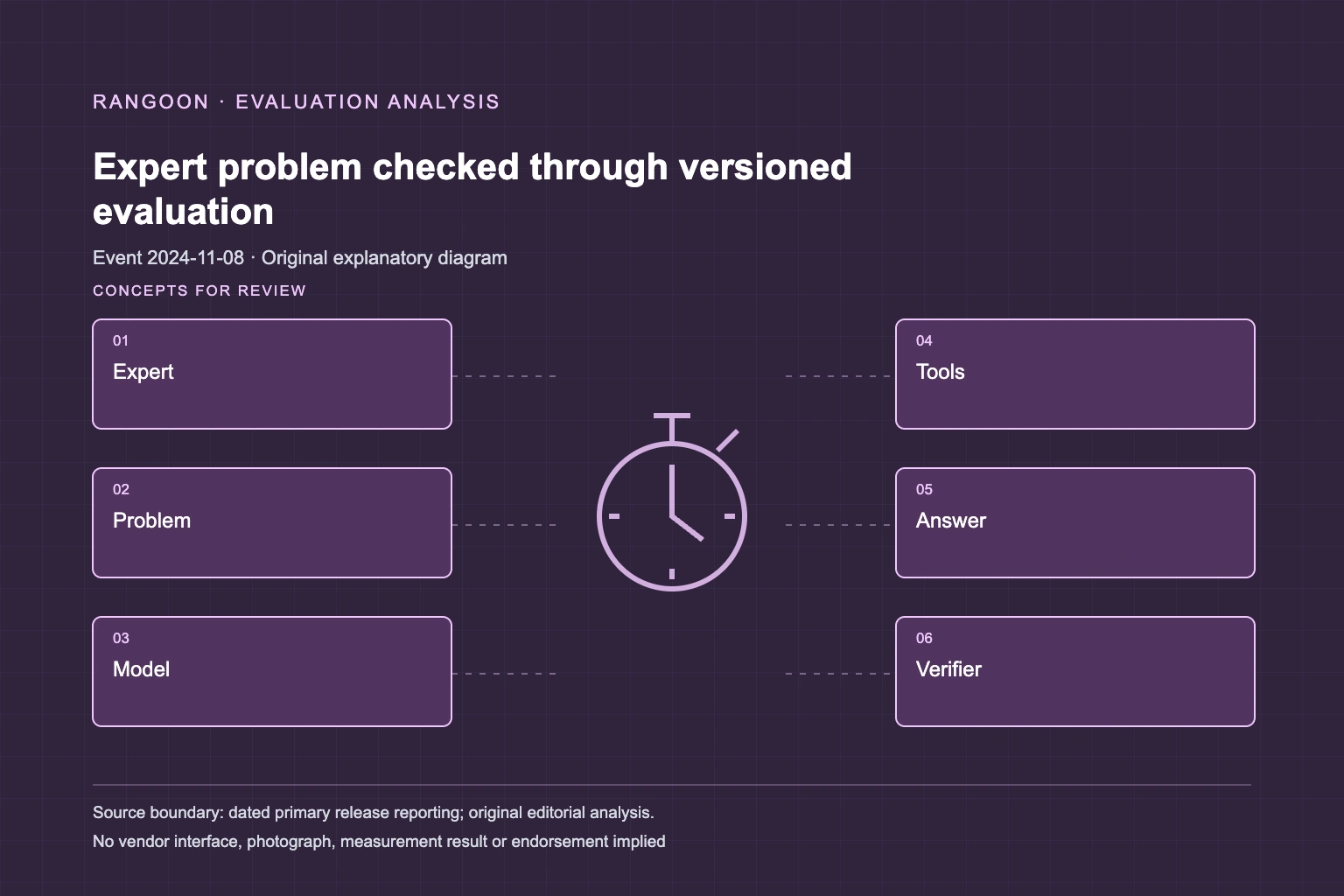
Epoch AI introduced FrontierMath on November 8, 2024, pairing original expert mathematics problems with automated answer verification.
Historical reporting: Epoch AI’s FrontierMath announcement says it was originally published November 8, 2024. The accompanying preprint, first submitted November 7, describes hundreds of original expert-crafted problems, automated verification and an effort to reduce training-data contamination. The announcement’s later ownership and holdout disclosures are material context for interpreting the benchmark. Any model score is a result under a particular FrontierMath version, prompt, tool policy, sampling setup and answer checker; it is not a general measure of mathematical research ability or scientific reliability.
Key takeaways
- FrontierMath made unpublished, expert-authored problems and automated checking central to an advanced-mathematics evaluation.
- The dated launch and preprint distinguish a benchmark design from later leaderboard results and revisions.
- A score needs its problem version, access conditions and verifier attached before it can support a comparison.
Epoch AI dated the FrontierMath announcement to November 8, 2024[source 1][source 2]
Epoch AI’s FrontierMath page says the announcement was originally published November 8, 2024. It introduced a benchmark of hundreds of original expert-crafted mathematics problems across major areas of modern mathematics. The authors described problems that can take relevant-domain researchers hours or days, placing the release outside short contest-style question answering. The associated preprint was submitted to arXiv on November 7. Those two dated records establish the reporting event: a benchmark and methodology became public. They do not establish a universal hierarchy of mathematical ability, a model’s readiness for unsupervised research, or the quality of any later score reported on a changed task set.
The benchmark coupled original problems with an automated answer-verification path[source 1][source 2]
The preprint describes hundreds of original problems written and checked with expert mathematicians, alongside automated verification intended to make answers scorable. This choice matters because an evaluation needs both a difficult target and a defined way to decide whether a run succeeded. Epoch’s launch says the problems were new and unpublished, an attempt to limit direct exposure in training data. Automated verification does not turn every mathematical judgment into a solved measurement problem. The reported result still depends on how a problem is worded, what form of answer the verifier accepts, whether tools are permitted, and whether a model has encountered related material. A passing answer demonstrates success on that bounded task and checker.
Version and access conditions became part of the meaning of a FrontierMath result[source 1][source 2]
The launch page identifies the analysis as using FrontierMath_10-22-24 and describes a later arrangement in which OpenAI commissioned 300 questions, with a subset of solution access withheld for evaluation. That disclosure is not peripheral. It shows why the exact problem version, who could see statements or solutions, and the timing of an evaluation matter when assessing possible contamination or independence. Epoch can publish its own internal evaluations, while sharing of questions and answers is constrained. A reader should therefore avoid collapsing the public launch, a paper revision, a supplier-reported run and a current leaderboard into one fact. They are different records with different evidence and different dates.
FrontierMath’s difficulty tiers and scoring setup make sampling depth part of each result[source 1][source 2]
FrontierMath’s November release organizes advanced problems by difficulty and reports results against a particular benchmark version, rather than presenting one timeless mathematics number. Its expert-written problems were designed to require substantial background knowledge, creative insight and execution, while its automated answer-verification path makes the submitted final answer scorable. A reported score is therefore a sample from a defined task pool and scoring setup. It should be read alongside the number of sampled problems, the model revision, prompt and permitted tools, especially because problems can vary greatly in the depth of mathematical work they require. A larger or harder sample can change the uncertainty and meaning of an average even when the model is unchanged. The benchmark’s useful result is a versioned estimate of performance on its expert-checked collection.
Sources
- Epoch AI: FrontierMath benchmark announcement (November 8, 2024)
- arXiv: FrontierMath technical paper (November 7, 2024)
Continue reading