

InvestAI proposed a layered fund to mobilise AI investment, not a €200 billion disbursement
The Commission launched InvestAI on February 11, 2025, describing a plan to mobilise €200 billion for European AI, including a €20 billion fund for four future gigafactories.
Historical reporting: the Commission launched InvestAI on February 11, 2025 and said it would mobilise €200 billion for AI investment, including a €20 billion fund to finance four future AI gigafactories. The initiative describes a layered fund, existing EU programmes and possible Member State participation. Mobilisation, fund design and pilot intentions are not cash already disbursed, a completed award, or a guarantee of private investment.
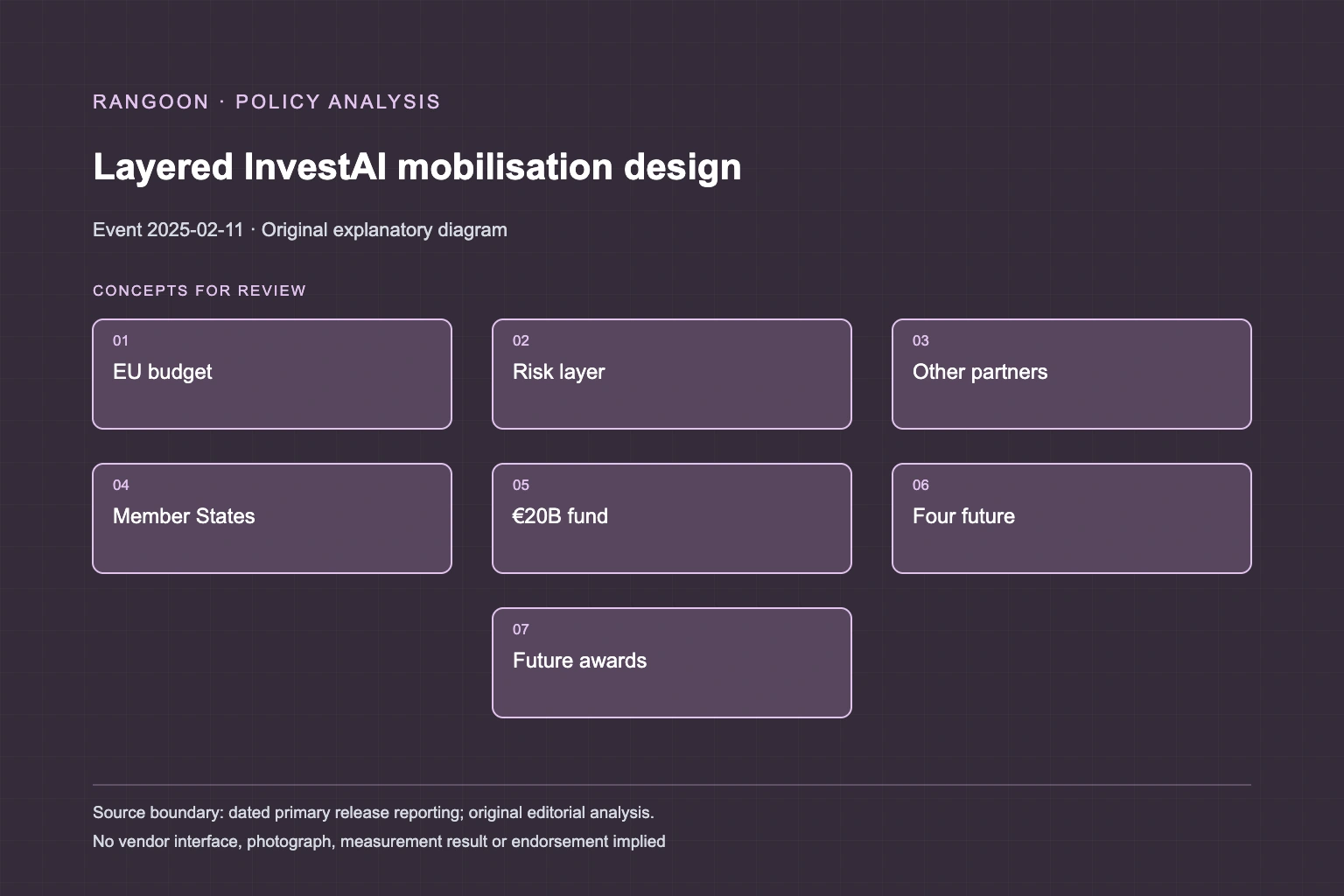
Key takeaways
- InvestAI described a mobilisation goal and a layered financing design, not a completed €200 billion spend.
- The €20 billion gigafactory figure was for a fund to finance four future facilities.
- The EU budget was described as de-risking other partners, making public and private roles part of the plan.
InvestAI set a mobilisation target rather than recording deployed capital[source 1]
On February 11, 2025, the European Commission launched InvestAI and said the initiative would mobilise €200 billion for AI investment in the EU. It also announced a €20 billion fund to finance four future AI gigafactories. “Mobilise” is distinct from spending: it describes an effort to bring public and private capital into a shared investment programme. The launch therefore made a financing architecture and a scale target newsworthy without showing that €200 billion had already reached projects, suppliers or data centres.
The plan used different risk positions to draw in other capital[source 1]
The Commission said InvestAI would include a layered fund with shares carrying different risk and return profiles. It described the EU budget as de-risking investment by other partners, with initial EU funding coming from existing programmes including Digital Europe, Horizon Europe and InvestEU. Member States could also contribute through Cohesion envelopes. This mechanism matters because the headline depended on participation beyond a single Commission grant. A fund structure can change who bears early risk, but it does not establish that every proposed partner committed funds or that a particular project cleared an award process.
Gigafactories were a pilot use of the planned financing approach[source 1]
The Commission linked the gigafactory fund to private-led AI infrastructure and said grants and equity would be combined for one of the pilot cases for strategic technologies. A gigafactory in this announcement was an intended large-scale compute project, not a named completed facility or a statutory new class of operator. Combining grants with equity is material because a grant reduces a project’s upfront burden while equity exposes a fund to project performance; neither term identifies a winner before an award. The tradeoff was between using public participation to reduce financing risk and retaining a project-selection process for infrastructure that had not yet been built. That is why the press release’s “four future” description is more precise than treating four sites as awarded, equipped or operational on launch day.
A mobilisation initiative could guide later awards without replacing them[source 1][source 2]
InvestAI built on the earlier AI Factory programme but did not convert those selected consortia into gigafactory awards. The Commission’s press material also described future steps and possible contributions, which are planning terms rather than completed transactions. A layered fund can make an otherwise hard-to-finance project investable by assigning different claim and risk positions, but that mechanism still needs investors, project terms and a later decision. The February record supports a claim about an EU initiative, target and funding design. It does not support an investment recommendation, a statement of available capacity, or an assertion that private capital had matched the public ambition. Later calls, selections and deployments need their own dated evidence.
Sources
Continue reading
Related reading
 News analysisThe Apply AI Strategy shifted the Commission’s AI story from building capacity to sector uptake3 min read
 News analysisThe AI Continent Action Plan joined compute, data, uptake and skills in one Commission roadmap3 min read
 News analysisEuroHPC selected seven AI Factory consortia before the facilities existed3 min read