

EuroHPC selected seven AI Factory consortia before the facilities existed
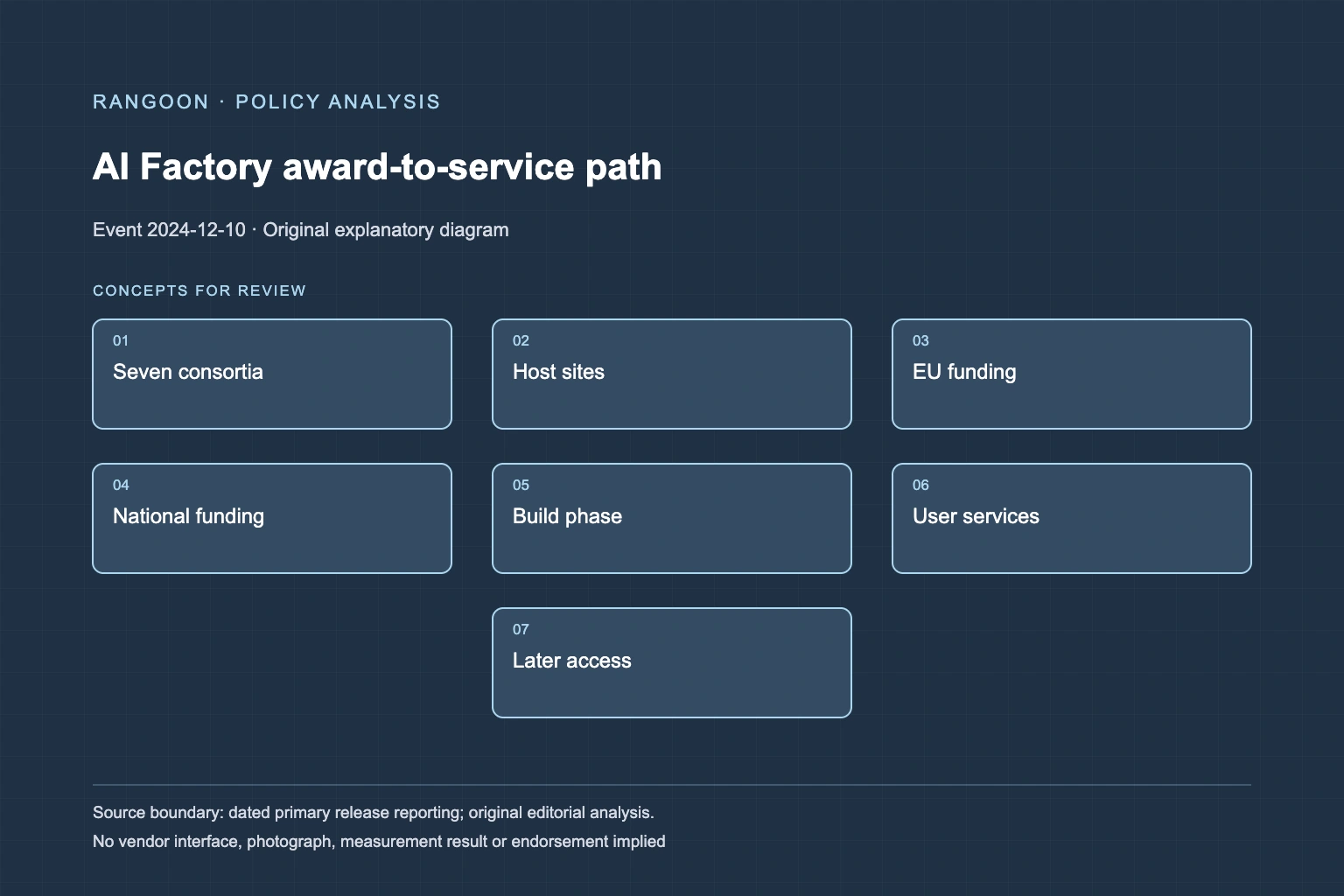
EuroHPC selected seven consortia for the first AI Factories on December 10, 2024, setting a €1.5 billion EU-national investment path rather than opening seven finished facilities.
Historical reporting: EuroHPC selected seven proposals on December 10, 2024 to establish and operate the first AI Factories. The Commission described €1.5 billion in combined national and EU funding, half from the EU. Selection and funding commitments are not proof that facilities, capacity, users or workloads were available on the event date.
Key takeaways
- Seven consortia were selected to establish and operate the first AI Factories.
- The €1.5 billion figure described combined planned investment, not cash already spent or delivered compute.
- A Factory combines infrastructure with access and support arrangements; selection did not make all those services live.
Seven consortia were selected for an establishment phase[source 1]
On December 10, 2024, the European High Performance Computing Joint Undertaking selected seven proposals to establish and operate the first AI Factories. The Commission named sites in Barcelona, Bologna, Kajaani, Bissen, Linköping, Stuttgart and Athens. The verb “selected” is the key status word: it recorded an award decision for consortia, not the opening of seven completed public compute services. The event put identifiable hosts and locations behind a European AI-infrastructure programme while leaving deployment work ahead.
The funding figure described a combined infrastructure commitment[source 1]
The Commission described the first seven as a €1.5 billion investment combining national and EU funding, with half from the EU through Digital Europe for infrastructure and Horizon Europe for AI Factory services. That split shows why the programme was more than a procurement of processors. It connected compute infrastructure with a planned service layer for startups, industry and research. The headline amount should therefore be read as the programme commitment the Commission reported, rather than a cash balance, a guaranteed capacity figure, or proof that each host had already received equivalent hardware.
A Factory linked supercomputing sites to a wider support model[source 1][source 2]
The selected sites were leading research and technology hubs, so the plan could build on existing national supercomputing organisations rather than create a single central facility. An AI Factory was intended to connect AI-optimised compute with expertise and access for users who may not operate their own large system. That design creates a practical tradeoff between a distributed network and uniform availability: local hosts can bring domain support and national links, but their systems, schedules and service stages need not be identical. It also means a programme-level announcement cannot answer a user’s later questions about queue policy, supported software, data handling or scheduled capacity at an individual site. Selection made the network architecture visible; it did not homogenise those future operating conditions.
The December decision was not a completed capacity or adoption result[source 1][source 2]
Later Commission pages describe additional selections and launches, which confirm that the AI Factory programme developed in stages after the first seven. Those later developments cannot be read back as December 2024 availability. The first-seven announcement did not establish a model-training result, a startup’s access entitlement, a regional power budget or a finished user-support workflow. A consortium award also leaves several technical transitions: acquiring and integrating compute, preparing data and user services, then allocating access within a host’s operating model. That operational detail is later work. Its historical significance is the first set of EuroHPC awards and their stated funding structure, with construction, commissioning and use remaining separate future questions.
Sources
Continue reading
Related reading
 News analysisSingapore’s digital minister linked national supercomputing, enterprise compute and quantum research at SCA20253 min read
 News analysisIsambard-AI came online as the UK completed the first phase of its AI Research Resource4 min read
 News analysisThe Apply AI Strategy shifted the Commission’s AI story from building capacity to sector uptake3 min read