

Isambard-AI came online as the UK completed the first phase of its AI Research Resource
The UK formally launched Isambard-AI in Bristol on July 17, 2025, bringing the national AI Research Resource fully online with its companion Dawn system.
Historical reporting: the UK formally launched Isambard-AI in Bristol on July 17, 2025. Government and University of Bristol records said the launch brought the AI Research Resource online alongside Cambridge’s Dawn system. The launch establishes operating infrastructure and an access program context; it does not guarantee a particular allocation, workload outcome, model capability or a specific research result.
Key takeaways
- The July 2025 event marked the formal launch of Isambard-AI and completion of the initial AI Research Resource pair with Dawn.
- A national supercomputer’s launch, hardware specification and user-access allocation are separate facts.
- Public compute capacity can enable research, but it does not guarantee access, a scientific result or responsible use of every workload.
The July event changed Isambard-AI from an announced project into launched infrastructure[source 1][source 2]
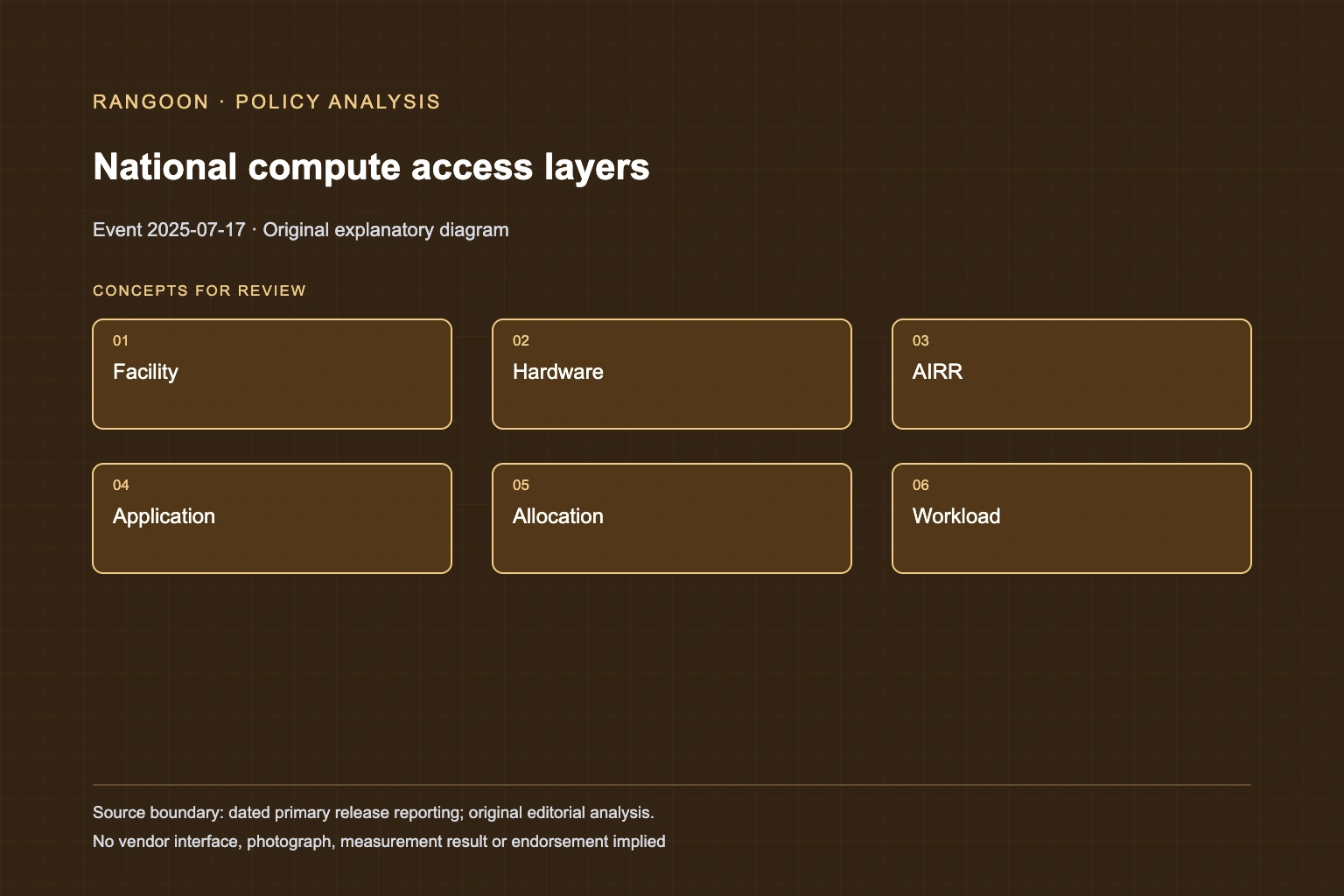
On July 17, 2025, the UK government announced the formal launch of Isambard-AI in Bristol. The Department for Science, Innovation and Technology said the launch brought the AI Research Resource fully online alongside the Dawn supercomputer in Cambridge. This distinction is material in infrastructure reporting. An investment announcement, a delivered machine, a formal launch and an accessible allocation service all mark different points in a project’s life, and the July event supplied evidence for the launch point.
The University of Bristol described Isambard-AI as a £225 million facility developed with HPE and NVIDIA and built and run by the Bristol Centre for Supercomputing. The government described it as the UK’s most powerful supercomputer at the time of launch. These are launch-era institutional descriptions. They should not be turned into a general claim that any researcher could immediately run any workload, that a named project had an allocation, or that the machine’s capacity alone solved a scientific or commercial problem.
The machine’s hardware mattered, while the resource also depended on access rules[source 1][source 2][source 3]
A June 30 government call, issued before the formal launch, described Isambard-AI as soon to be fully operational and, with Dawn, as the first £300 million phase of the AI Research Resource. The call also set out a pilot route for selected research proposals. The facility’s scale explains why the launch was national news: large accelerator clusters can support work that is difficult to fit on ordinary institutional systems. Yet hardware is only one layer of an operating resource. Storage, networking, software environments, queueing, user support, data controls and allocation policy shape what a researcher can actually do with a system.
The government had already published a call for researchers under the Sovereign AI AIRR launch route before the formal opening. That evidence supports the existence of an allocation pathway, not a blanket entitlement to capacity. Applications, eligibility, review and scheduling can limit access even when a facility is running. A useful account therefore separates the technical resource from the governance mechanism: the launch showed a national compute asset was online, while the route from an idea to a granted workload still required its own process.
Potential research applications did not amount to promised breakthroughs[source 1][source 2]
The Bristol release connected Isambard-AI to potential work in areas including robotics, climate research, big data and drug discovery. Such examples explain the types of compute-intensive research a facility might support, but they are not results announced on launch day. A large system can reduce a capacity constraint while leaving research quality dependent on the question, data, methods, expertise, validation and review. It is more accurate to describe the launch as expanding infrastructure available to those efforts than to claim a breakthrough from the existence of the machine.
The government also framed the resource as part of a strategy to make the UK an AI maker. That is a policy ambition, not a metric established by pressing the launch switch. National infrastructure can attract work and make some projects feasible, but outcomes still depend on allocation decisions, researchers, companies, data rights and follow-on investment. The July evidence supports a major new operating capability; it does not measure the longer-term economic effect that policy advocates hoped the resource would produce.
Operating capacity was a starting point for evidence, not evidence of every later outcome[source 1][source 2][source 3]
Isambard-AI’s launch made a previously planned part of the AI Research Resource tangible. The record is stronger than a funding pledge because it describes a formally opened facility and a paired national resource with Dawn. It is still bounded. A supercomputer can be online while access windows, workloads and support arrangements vary across users. The appropriate claim is that a particular national compute capability entered operation, not that all intended research, public-service or business benefits had already occurred.
This article does not use later rankings, allocations, model runs or funding changes to enlarge the July event. It also does not offer medical, scientific or investment advice from possible research uses. The dated sources establish a clear infrastructure milestone: the UK launched Isambard-AI and said its AI Research Resource was fully up and running, making subsequent use, outcomes and governance matters for separate evidence.
Sources
- GOV.UK: Engines of AI primed to accelerate new breakthroughs, economic growth, and transform the UK into an AI maker (July 17, 2025)
- University of Bristol: UK’s most powerful supercomputer launches in Bristol (July 17, 2025)
- GOV.UK: Sovereign AI AIRR launch opportunity call for researchers (June 30, 2025)
Continue reading
Related reading
 News analysisSingapore’s digital minister linked national supercomputing, enterprise compute and quantum research at SCA20253 min read
 News analysisBritain’s AI Opportunities Action Plan paired 50 recommendations with a government response4 min read
 News analysisNVIDIA’s memory codesign post highlights a practical boundary between capacity and usable agent throughput3 min read