FLUX1.1 Pro Ultra paired a high-resolution path with a Raw rendering control
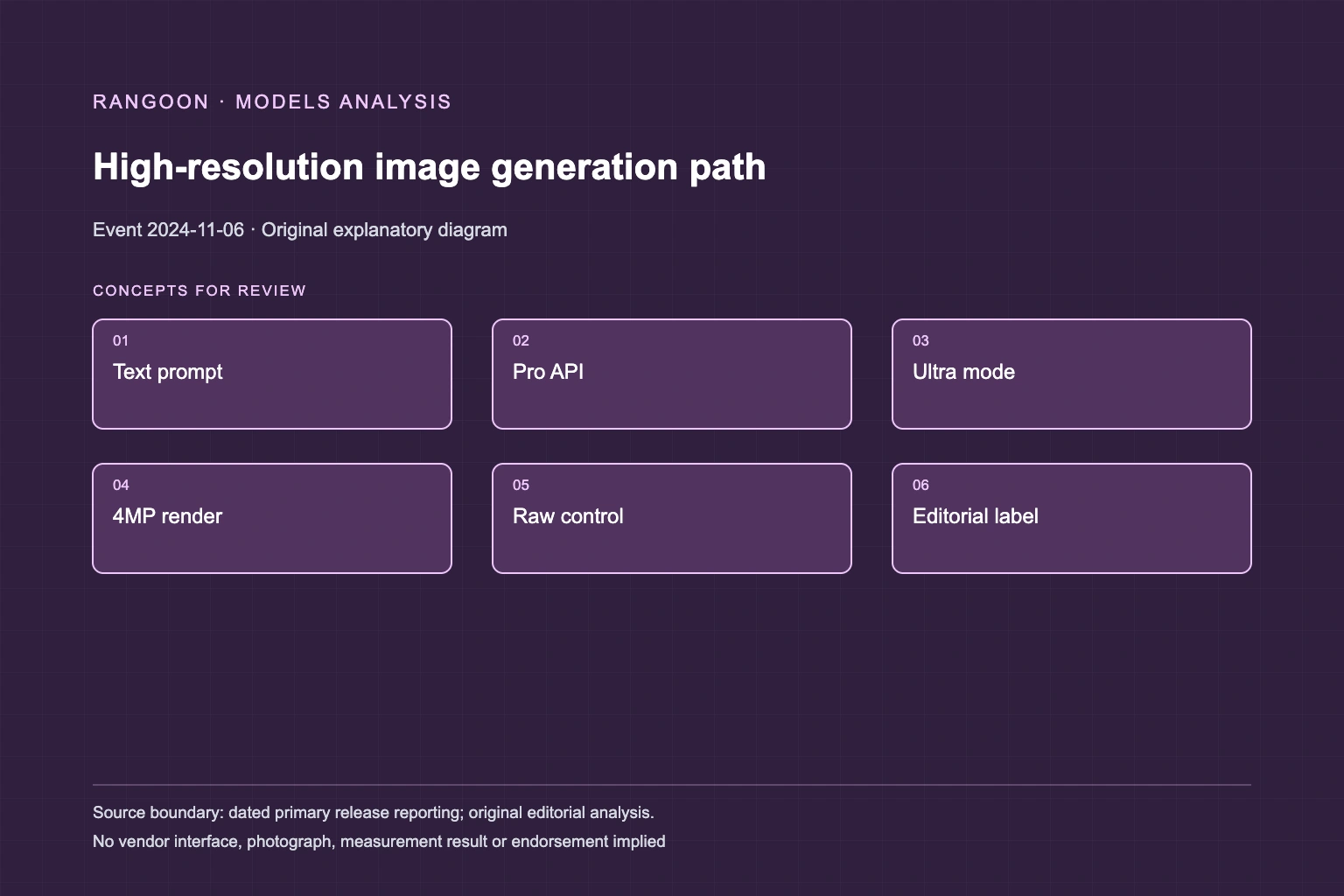
Black Forest Labs added FLUX1.1 Pro Ultra and Raw modes on November 6, 2024, extending its hosted image-generation API to 4MP output.
Historical reporting: Black Forest Labs announced FLUX1.1 [pro] Ultra and Raw modes on November 6, 2024. Ultra was a hosted FLUX1.1 [pro] API option for up to 4MP images, while Raw was a rendering-style control. The launch did not state a public weight license for the hosted model. Current catalog wording is later context, not launch-date availability proof.
Key takeaways
- Ultra changed a hosted generation option by raising output resolution, so image dimensions and delivery cost became product constraints.
- Raw was a rendering control, not a factual or photographic-authenticity claim about generated people or scenes.
- A high-resolution image model needs review of prompt rights, artifacts, and output handling before its images enter a published workflow.
The November event extended an existing hosted Pro model[source 1]
On November 6, 2024, Black Forest Labs announced FLUX1.1 [pro] Ultra and Raw modes. The company described Ultra as a new high-resolution capability for FLUX1.1 [pro], producing images up to 4 megapixels, four times the standard model resolution, with a stated generation time of ten seconds per sample. This was an option on a hosted image-generation model, not a publication of a separately downloadable Ultra checkpoint.
That distinction affects how the release should be understood. A hosted option can change output dimensions, price, queue behavior, available aspect ratios, and delivery path while leaving the customer without control of weights or serving infrastructure. The launch page gave a per-image price and speed comparison, but those are Black Forest Labs statements under its own service conditions, not a capacity measurement for another prompt mix or API integration.
Four-megapixel output changes more than the canvas size[source 1][source 2]
A larger generated image gives a designer more pixels for cropping, print preparation, retouching, and visual inspection, but it also makes artifacts easier to see. Fine text, repeated patterns, hands, edges, and composited-looking surfaces can all require closer review at the delivered resolution. A generation pipeline should preserve the requested dimensions and original response so that a downsampled preview does not become the only evidence used to approve a final asset.
Resolution also changes downstream treatment. A 4MP file can have a different storage cost, upload time, social crop, accessibility description, and derivative workflow than a smaller image. These are consequences of the announced Ultra mode, not extra product promises: a high-resolution render is still synthetic media whose claims about a person, place, event, or product need the same editorial verification as any other illustration.
Raw mode was an aesthetic control rather than a provenance signal[source 1]
Black Forest Labs described Raw mode as a way to make results feel less synthetic and more like candid photography, with more diversity in human subjects and more realistic nature images. That is a vendor description of the requested rendering style. It does not mean an output is documentary, unedited, unbiased, or evidence that a photographed event occurred.
For creative work, the useful question is whether the control produces a result that matches a declared visual brief without misleading the audience. A publisher can label the work as generated or illustrative, avoid attaching it to a real-world claim it cannot support, and inspect whether a prompt has accidentally borrowed a protected identity, trademark, or recognizable location. Raw styling may lower a viewer’s skepticism, which makes clear contextual labeling more important rather than less.
API access and model licensing are separate questions[source 1][source 2]
The Ultra announcement directed users to access FLUX1.1 [pro] through Black Forest Labs’ API. It did not state a public weight license for Ultra or Raw, so the historical record should not call this a permissive open-weight release. A later Black Forest Labs model catalog may help locate a current product, but it cannot supply terms that were absent from the November launch announcement.
An API customer therefore has a service relationship as well as a creative workflow. The applicable terms, data handling, model name, pricing, rate behavior, and export format should be checked at the time of use, while the generated image’s rights and depiction risks remain separate editorial questions. This boundary keeps a dated release report from turning a vendor’s hosted availability into an unsupported ownership or rights claim.
Sources
Continue reading