FLUX.1 Kontext joined image generation and editing through text-and-image context
Black Forest Labs released FLUX.1 Kontext on May 29, 2025, offering Pro and Max image models that take text and reference images for generation and edits.
Historical reporting: Black Forest Labs announced FLUX.1 Kontext on May 29, 2025 as a family for in-context image generation and editing. Kontext [pro] and [max] were offered through the BFL API and named partners; Kontext [dev] was only a private beta for research and safety testing. The public June 26 [dev] release is later availability and license context, not evidence of May launch access.
Key takeaways
- Kontext made a reference image part of a generation request, so consent, input rights, and edit lineage became first-class concerns.
- Pro and Max were hosted offerings while Dev was private beta at launch; their availability and licensing should not be collapsed.
- Consistency and local-editing claims require visual review across turns because a plausible edit can still alter an identity or key detail.
The May event introduced in-context image generation and editing[source 1]
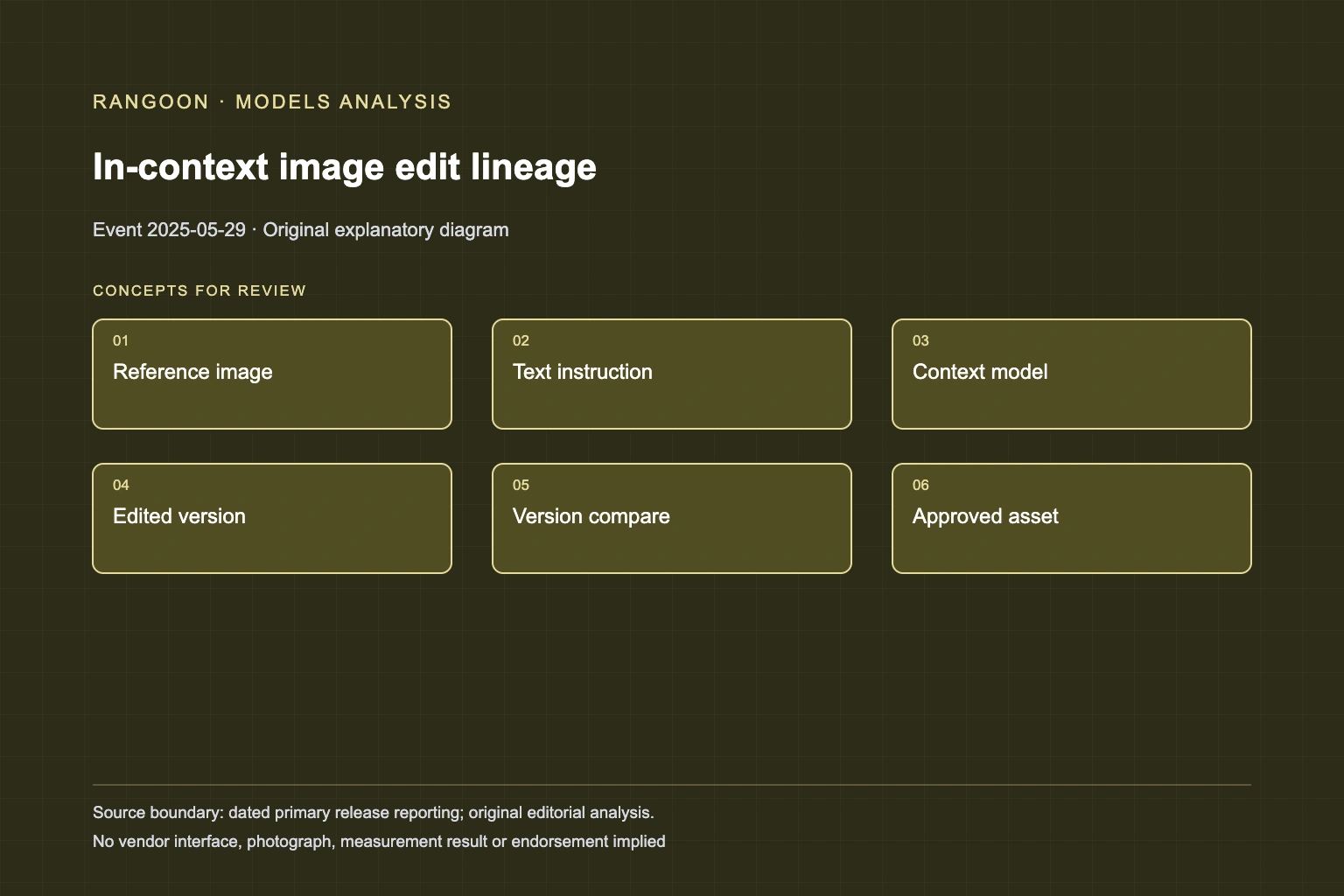
On May 29, 2025, Black Forest Labs announced FLUX.1 Kontext, a suite of generative flow-matching models that accepted both text and images. The launch said the family could extract visual concepts from a reference image and use text instructions to generate new images, apply local changes, preserve styles, and refine an image over multiple turns. That makes the input image part of the model context rather than merely a file attached to a separate editor.
The mechanics change the creative question from “what should this prompt draw?” to “what may be carried forward from this reference?” Character features, objects, typography, backgrounds, and style cues can be relevant context even if a user mentions only one requested edit. A reviewer should compare the source image and every resulting version, especially when the reference contains a person, brand, artwork, or sensitive document detail.
Pro, Max, and Dev had different launch paths[source 1][source 2]
Black Forest Labs introduced Kontext [pro] and [max] as new in-context models available through its API, named creative applications, and infrastructure partners. It described [pro] as a model for iterative local and generative edits, and [max] as an experimental model aimed at prompt adherence, typography, and consistency. Those availability statements concern hosted offerings and named distribution paths, not an assertion that all family variants were downloadable weights.
The same announcement described a 12B Kontext [dev] variant as a private beta for research usage and safety testing, with public distribution planned later. On June 26, Black Forest Labs announced the later public [dev] release under the FLUX.1 Non-Commercial License. That later license and access event clarifies why the May report must not call [dev] open weights or apply June terms to the Pro and Max API products.
Multi-turn editing creates an image lineage rather than one output[source 1][source 2]
Kontext’s launch emphasized iterative edits that build on previous results while preserving characters, identities, styles, and distinctive features. In a creative tool, each turn can preserve useful continuity but also carry forward unwanted artifacts, source-specific traits, or a mistaken change that becomes harder to notice after several variations. A practical review compares versions at checkpoints instead of judging only the final render.
Local editing is also not a guarantee of isolation. An instruction to change a sign, garment, or object can alter lighting, background text, pose, or facial detail around the requested region. The announcement’s capability examples establish an intended interaction pattern; they do not verify that an edit will respect an organization’s brand rules, accessibility requirements, or factual constraints for every image.
Vendor speed and consistency claims need task-specific interpretation[source 1][source 2]
Black Forest Labs reported Kontext evaluation results across in-context generation tasks and described lower latency than competing systems. These are supplier results under its benchmarks, models, prompts, and infrastructure. They do not predict turnaround time for another provider, a particular source-image resolution, an iterative queue, or a workflow that requires manual visual approval.
A creative team can make the release useful by documenting the source-image rights, requested transformation, selected family variant, and approved output. This is not a generic governance checklist: it is the minimum lineage needed to know whether a result derives from a licensed campaign asset, a customer upload, a staff portrait, or an unverified internet image. Without that context, a strong consistency result can obscure a rights or representation problem.
Sources
Continue reading