

Gemini 2.0 put multimodal output and tool use in one release
Google introduced Gemini 2.0 and an experimental Gemini 2.0 Flash on December 11, 2024. The release made output contracts central to agent evaluation.
Historical reporting: Google published its Gemini 2.0 announcement on December 11, 2024. Google’s developer announcement from the same day described Gemini 2.0 Flash Experimental; analysis below is editorial.
Key takeaways
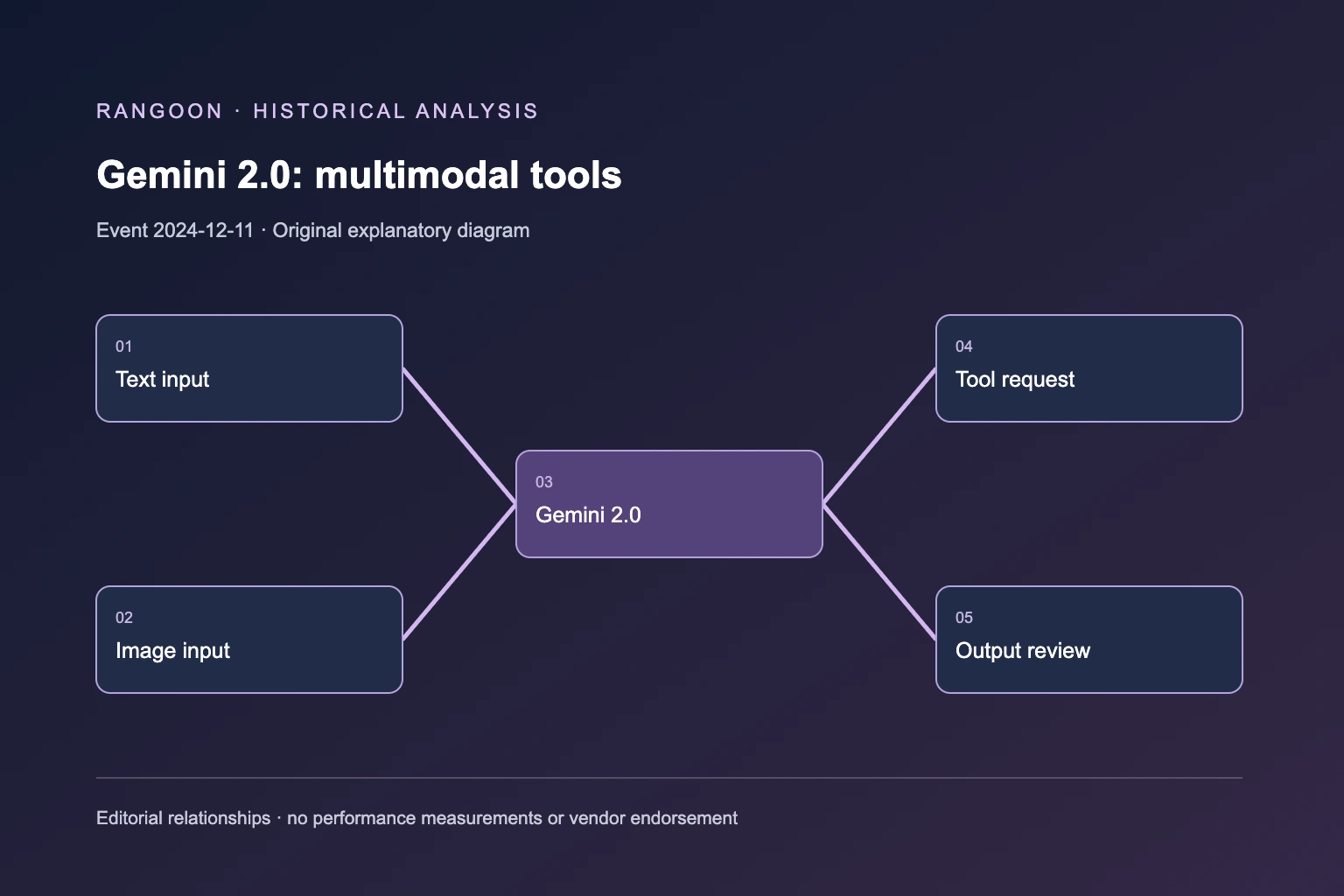
- Gemini 2.0 combined multimodal input, multimodal output, and native tool use in Google’s release description.
- An agent evaluation should inspect tool proposals and output types, not only a final text answer.
- Experimental availability is a reason to pin a test configuration, not a substitute for a compatibility record.
What Google announced[source 1][source 2]
On December 11, 2024, Google introduced Gemini 2.0 as a model family for what it called the agentic era. The company said the first model was Gemini 2.0 Flash in experimental form. Its announcement described multimodal inputs, native image and audio output, and native tool use, while also presenting research prototypes such as Project Astra, Project Mariner, and Jules.
A second Google post addressed developers more directly. It said Gemini 2.0 Flash Experimental could be explored through the Gemini API in Google AI Studio and Vertex AI, and described the model as building on Gemini 1.5 Flash. Both posts are dated December 11. They establish the release framing, not a timeless statement about every product surface or later model version.
Editorial analysis: more output types change the contract
A text-only assistant can often be evaluated with a prompt, an expected answer shape, and a human review. A system that can propose tool calls or return images and audio has a wider contract. Its useful output may include arguments for a tool, an artifact reference, modality metadata, and a request for an action. Each field can create a failure mode that a text-quality score does not reveal.
The same is true for agentic prototypes. A demo can show that a capability exists, while an operator still needs to determine which interface, account, tool permissions, and human checkpoints apply to a particular workflow. Historical release language should initiate that investigation, not close it.
Editorial analysis: test the whole proposed action
A useful evaluation fixture records the input, the expected output modalities, permitted tools, allowed argument range, and required human decision. It should include cases where the model must decline a tool, ask for missing information, or return an artifact that fails validation. This turns an impressive final response into evidence about the real interface the workflow will depend on.
For tool calls, validate the schema before execution and retain the proposed call separately from its result. For generated assets, validate type, size, provenance expectations, and any downstream safety or rights process before publication. A model selecting a plausible action is not evidence that the action was authorized or that its returned artifact satisfies a production contract.
Editorial analysis: make release tests reproducible
Pin the model identifier, API surface, prompt revision, tool schema, and evaluation fixtures when trying a newly announced capability. Compare the candidate with the incumbent on ordinary success cases and on malformed inputs, unavailable tools, content that must stay inside a boundary, and failed downstream validation. Record results by output type instead of reducing the run to one overall pass score.
The lesson from the Gemini 2.0 announcement is not that every workload needs multimodal agents. It is that a broader model interface calls for broader acceptance checks. Teams can adopt one output class at a time, retain the evidence for each decision, and keep a known configuration available while a new surface proves its behavior.
Sources
- Google: Introducing Gemini 2.0, our new AI model for the agentic era (December 11, 2024)
- Google Developers Blog: The next chapter of the Gemini era for developers (December 11, 2024)
Continue reading
Related reading
 News analysisGoogle brought NotebookLM to iOS and Android with mobile source sharing and offline Audio Overviews3 min read
 News analysisMedGemma 1.5 expanded a 4B model toward volumes, slides and longitudinal imaging inputs3 min read
 News analysisGrok 4’s July launch put tool use, subscriber access and an API on the same release record3 min read