

Google brought NotebookLM to iOS and Android with mobile source sharing and offline Audio Overviews
Google released the first NotebookLM mobile app on May 19, 2025, bringing source questions, sharing and downloadable Audio Overviews to iOS and Android.
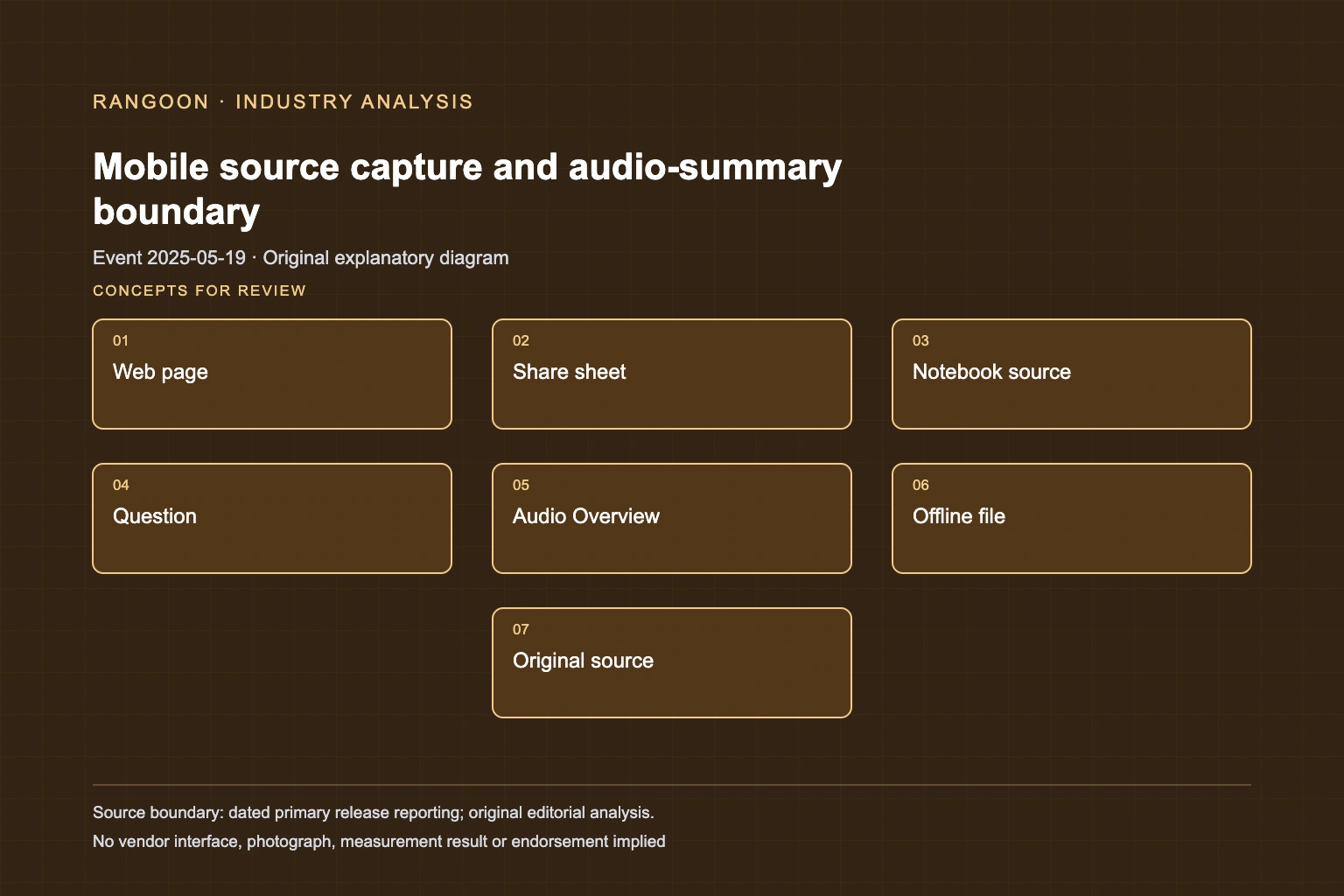
Historical reporting: Google released the first NotebookLM mobile app on May 19, 2025 for iOS and Android. Its announcement names offline Audio Overview playback, background listening, questions for sources, and sharing a website, PDF, or YouTube video into a notebook. Current product pages are later context and do not establish launch-day input support beyond the named examples or universal accuracy.
Key takeaways
- The first NotebookLM mobile release put source capture and Audio Overview playback on phones and tablets.
- Sharing a page or file into a notebook changes the source set, so provenance begins before the generated response.
- Offline audio makes playback portable but does not make an audio summary an authoritative source.
The first app brought core NotebookLM flows to two mobile platforms[source 1]
Google released its first NotebookLM mobile app on May 19, 2025 for Android and iOS. The announcement said the first version included many core NotebookLM features, while also saying refinements and more features would come later. Google named iOS 17 or later for iPhone and iPad, and Android 10 or later for phones and tablets.
That is an app-release record with stated platform floors, not evidence of identical behavior on every device or a complete replacement for the web product. Feature additions after the first version remain separate milestones. App-store listing did not establish device storage, network quality, or account eligibility for every user. Those conditions differ.
Downloadable Audio Overviews changed when a generated discussion could be played[source 1]
The launch let users download Audio Overviews for offline playback and listen in the background. It also let a user tap Join to ask questions or steer the hosts in a new direction. These are interaction and playback mechanics: a notebook’s source-grounded material can be consumed away from a network connection, then explored again through a follow-up question.
An Audio Overview remains a generated presentation of notebook material. Offline playback preserves the downloaded audio, not a new verification of the source set, so a user should open original materials when the exact wording, date, or claim matters.
Portable access did not convert summaries into verified research[source 1][source 2]
The mobile launch made NotebookLM easier to use while traveling, reading, or moving between apps. It did not turn every Audio Overview, answer, or source-derived summary into a primary record. The right evidence still depends on the underlying source, its publication date, and whether the notebook contains the relevant material.
Google’s May event supports a focused claim about iOS and Android access plus the announced offline, question, and sharing flows. It does not prove a universal accuracy rate, later mobile features, every supported input type, or secure handling for a particular user’s device and account.
Sources
Continue reading
Related reading
 News analysisGemini 2.0 put multimodal output and tool use in one release3 min read
 News analysisGemini Advanced opened Deep Research as a report workflow with a user-reviewed research plan3 min read
 News analysisMedGemma 1.5 expanded a 4B model toward volumes, slides and longitudinal imaging inputs3 min read