

Gemini CLI put agent action boundaries inside the terminal
Google announced Gemini CLI in June 2025 as an open-source terminal agent. The launch highlights why shell commands, workspace scope and user approval need visible controls.
Historical retrospective: Google announced Gemini CLI on June 25, 2025, and the official project repository recorded active launch-day use. This article does not make current install, model, quota, privacy or feature claims.
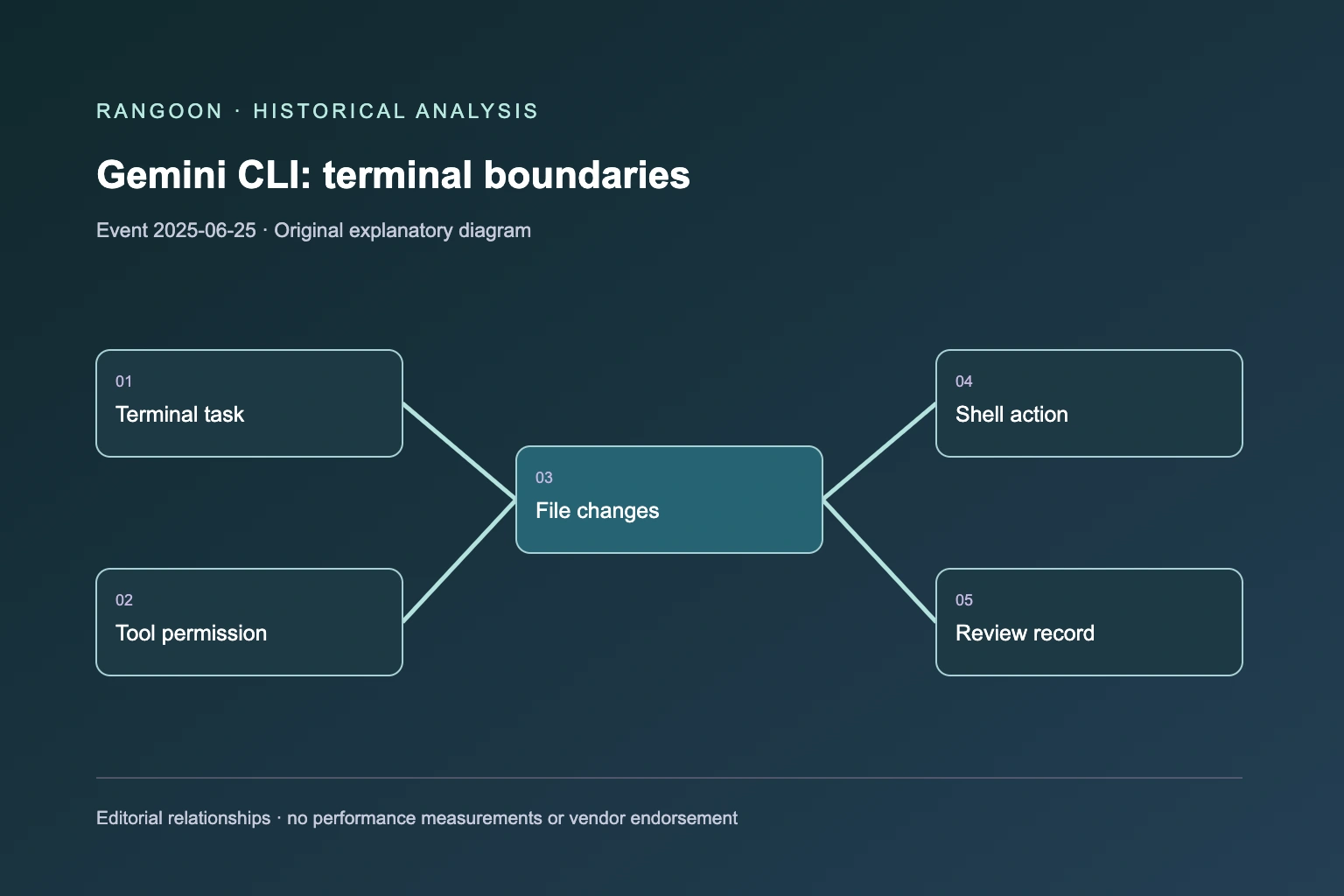
Key takeaways
- A terminal agent turns natural-language assistance into a local command-execution boundary.
- Open source supports inspection, but local configuration and command scope still determine a run's effects.
- Command proposals, execution receipts and approval prompts should remain distinguishable in the terminal.
Gemini CLI brought an agent workflow to the command line[source 1][source 2]
On June 25, 2025, Google announced Gemini CLI as an open-source AI agent for developers' terminals. The launch post described uses beyond coding, including problem solving and task management, and named tools for code understanding, file manipulation and command execution. The official Gemini CLI repository shows launch-day activity and provides the public codebase for the project. These sources document a historical launch of a terminal-focused agent, not a current guarantee about its installation, capabilities or underlying model.
A terminal is distinctive because it can connect a natural-language request to files, processes, credentials and networked tools already available to a developer. That proximity is useful, but it removes the protective distance that a separate chat surface can provide. The important engineering question is not whether a command is syntactically valid. It is whether the proposed command has an identified target, a bounded workspace and approval appropriate to its possible effect.
A shell receipt should show proposal, approval and result
A terminal-agent receipt should first preserve the proposed action in a form the operator can read: command, working directory, relevant environment category, files expected to change and external destinations. Before execution, it should record the approval mode and any policy that allowed or denied the request. After execution, it should capture exit status, bounded output, changed-file summary and a stable reference to fuller logs when needed. These phases should not collapse into a single success message.
Workspace scope needs the same clarity. A command that is safe inside a temporary checkout can be harmful in a home directory, production configuration or shared volume. Resolve paths before display, restrict destructive or networked operations by policy, and do not let a convenience fallback silently expand the work area. When a request is ambiguous, stop with the ambiguity visible rather than guessing a filename, branch or deployment target.
Retrospective lesson: test terminal agency through negative cases
A credible terminal-agent test set includes allowed read commands, bounded file edits, denied path traversal, malformed arguments, commands requiring confirmation, failed subprocesses and unreachable network targets. Exercise repeated requests to see whether a retry can duplicate a state change. Test the dry-run or proposal view independently from execution so a polished explanation cannot be mistaken for proof that no command ran.
Keep approval records bound to a command form and workspace, not to a broad conversational intention. A user may authorize editing one file without authorizing a package installation, a repository push or an external upload. This makes a terminal agent easier to use under real constraints because its stops are explainable and reproducible. Gemini CLI's June 2025 launch remains a useful historical prompt: an agent can be open source and locally useful while command authority still needs explicit, inspectable boundaries.
Sources
- Google: Gemini CLI, your open-source AI agent (June 25, 2025)
- Google Gemini CLI: official project repository (June 25, 2025)
Continue reading
Related reading
 News analysisGemini CLI extensions made tool packaging a terminal-agent governance concern3 min read
 News analysisTerminal-Bench released version 2.0 with Harbor and renewed task verification3 min read
 News analysisGoogle’s Gemini Robotics On-Device put a vision-language-action model on the robot3 min read