

GitHub previewed Copilot Spaces as a shared context layer for code and project knowledge
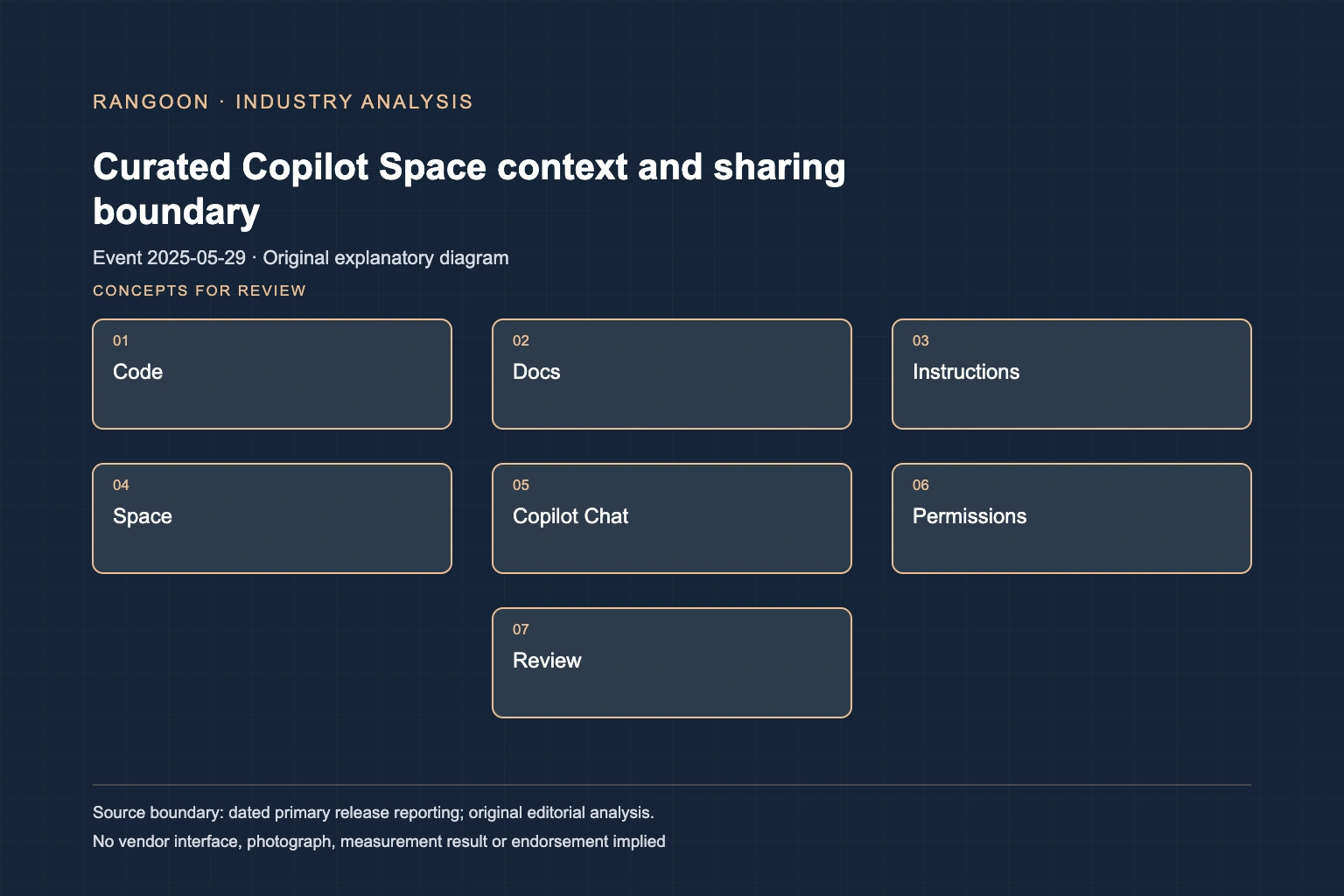
GitHub previewed Copilot Spaces on May 29, 2025, letting Copilot Chat use a curated, shareable set of code, documents, notes and instructions.
Historical reporting: GitHub announced Copilot Spaces on May 29, 2025 as an early preview. The launch says a space could collect code, documents, specifications, and custom instructions, then be shared across an organization; it also names a June 18 billing change. Current GitHub documentation supplies later product behavior and sharing context, not proof that those behaviors were all available at preview launch.
Key takeaways
- Copilot Spaces was a preview feature for curating reusable context around a task or project.
- A space changes the context boundary for chat, but its sources and access rules still determine what the model can use.
- Preview availability, billing, organization policy and later IDE support were separate product questions.
The May announcement described a preview, not a finished enterprise rollout[source 1]
GitHub introduced Copilot Spaces on May 29, 2025 and called the feature an early preview. Its announcement said a space could centralize project context for Copilot, including code, documents, specifications, and custom Copilot instructions. GitHub said spaces could be shared across an organization and were available on github.com for Copilot users, subject to an organization administrator opting into preview features for Business or Enterprise customers.
That record establishes a preview surface and its stated access condition. It does not establish that every organization enabled the preview, that every source type behaved the same way, or that a space produced correct answers for a particular codebase.
Curated context moves a knowledge-selection decision into the product surface[source 1][source 2]
A space can give a chat a repeatable starting set of project material instead of asking each user to reconstruct the same background in every prompt. That can make a question more specific, but the result still depends on whether the chosen sources are current, relevant, complete, and readable by the user. Custom instructions further shape the request but do not turn supporting material into verified facts.
Current GitHub documentation describes spaces as holding repositories, files, pull requests, issues, free text, images, and uploads. That is later maintained product context; it should not be read back as a complete May preview feature inventory.
Shared context requires both freshness and permission boundaries[source 1][source 2]
The launch said a space could scale expertise by being shared across an organization. A shared set of notes and sources can reduce repeated explanation, while also increasing the importance of ownership, updates, and source hygiene. If old designs or conflicting instructions remain in the set, grounding can faithfully surface stale context.
GitHub’s current documentation says GitHub-hosted sources in a space can update as they change and describes organization sharing choices. Those later details do not erase the need to verify source permissions and review the material that a team has chosen to centralize.
The preview carried a later billing boundary as well as a technical one[source 1][source 2]
GitHub’s May post said Spaces would follow the Copilot Chat billing model beginning June 18, 2025. It distinguished premium-model chats from included model usage and said free users’ space chats would count toward their monthly chat limit. Those are dated product statements, not a forecast of a team’s actual request volume or cost.
The historical conclusion is narrow: GitHub previewed a context-curation feature for Copilot Chat. It does not prove that a space is a source of truth, that it grants access to protected code, or that its shared context replaces code review and tests. Space ownership needs active maintenance.
Sources
Continue reading
Related reading
 News analysisZoom released AI Companion 2.0 as a cross-Workplace context and action surface3 min read
 News analysisWorkday announced Build with a future Agent Builder availability window3 min read
 News analysisPerplexity launched Comet first for Max subscribers, joining web browsing with an in-browser assistant3 min read