Google introduced Agentspace in early access for enterprise search, reasoning and custom agents
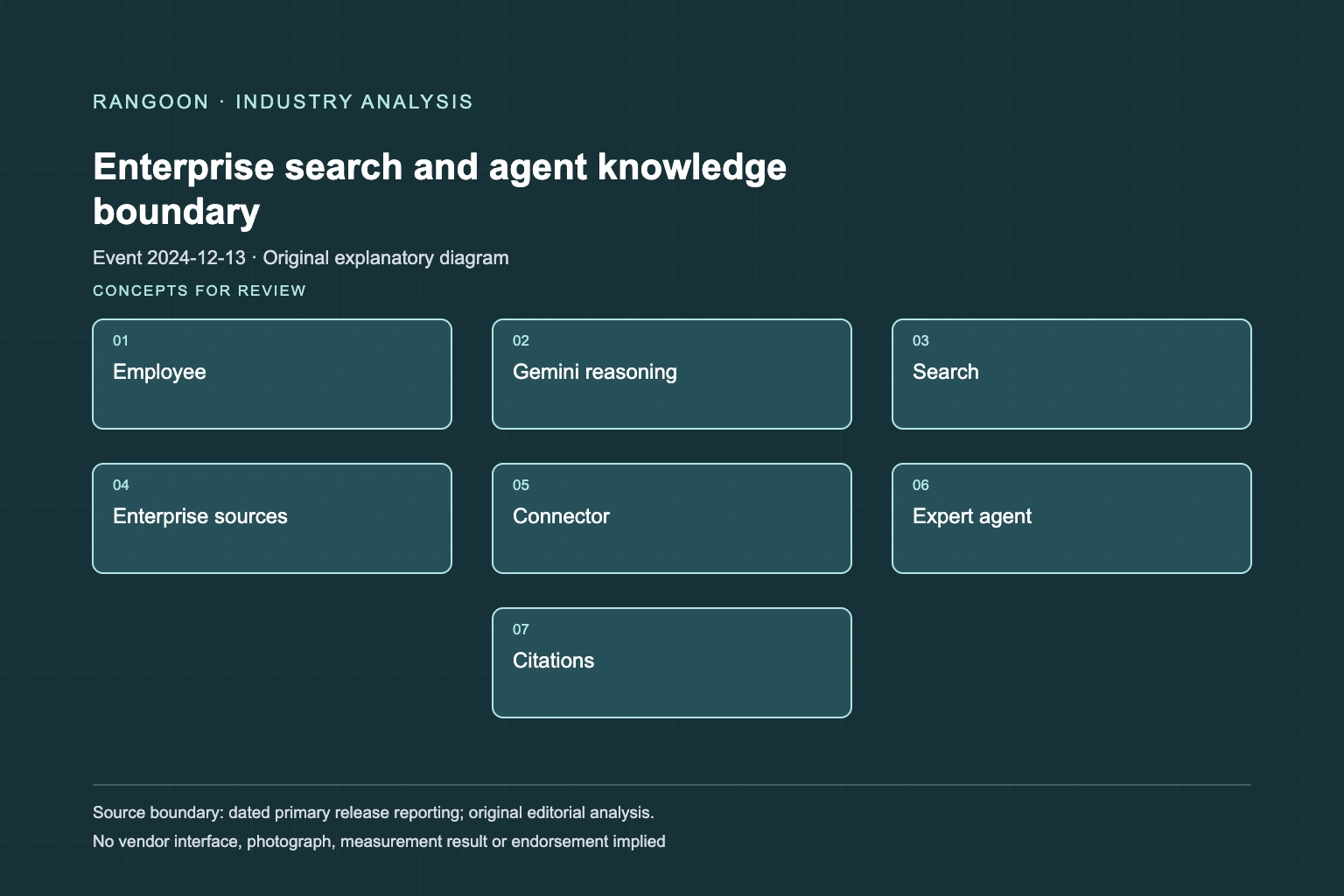
Google introduced Agentspace on December 13, 2024, offering early access to an enterprise surface combining Gemini reasoning, Google search and company data.
Historical reporting: Google Cloud introduced Google Agentspace on December 13, 2024 and invited organizations to sign up for early access. The announcement describes Gemini reasoning, Google-quality search, enterprise data across hosting locations, an enterprise NotebookLM experience, and custom expert agents. The current product page is later context; the announcement page’s later editor note says Agentspace is now part of Gemini Enterprise, so it cannot establish a December 2024 generally available product state.
Key takeaways
- Google introduced Agentspace as early-access enterprise infrastructure, not a December 2024 general-availability claim.
- Its design combined search, Gemini reasoning and enterprise sources, making connector quality and permissions central to usefulness.
- The later Gemini Enterprise product note is lineage context, not launch-day capability proof.
The December event offered early access, not an unqualified GA milestone[source 1]
Google Cloud introduced Google Agentspace on December 13, 2024 and invited organizations to sign up for early access. The announcement said Agentspace brought together Gemini reasoning, Google-quality search, and enterprise data regardless of where that data was hosted. It framed the surface as a way for employees to ask complex questions, receive suggestions, and use agents around company information.
Early access is a material availability qualifier. It does not establish a generally available service, universal connector support, or a completed rollout for every enterprise that read the announcement. Initial access also leaves terms, regions, and rollout sequencing to the actual service program.
Agentspace combined an enterprise search problem with an agent-discovery problem[source 1]
The launch described a company-branded multimodal search agent and a space for custom expert agents. It also described NotebookLM Plus as an enterprise NotebookLM experience for uploading information, synthesis, insights, and new ways to engage with data. That design can shorten the path from search to assistance, but it also joins source selection, retrieval, model inference, and action design in one user experience.
Search quality depends on what has been indexed, how documents are segmented, what identity can access them, and how a result cites its evidence. An agent layer cannot compensate for a missing source, stale connector, or permission mistake simply by producing a fluent answer.
Enterprise data across locations still needs scoped connections and result checks[source 1][source 2]
The phrase enterprise data regardless of hosting location describes a broad integration goal, not a promise that all data is immediately searchable or actionable. Every connector needs authentication, indexing or retrieval rules, source lifecycle handling, and a decision about what the agent may expose or change. Those controls determine the effective knowledge boundary more than a single search box does.
Google’s current Agentspace product page describes security and compliance-oriented product material. It is later context and should not be treated as proof that a December early-access tenant had a given control, configuration, or data-residency outcome.
Later product lineage should not rewrite the original availability state[source 1][source 2]
Google’s original announcement page now carries an editor note saying Agentspace is now part of Gemini Enterprise. That later product note helps explain the lineage, while confirming why the December 2024 event should remain a dated Agentspace early-access announcement. Names, packaging, and orchestration surfaces can change after an initial release.
The historical record supports the early-access introduction and its stated components. It does not prove a present Gemini Enterprise entitlement, a deployed corporate search result, or that an agent could act correctly across every source system. That matters when comparing announcement timelines. Maturity differs by event.
Sources
Continue reading