

DeepMind’s SIMA 2 research preview used Gemini to plan and learn in virtual 3D worlds
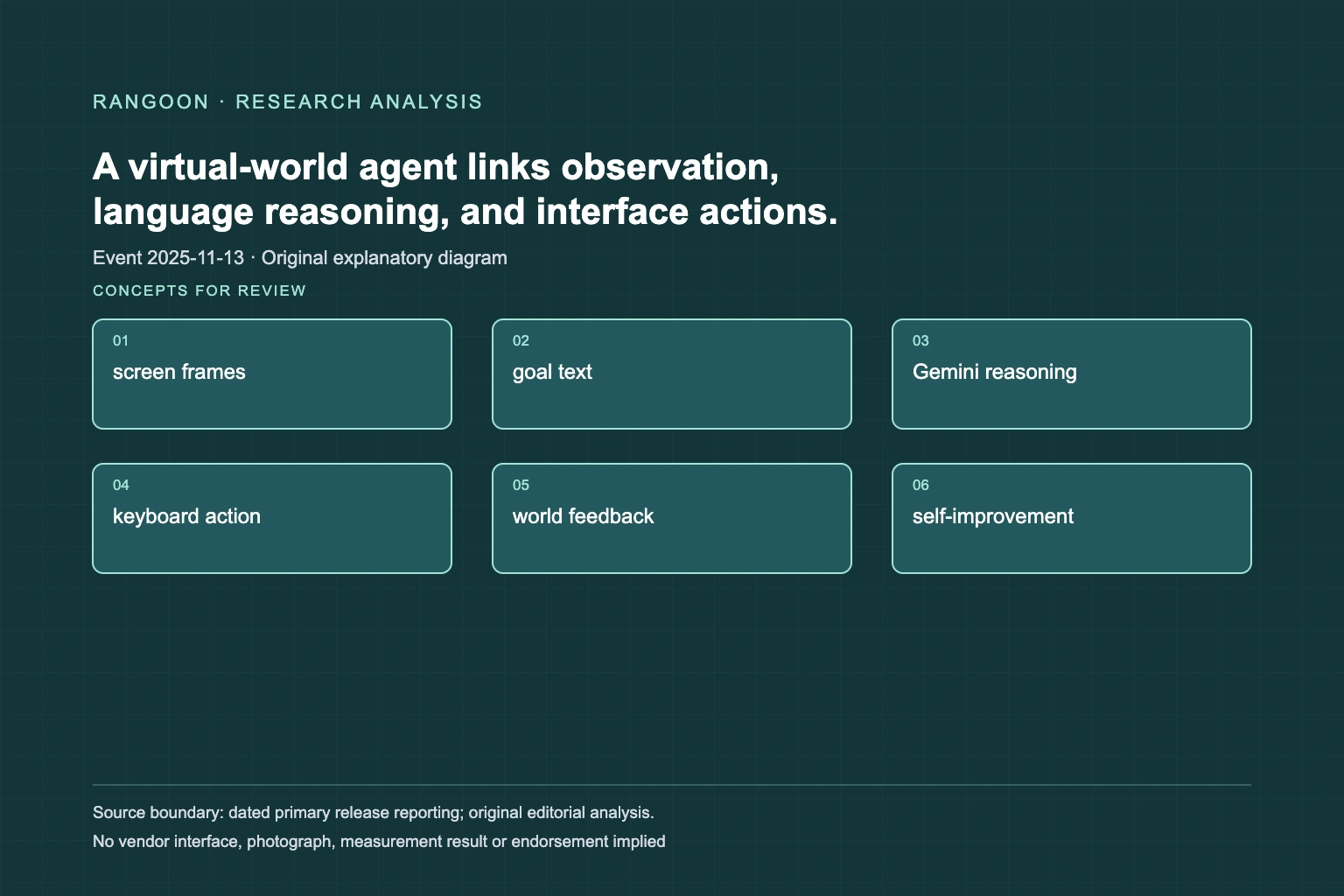
Google DeepMind introduced SIMA 2 on November 13, 2025, a limited research-preview agent that used Gemini reasoning in interactive 3D virtual worlds.
Historical reporting: Google DeepMind introduced SIMA 2 on November 13, 2025 as a limited research preview for a small cohort of academics and game developers. The launch describes a Gemini-powered agent that follows instructions, reasons about goals, converses, and improves over time in 3D virtual worlds. The original SIMA research page supplies earlier comparison context, not evidence that SIMA 2 was broadly available or ready for physical deployment.
Key takeaways
- SIMA 2 was a limited research preview in virtual 3D environments, not a released physical robot controller.
- Gemini reasoning added goal discussion and planning to an agent trained to act in multiple simulated worlds.
- Virtual-world results can inform embodiment research without proving real-world perception or safety performance.
The November event was a limited research preview[source 1]
Google DeepMind introduced SIMA 2 on November 13, 2025 as research into interactive agents for 3D virtual worlds. It said access would go to a small cohort of academics and game developers, explicitly calling the effort a limited research preview. That status is narrower than public product availability or a general software release.
The announcement framed SIMA 2 as a gaming companion that could follow language instructions, think about goals, converse with users, and improve over time. Those are research capabilities under the described settings, not a guarantee of dependable performance in every game or application.
Virtual worlds give an agent observable rules and controllable actions[source 1]
SIMA 2 acts in interactive three-dimensional environments where a task can involve navigation, object use, menus, and other world-specific controls. Google described Gemini as the core that let the agent reason about instructions rather than only map a command to a fixed action. This makes planning part of the loop, alongside visual interpretation and the available action set.
A virtual environment also bounds what the agent can observe and change. Asset design, physics, controls, evaluation tasks, and training worlds can all shape apparent competence, so success there does not directly transfer to a physical environment.
Learning over time is a research direction with evaluation and safety questions[source 1]
Google said SIMA 2 could improve itself over time and described broad multi-world training with Gemini reasoning. Adaptive behavior can help an agent cope with unfamiliar tasks, while also making versioning and evaluation important because the system can change after an initial test. The launch does not disclose a universal learning rule, success rate, or operational governance scheme.
The company called the work a step toward embodied intelligence and noted possible future robotics relevance. That is a research direction, not evidence that SIMA 2 controls hardware, has been validated around people, or is ready for a safety-critical setting.
SIMA 2 should remain separate from the earlier SIMA record and from physical robotics[source 1][source 2]
DeepMind’s March 2024 SIMA research introduced a generalist agent that followed basic instructions across virtual worlds. SIMA 2 is a later, separate research milestone with Gemini-powered reasoning and a limited-preview access state. Keeping the events separate avoids treating a new capability claim as a rewrite of the original research record.
The November announcement supports a narrow conclusion about research in virtual worlds. It does not prove open availability, a real-world robot integration, broad game compatibility, or a measured advantage over every specialized agent. A simulator’s controllable state and resettable task structure remain materially different from uncontrolled physical environments and their safety constraints. Those gaps need separate physical validation before robot control.
Sources
Continue reading
Related reading
 News analysisGoogle’s Gemini Robotics On-Device put a vision-language-action model on the robot3 min read
 News analysisGemini Robotics 1.5 joined robot motor control with a separate embodied-reasoning model3 min read
 News analysisGoogle put Guided Learning into Gemini with LearnLM-informed study tools3 min read