

Gemini Robotics 1.5 joined robot motor control with a separate embodied-reasoning model
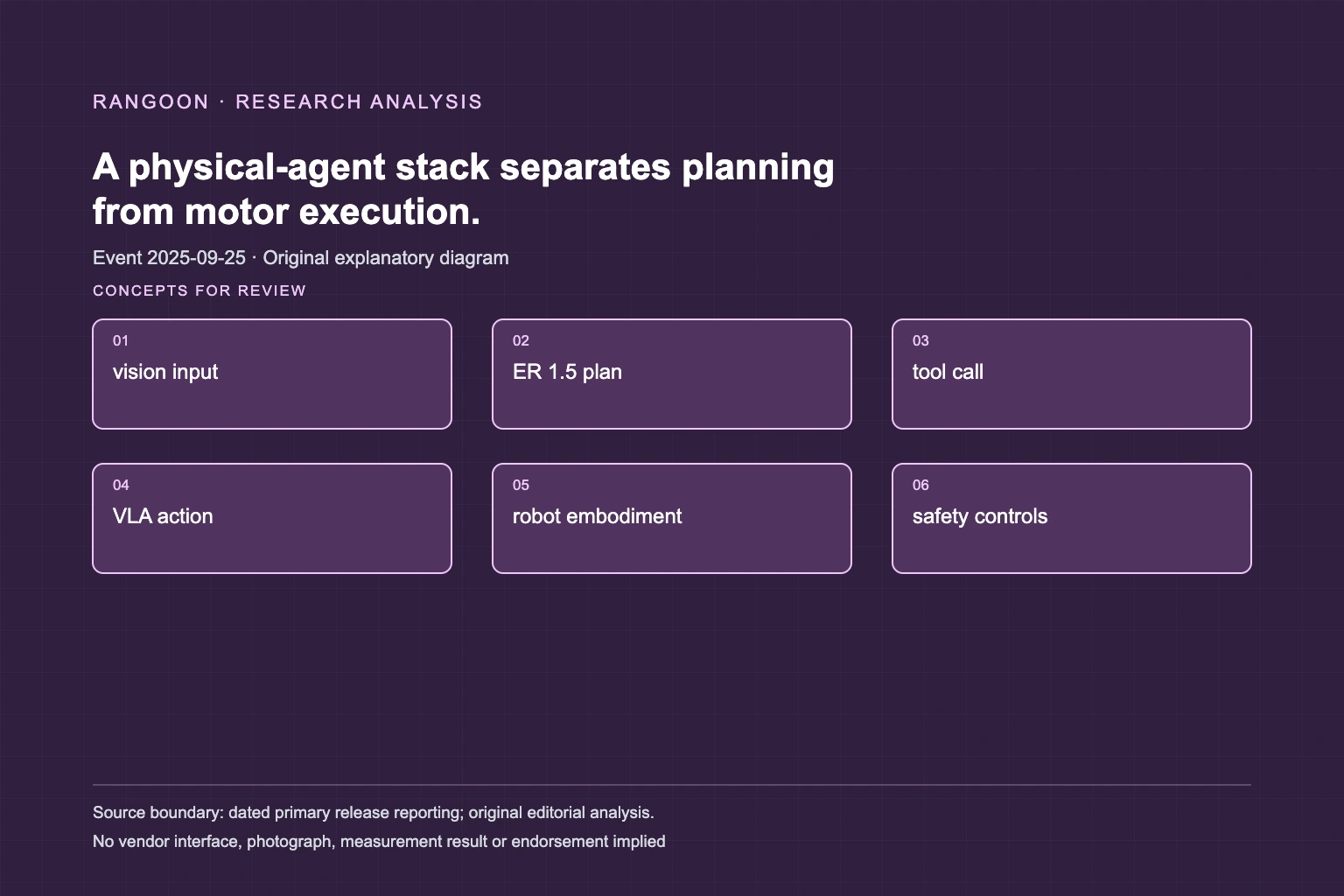
Google DeepMind introduced Gemini Robotics 1.5 on September 25, 2025, pairing a vision-language-action model with embodied reasoning for multi-step robot tasks.
Historical reporting: Google DeepMind introduced Gemini Robotics 1.5 and Gemini Robotics-ER 1.5 on September 25, 2025. Its written launch describes visual instructions flowing to motor commands, natural-language thinking, tool use, and cross-embodiment transfer. The official YouTube metadata is recorded only as creator/title discovery evidence; no video watching, transcript, quote, or thumbnail claim is used. Vendor benchmark and safety statements are not independent deployment proof.
Key takeaways
- Gemini Robotics 1.5 was a VLA model for mapping visual information and instructions to robot actions.
- The paired ER model handled high-level reasoning and tools, leaving physical controllers as a separate safety layer.
- A demo or vendor benchmark does not establish robust behavior for a different robot, site, or task.
The September event introduced two related robotics models[source 1]
Google DeepMind announced Gemini Robotics 1.5 and Gemini Robotics-ER 1.5 on September 25, 2025. The company described the first as a vision-language-action model that turns visual information and instructions into motor commands, and the second as an embodied-reasoning model for planning and tool use. This was a model announcement, not a claim that a finished robot system had reached broad commercial deployment.
The launch page also points readers to a trusted-tester program. Access through a tester program is a distinct state from a public API, an open-weight release, or a shipped consumer robot.
Reasoning and motor control create a division of labor inside a robot stack[source 1][source 2]
A VLA model connects what a robot sees and what a user asks to an action representation. Google said Robotics 1.5 could generate natural-language reasoning before acting and split longer work into shorter executable segments. That can make intermediate intent visible, but it does not remove uncertainty in perception, object state, grasping, or motion execution.
The ER model was presented as a way to reason, plan, and use tools. A practical deployment still needs an interface between that high-level plan and hardware-specific control, including force, balance, collision avoidance, and an emergency stop path.
Transfer across robot bodies is an engineering claim with hardware limits[source 1]
Google reported that skills shown during training on one robot could transfer to other embodiments, naming ALOHA 2, Apollo, and a bi-arm Franka setup. Transfer matters because robots differ in degrees of freedom, cameras, reach, grippers, and controller timing. A motion that is sensible for one body can be unreachable or unsafe for another.
The company’s observed transfer result is useful research evidence under its stated setups. It is not an independent reliability result for a warehouse, home, factory, mobile platform, or a robot with different sensors and actuation.
High-level model reasoning does not replace low-level physical safety systems[source 1][source 2]
Google said its approach combined semantic reasoning with low-level safety subsystems such as collision avoidance. That framing recognizes separate risks: the model can misunderstand a task, while the machine can still collide, drop an object, or exceed a mechanical limit. The launch also described an ASIMOV benchmark upgrade and vendor evaluation results.
Those evaluations and demonstrations do not certify every physical deployment. The September record supports a bounded claim about the two announced models and their stated mechanics, not a guarantee of safe autonomous action around people. A deployment must connect model output to actuator limits, environment sensing, controller checks, and a recovery path after an unexpected contact or failed grasp. That chain needs testing at final robot speed and load under expected field use.
Sources
Continue reading
Related reading
 News analysisGoogle’s Gemini Robotics On-Device put a vision-language-action model on the robot3 min read
 News analysisDeepMind’s SIMA 2 research preview used Gemini to plan and learn in virtual 3D worlds3 min read
 News analysisGoogle put Guided Learning into Gemini with LearnLM-informed study tools3 min read