

Google made Gemini Embedding stable while keeping vector size a retrieval choice
Google made gemini-embedding-001 generally available on July 14, 2025, bringing a stable text-embedding API model with selectable output dimensions to retrieval workloads.
Historical reporting: Google announced general availability of gemini-embedding-001 on July 14, 2025 for the Gemini API and Vertex AI. Google described a text model supporting more than 100 languages, a 2,048-token maximum input length and selectable output dimensions using Matryoshka Representation Learning. Google documentation describes embeddings as representations used for search, classification and clustering. The company’s benchmark and cost statements are supplier materials, not a universal retrieval result.
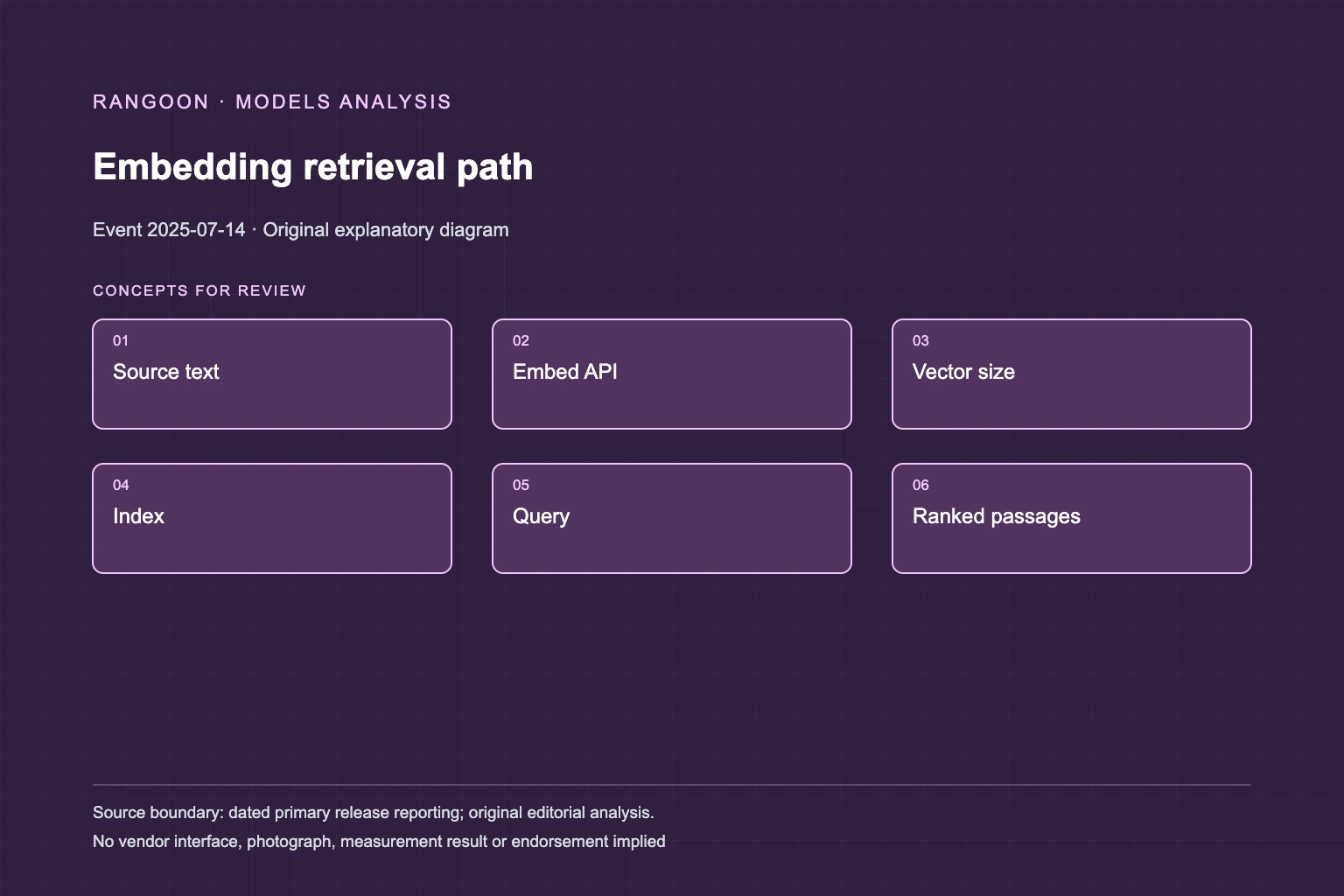
Key takeaways
- The July event moved Google’s Gemini text-embedding model from experimental availability to a stable API release.
- Output dimension was a product setting with storage and quality tradeoffs, not a guarantee of equal retrieval quality.
- Embedding quality still depends on corpus preparation, query design, index settings and a measured task.
General availability changed the release status, not the retrieval problem[source 1][source 2]
On July 14, 2025, Google announced that gemini-embedding-001 was generally available in the Gemini API and Vertex AI. The company positioned it as its first Gemini Embedding text model and said it could support retrieval, classification and related representation tasks. General availability is a concrete product milestone: it tells developers which model identifier and service surface Google had made stable. It does not show that a particular document collection had been embedded, that an application had migrated successfully or that a RAG system produced more accurate answers after switching models.
The release exposed output size as an engineering decision[source 1][source 2]
Google said the model used Matryoshka Representation Learning and allowed dimensions below its default 3,072, recommending several higher-size settings for quality. That describes a useful retrieval design choice: smaller vectors can reduce storage and search cost, while a larger representation can retain more information. It is not a promise that every reduced setting preserves the same ranking on every corpus. A legal archive, code base and customer-support collection can differ in document length, vocabulary, language mix and relevance labels, so the right dimension needs evaluation against the task rather than a generic number.
Language support and input length defined a model boundary[source 1][source 2]
The announcement described support for more than 100 languages and a maximum input length of 2,048 tokens. Those are model-interface facts, not a claim that all languages or document types retrieve equally well. Long files may still need chunking, and a chunking policy changes which passages a search system can retrieve. Google’s documentation also separates embeddings from later retrieval or generation steps: an embedding endpoint returns a representation, while the index, filtering, reranking and answer model remain choices for the application. The July release did not collapse those layers into one managed outcome.
Published rankings were not a substitute for application measurement[source 1][source 2]
Google referred to MTEB results and compared its model with earlier and external offerings. Those figures describe the company’s cited evaluation setup and are useful for seeing what it chose to test. They do not independently establish a ranking on a reader’s corpus, cost after indexing or answer quality in a complete RAG workflow. The stable-release record therefore supports a narrow historical claim: Google made gemini-embedding-001 generally available with stated text, language and dimension characteristics. It does not prove a customer deployment, universal cost advantage or a result for an unreported search workload. The API documentation places embedding beside semantic search, classification and clustering, which reinforces that the vector is an intermediate representation. Relevance still has to be assessed at the retrieval boundary and, where used, at the later answer boundary.
Sources
Continue reading
Related reading
 News analysisWeaviate announced a three-agent suite while keeping availability stages distinct3 min read
 News analysisQdrant Cloud Inference put embedding generation, storage and indexing behind one API call3 min read
 News analysisQdrant 1.13 joined GPU indexing with collection-level operational limits3 min read