Genkit 1.0 made a Node.js AI feature framework generally available
Firebase announced Genkit 1.0 for Node.js on February 12, 2025, stabilizing core AI primitives while keeping agent APIs in a beta namespace.
Historical reporting: Firebase announced Genkit 1.0 for Node.js on February 12, 2025. A Firebase technical article eight days later shows a concrete Genkit-based structured-data workflow. Neither source establishes current service availability or a production outcome for a downstream application.
Key takeaways
- Genkit 1.0 stabilized Node.js primitives while some agent APIs remained beta.
- The framework combined generation, structured output, tools, retrieval and local inspection.
- A deployment record needs its provider plugins, flow inputs, output schema and evaluation set.
Firebase drew a stable boundary around the Node.js framework[source 1][source 2]
Firebase announced Genkit 1.0 for Node.js on February 12, 2025, after the framework’s 2024 preview. The release described an open-source framework for AI-powered features and identified a unified generation API, structured generation, tool and function calling, vector search, a CLI, local Developer UI, and production monitoring when deployed with Firebase or Google Cloud. Crucially, the announcement said the Node.js framework was production-ready while Go remained alpha, and described chat, session state, and multi-agent APIs as beta work. That language established a specific stability boundary rather than a blanket maturity claim for every Genkit package or language.
Flows connected provider calls to inspectable application work[source 1][source 2]
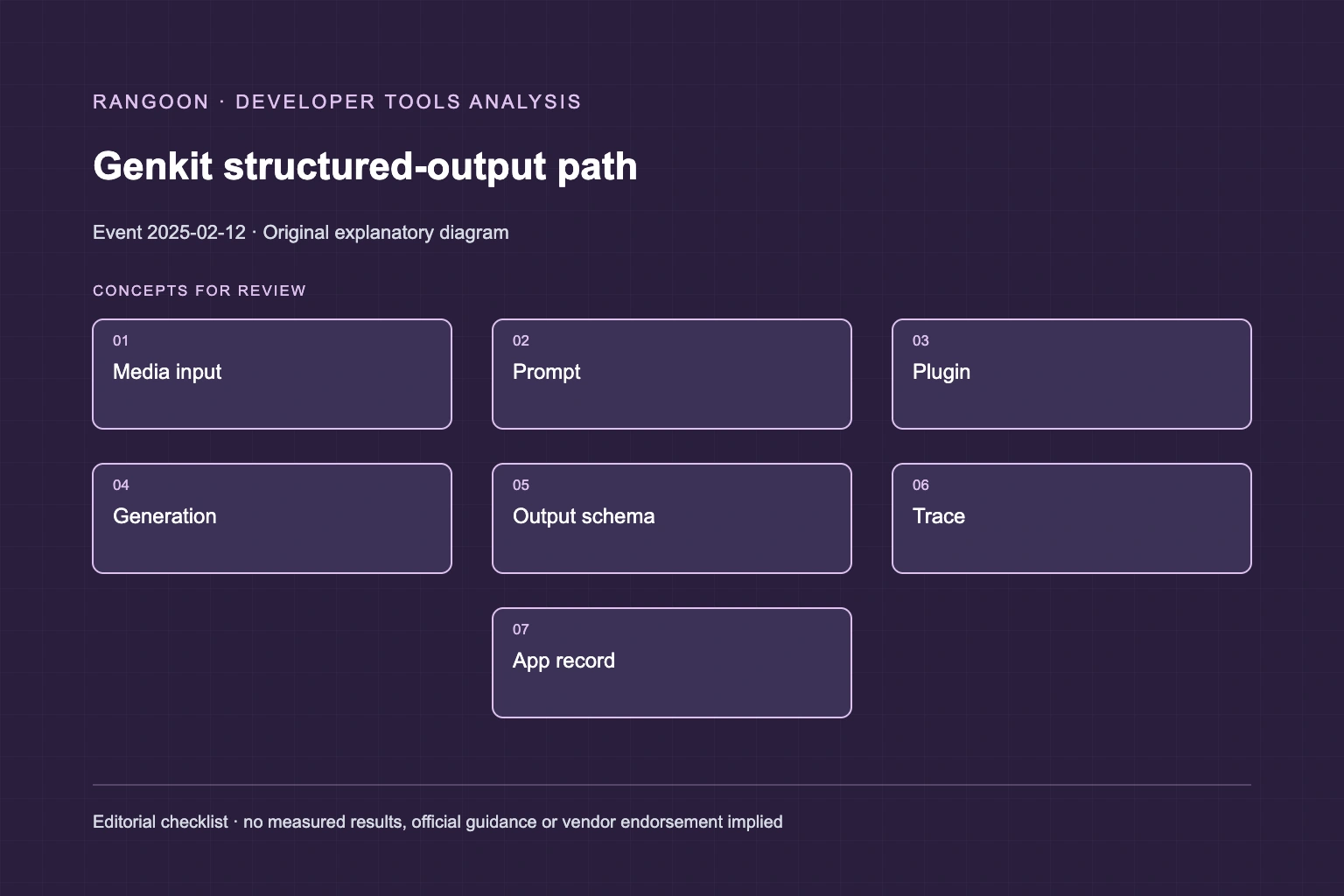
Genkit’s architecture placed model calls inside an application-oriented layer of plugins, flows, prompt definitions, schemas, traces, and evaluation tools. The companion Firebase article from February 20 demonstrated a Node.js command-line workflow that passed a PDF URL and extraction instruction through Genkit’s generation API, then returned structured output. It is a useful dated technical example because it shows the framework operating between multimodal input and application data, rather than only describing a feature list. The example does not show that an extracted invoice field is accurate. A generation result still requires the output schema and the domain’s own validation before it becomes a record a product can use.
The stable API line made plugin and output choices more important[source 1][source 2]
A Genkit 1.0 implementation needed to name more than the framework version. Its technical behavior depended on the chosen model plugin, a default model, prompt and flow definitions, tool implementations, input media handling, output schema, and the storage or telemetry path around the run. The GA announcement’s division between stable core primitives and beta agent APIs gave teams a reason to keep those dependencies separate in their release notes. A useful test set would include valid and malformed documents, missing media, incomplete model outputs, and known expected extractions. That turns the framework’s trace and evaluation facilities into evidence about the actual workflow instead of treating them as a general accuracy guarantee.
The event was a framework-stability announcement, not a model result[source 1][source 2]
Genkit 1.0 is best understood as a point at which Firebase made a Node.js foundation for AI features available under a stable release label. Its value was compositional: a developer could put model access, retrieval, tool calls, structured output, local inspection, and monitoring in one application framework while retaining choices about providers and deployments. The later PDF example illustrates one such composition, not a universal pattern. Historical reporting should retain the release date, language, package channel, selected plugins, input modality, schema, and trace identifier when available. It should separately state whether a flow used a stable entrypoint or a beta namespace. That distinction helps a later reader interpret which compatibility promise applied to the flow. The February sources do not prove that Genkit has a particular current API, that every beta agent pattern later stabilized, or that a document-extraction workflow reaches production-grade accuracy.
Sources
- Firebase: Announcing Firebase Genkit 1.0 for Node.js (February 12, 2025)
- Firebase: Extracting structured data from PDFs using Gemini 2.0 and Genkit (February 20, 2025)
Continue reading