

Google released MedASR as a 105M medical-dictation speech-to-text foundation model
Google’s MedASR release artifact records December 18, 2025 for a 105-million-parameter Conformer model built for medical speech transcription and adaptation.
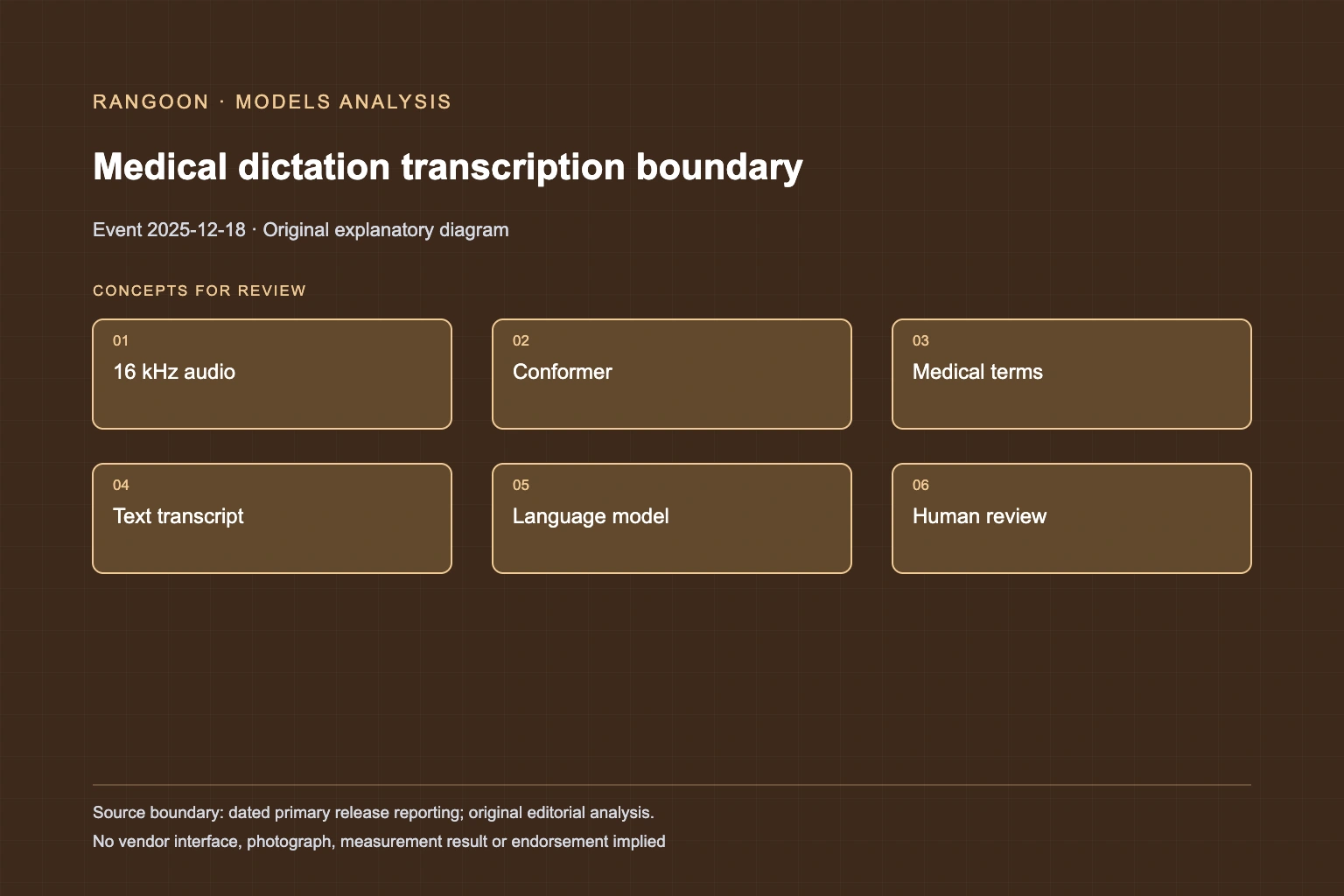
Historical reporting: Google’s MedASR release artifact records model creation on December 18, 2025. Google’s January 13, 2026 MedGemma 1.5 post is later context for pairing MedASR with MedGemma and is not treated as proof of a December feature. The December artifact establishes a 105M Conformer speech-to-text model, 16 kHz mono audio input, text output and stated limits; it does not establish transcription correctness, clinical-document accuracy, diagnosis or care guidance.
Key takeaways
- MedASR converted specified audio inputs to text and could feed a separate language-model stage.
- Its 105M Conformer architecture and 16 kHz mono waveform contract made audio capture part of system quality.
- Reported dictation benchmarks and safety review did not eliminate transcription or downstream interpretation error.
The December release artifact introduced a medical speech-to-text component[source 1][source 2]
Google’s MedASR release artifact records model creation on December 18, 2025. The associated Google model card describes MedASR as a 105-million-parameter Conformer model for medical dictation, with mono-channel 16 kHz int16 waveform input and text-only output. That input and output contract matters because MedASR is a transcription component, not a general multimodal assistant. A system may place a language model after transcription, but that later reasoning stage is a separate model boundary with its own prompt, context and error behavior.
Audio quality and vocabulary coverage remained part of the result[source 1]
The model card says MedASR was trained on a corpus of de-identified physician dictations and is intended for medical terminology such as radiology dictation. It also lists limits around English language coverage, speaker diversity, microphone quality, newer terminology and temporal data. Those details show why speech recognition cannot be evaluated only by a single average word-error rate. Recording quality, accents, specialty vocabulary, background noise and the way dates or dosages are spoken can all change the transcription. A downstream application needs to preserve the audio and review path for important text instead of treating the emitted string as an automatically verified record.
Connecting MedASR to a generative model created two separable error paths[source 1][source 2]
Google’s later MedGemma 1.5 post said MedASR can pair with MedGemma for advanced reasoning tasks. Its own model documentation describes the immediate contract more narrowly: MedASR converts speech to text, which can become input for a text-to-text response. That is useful to understand as a pipeline, not as one combined model. Speech recognition can mishear a term, number or medication name; a later language model can then misinterpret even a correct transcript or add unsupported text. Retain the raw audio, transcript, model versions, prompt and review correction so a later reader can locate the stage where an error originated.
Google’s reported dictation scores were not a claim of universal transcription accuracy[source 1][source 2]
Google compared MedASR with other systems on named medical-dictation datasets and described internal safety evaluation around transcription errors. These are provider-reported measurements on particular data and decoding settings, not a guarantee for every clinician, microphone, specialty or use context. The model card also says the output is not intended to directly inform diagnosis, patient management or treatment recommendations and calls for validation and meaningful adaptation. The supported historical claim is the December release of a medical-dictation foundation model and its stated contract. It does not establish that any record is correct or that a combined transcription-and-generation workflow is safe for direct clinical use. Word error rate alone can also hide whether the changed word is medically material, so task review cannot end with one aggregate metric.
Sources
- Google on Hugging Face: MedASR release artifact and model card (December 18, 2025)
- Google Research: MedGemma 1.5 and MedASR announcement (January 13, 2026)
Continue reading
Related reading
 News analysisGoogle introduced MedGemma at I/O as an open starting point for medical text and image work3 min read
 News analysisOpenAI released HealthBench for rubric-based evaluation of health conversations3 min read
 News analysisNVIDIA positioned Parakeet v2 as an English speech-recognition research model, not a universal transcription result3 min read