

Google introduced MedGemma at I/O as an open starting point for medical text and image work
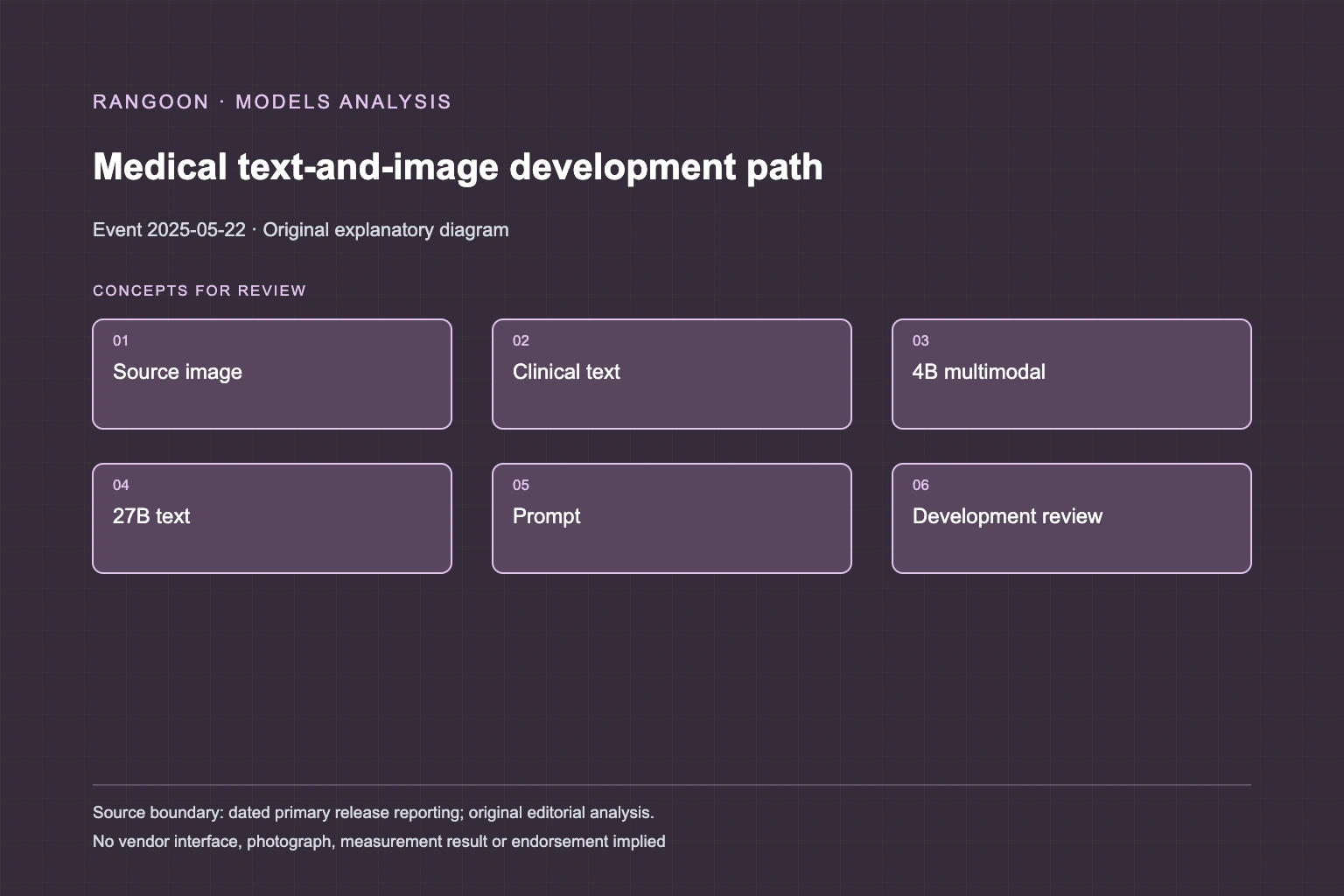
Google announced MedGemma on May 22, 2025, describing Gemma 3-based 4B multimodal and 27B text models for developers researching medical text and image applications.
Historical reporting: Google Research announced MedGemma at I/O on May 22, 2025 and described available 4B multimodal and 27B text-only variants. The later maintained MedGemma documentation clarifies family architecture and development boundaries, but is not treated as proof of every May launch detail. The sources describe developer starting points and baseline evaluations, not clinical approval, diagnosis, treatment, or deployment outcomes.
Key takeaways
- MedGemma separated a smaller multimodal variant from a larger text-oriented variant.
- Images and clinical text were model inputs for research and development, not independently verified medical records.
- Open weights and baseline scores did not remove the need for task-specific adaptation and validation.
The May I/O announcement framed MedGemma as a developer starting point[source 1]
Google Research announced MedGemma on May 22, 2025 during I/O. Its release described the family as an open model for multimodal medical text and image comprehension, naming a 4B model and a 27B text-only model available through the Health AI Developer Foundations collection. The announcement said the family was intended to help developers build health applications and gave examples such as radiology-image analysis and clinical-data summarization. Those examples establish a research and product-development scope; they do not show a finished system making a correct diagnosis or taking responsibility for a medical decision.
Model size and modality changed what an application could submit[source 1][source 2]
MedGemma’s family design mattered because input modality defines the application boundary. A multimodal model can receive an image together with text, while a text-only variant cannot reconstruct visual evidence that was never supplied. The maintained documentation describes Gemma-derived components and medical text and image comprehension, including the use of an image encoder for multimodal variants. In practice, an image file, any associated prompt, and the preprocessing applied before inference are all part of the evidence path. A generated explanation is therefore not a substitute for preserving the original source material and the context in which it was produced.
A benchmark baseline did not settle a downstream use case[source 1][source 2]
Google said MedGemma showed baseline clinical-knowledge and reasoning performance similar to larger models on MedQA, and its documentation describes evaluation on clinically relevant benchmarks. A benchmark is useful for comparing a model under a stated task and scoring method, but it does not represent every image quality, documentation style, patient population or workflow. The model card says developers are expected to adapt and fine-tune for their intended use. That matters technically because a downstream system may add retrieval, image handling, structured records and human review, each of which can introduce errors or change the question that reaches the model.
The release was not evidence of clinical validity or approval[source 1][source 2]
The announcement and model documentation describe a family of models, availability paths and baseline capabilities. They do not certify a hospital workflow, validate an output against a particular case, or authorize direct use in diagnosis, patient management or treatment. Medical models also have a specific problem of representation: a text extract can omit timing or context, while an image can be cropped, compressed or paired with an incomplete prompt. The historically supported fact is the May introduction of MedGemma as an open developer family. Claims about real-world accuracy, safety, clearance or care outcomes require separate evidence tied to the exact application, data and review process. Availability through a model hub identifies a distribution path; it does not document an organisation’s configuration, input controls or review practice.
Sources
Continue reading
Related reading
 News analysisMedGemma 1.5 expanded a 4B model toward volumes, slides and longitudinal imaging inputs3 min read
 News analysisGoogle released MedASR as a 105M medical-dictation speech-to-text foundation model3 min read
 News analysisOpenAI released HealthBench for rubric-based evaluation of health conversations3 min read