

Granite 3.2 made reasoning mode a route-level choice
IBM released Granite 3.2 on February 26, 2025 with controllable experimental reasoning and a model card for the 8B instruction artifact, making route policy observable.
Historical reporting: IBM’s February 26, 2025 announcement records the Granite 3.2 launch and describes experimental reasoning controls; the 8B Instruct model card records the released artifact, lineage, and stated capability. IBM-reported benchmark comparisons are vendor claims under their stated methods, not local performance measurements.
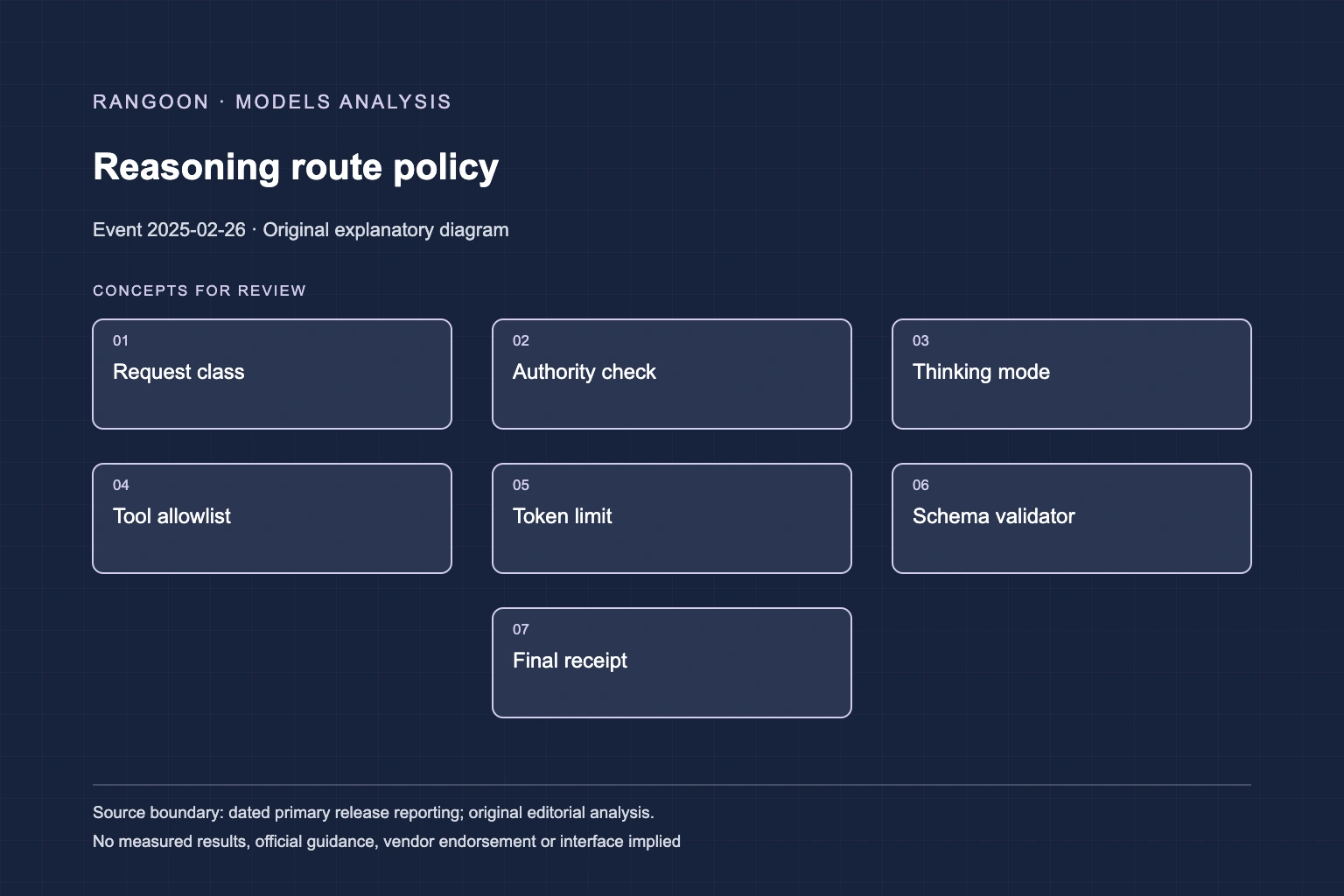
Key takeaways
- Granite 3.2 framed reasoning as a controllable inference path instead of an invisible family-wide default.
- A route must record whether thinking was enabled, because the setting can alter output form, latency, token use, and evaluation comparability.
- Vendor benchmark statements cannot replace tests of a product’s schemas, evidence use, approvals, or time budget.
The February release combined reasoning, vision, and smaller safety models[source 2]
On February 26, 2025, IBM announced Granite 3.2 as a family update with 2B and 8B Instruct models featuring experimental chain-of-thought capabilities that could be switched on or off. The announcement also named Granite Vision 3.2 2B for document understanding, revised Guardian models, sparse embeddings, and updated TinyTimeMixers. IBM described benchmark outcomes for its own models, including instruction-following and math-reasoning comparisons. Those figures establish what IBM reported under its named evaluation methods, prompts, and scoring conditions; they do not measure another application, tool route, user population, latency budget, change-control policy, or route-specific system prompt.
The model card ties the 8B release to Granite 3.1[source 1]
The Granite-3.2-8B-Instruct card identifies an 8-billion-parameter long-context model built on Granite-3.1-8B-Instruct and fine-tuned for thinking capabilities. It says the model used a mixture of permissively licensed open-source data and internally generated synthetic reasoning data, and it describes thinking as controllable when required. The card also lists general instruction following, retrieval-augmented generation, function calling, and long-context tasks among its capabilities. That description is useful for selecting a test candidate, but it leaves a deployer responsible for validating the exact revision, runtime, chat template, output handling, tool schema, artifact configuration, and user task.
A reasoning toggle belongs in a testable routing contract[source 1][source 2]
Granite 3.2 made the reasoning capability optional, so the technical question is which tasks actually earn that path. A route can select it only when the task and time allowance fit, rather than applying it to every query that reaches the family. Enabled and disabled modes need the same prompt, sources, output contract, and tool permissions; otherwise a change in the surrounding route can be mistaken for a benefit from thinking. The result is a visible product choice whose latency, token use, and answer form can be compared after an artifact or routing change. For a multi-step request, that comparison can show whether added deliberation produces a better-grounded final field or only a slower duplicate of the direct route under the same evidence and authority rules.
Reasoning output cannot substitute for action evidence[source 1][source 2]
For a tool workflow, the relevant test is not whether a thinking response looks persuasive. Give each mode the same evidence-based task, a missing-source task, and a request that cannot proceed without approval, then compare the final answer, tool request, and stated uncertainty. If the reasoning route reaches a different result, the record should reveal whether it used stronger evidence or simply spent a different token and time budget. IBM’s release establishes a controllable option; only route-specific cases show whether that option changes a decision without changing the authority boundary.
Sources
- IBM Granite: Granite-3.2-8B-Instruct model card (February 26, 2025)
- IBM: Granite 3.2: reasoning, vision, forecasting and more (February 26, 2025)
Continue reading
Related reading
 News analysisNASA and IBM launched a lunar foundation model with code and model access for science work3 min read
 News analysisIBM released Granite-Docling-258M as a compact document-conversion VLM3 min read
 News analysisIBM and NASA opened Surya for heliophysics research, with a NASA technical record of its solar inputs3 min read