

NASA and IBM launched a lunar foundation model with code and model access for science work
NASA and IBM launched a lunar science foundation model on September 10, 2026, trained primarily on Lunar Reconnaissance Orbiter data and released with code.
Historical reporting: NASA announced on September 10, 2026 that it and IBM had launched a lunar foundation model trained primarily on Lunar Reconnaissance Orbiter data. IBM’s same-day technical account documents the joint release and public model, code and data materials. The sources establish a research-model release; they do not establish autonomous spacecraft operation, a mission-critical flight deployment, geological truth for every model output, or a validated planetary decision system.
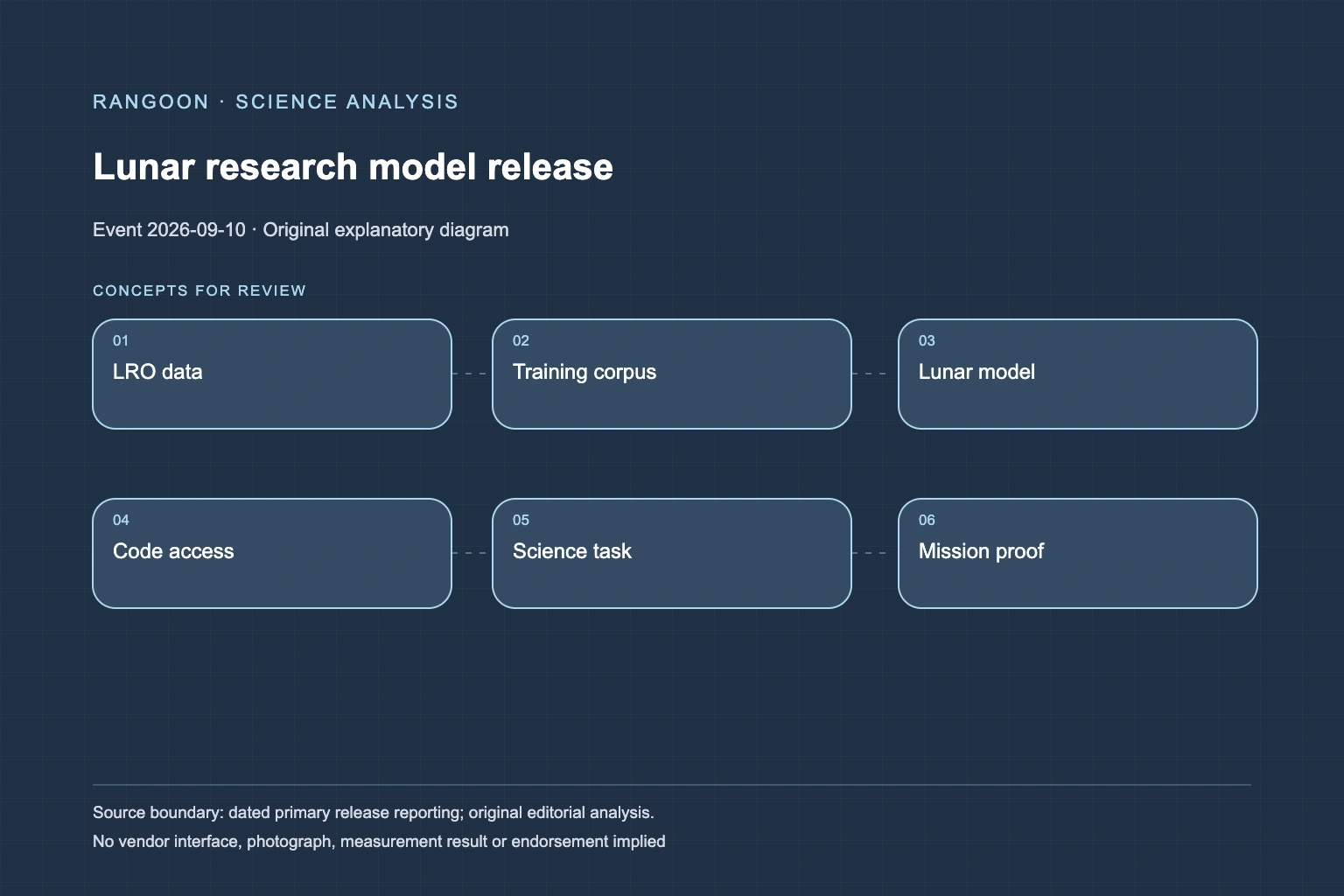
Key takeaways
- NASA and IBM released a lunar foundation model with public technical materials.
- NASA says training relied primarily on Lunar Reconnaissance Orbiter data.
- Research-model availability is distinct from autonomous mission use or scientific validation of each output.
NASA framed the launch as a lunar-science model release, not a spacecraft control system[source 1][source 2]
NASA announced on September 10, 2026 that it and IBM had launched an AI foundation model for lunar science. NASA says the model was trained primarily on data from the Lunar Reconnaissance Orbiter and made available through public model and code channels. This is a defined scientific-AI release: it provides a model intended to help researchers work with lunar observations. It is not an announcement that the model flies a spacecraft, selects a landing site without review, or establishes scientific facts automatically. Lunar data analysis still depends on instruments, geospatial context, reference measurements and expert interpretation. The release is therefore best understood as infrastructure for research and experimentation. The source does not claim that a model output alone replaces planetary-science methods or mission decision authority.
Public code and model materials make the release inspectable, but not automatically reproducible for every use[source 1][source 2]
NASA points readers to a public model page and code repository, while IBM describes a related technical report and dataset materials. This access is significant because it gives scientific users a route to inspect and adapt the work. It does not mean every user will obtain the same results. Reproduction depends on the exact data preparation, software environment, model version, task framing and evaluation procedure. A model trained primarily on Lunar Reconnaissance Orbiter data may be useful for many research questions while still needing separate validation when paired with another instrument or scientific objective. Neither source supplies a universal accuracy score across lunar terrain, lighting, geographic region and analysis task. The archive records the release of tools and materials, while leaving any application-level claim to later evidence.
A foundation model can organize evidence without becoming the evidence itself[source 1][source 2]
Foundation models can help researchers find patterns or produce representations from large collections of observations. That potential does not alter the difference between a model inference and a scientific conclusion. A researcher must still compare outputs with observations, quantify uncertainty and test whether an apparent pattern survives alternative explanations. NASA’s release describes a model for lunar science, but it does not present a complete validation catalogue for every possible geological interpretation. The sources also do not state that the model is calibrated for operational navigation, hazard clearance or mission planning. Keeping those boundaries clear protects the historical record from a false escalation: open scientific tooling expands research options, yet it does not supply a substitute for mission assurance or domain review.
The announcement establishes access and collaboration, not a completed mission outcome[source 1][source 2]
The September event is supported by two aligned primary records from NASA and IBM. Together they establish the release, the stated Lunar Reconnaissance Orbiter data emphasis, and public access to associated artefacts. They do not establish that another NASA programme deployed the model in a flight system, achieved a new discovery because of it, or accepted its output for a safety-critical decision. No source offers a spacecraft operations log, a planetary-protection assessment or a benchmark that covers all anticipated lunar applications. The archive can accurately state that a jointly developed model entered the public research ecosystem. Claims about its eventual scientific or operational value must be tied to later task-specific studies or mission records rather than inferred from launch-day availability.
Sources
- NASA: NASA, IBM Launch AI Foundation Model for Lunar Science (September 10, 2026)
- IBM Research: A rough guide for going back to the Moon (September 10, 2026)
Continue reading
Related reading
 News analysisIBM and NASA opened Surya for heliophysics research, with a NASA technical record of its solar inputs3 min read
 News analysisIBM released Granite-Docling-258M as a compact document-conversion VLM3 min read
 News analysisUltralytics released YOLO26 with optional NMS-free real-time vision inference3 min read