

Jina’s v4 release combined text-image embeddings with dense and late-interaction outputs
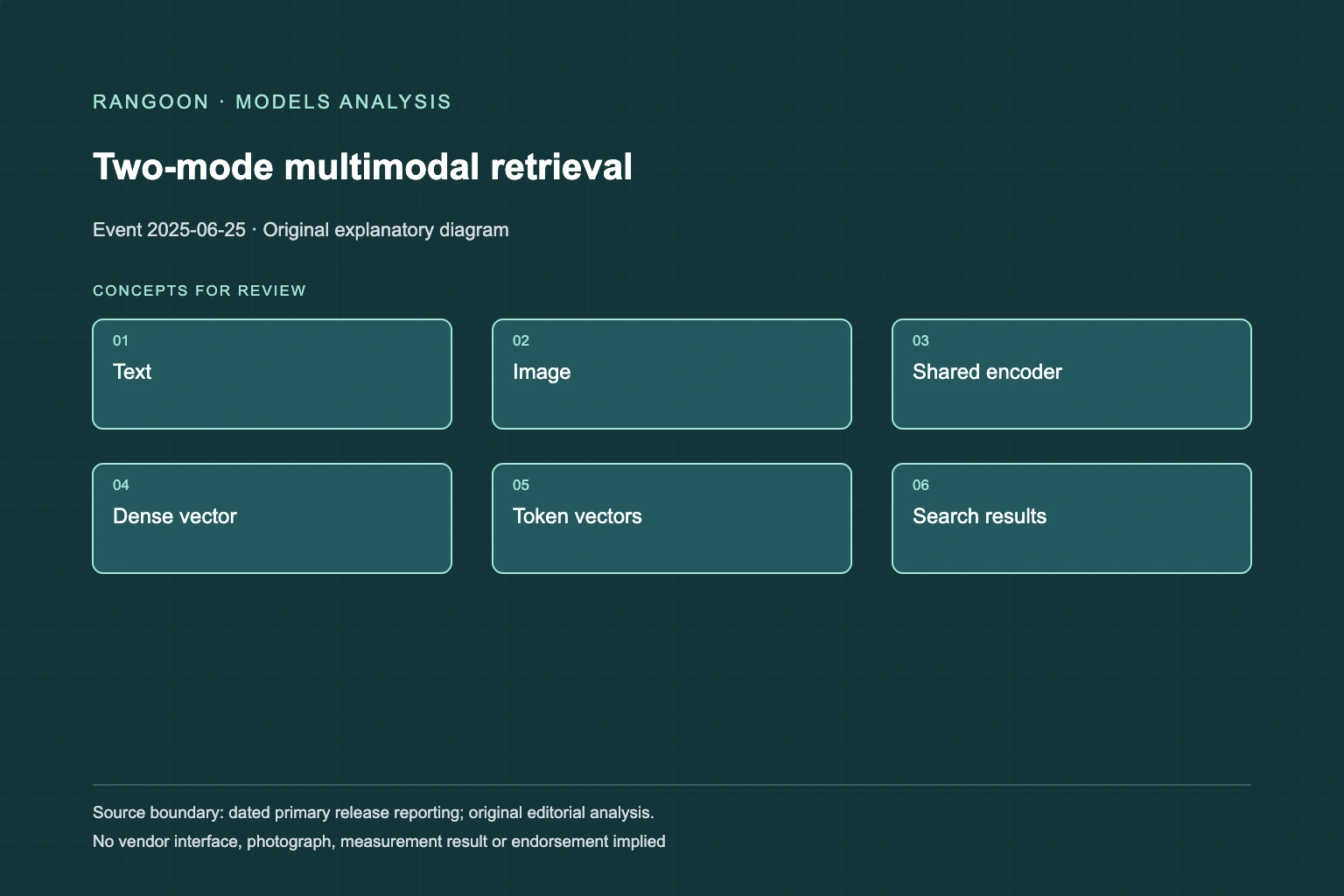
Jina released jina-embeddings-v4 on June 25, 2025, pairing unified text-image representations with single-vector and multi-vector retrieval output modes.
Historical reporting: Jina announced jina-embeddings-v4 on June 25, 2025 as a 3.8-billion-parameter model for multimodal and multilingual retrieval. Jina described text and image inputs, task-specific LoRA adapters, a 32,768-token native context and dense or late-interaction outputs. A direct model record supplies artifact context and lists June 24 as its own release date; it does not change the June 25 announcement date. Jina’s benchmark comparisons are supplier-published results, not proof that a particular customer’s documents, hardware or index achieved them.
Key takeaways
- Jina’s release joined text and image retrieval in one model family while preserving two output styles.
- Dense and multi-vector outputs represented different index-cost and matching-detail choices.
- Benchmark statements did not establish performance on a customer’s visually rich documents or production retrieval stack.
Jina released a multimodal model rather than a finished document-search system[source 1][source 2]
On June 25, 2025, Jina announced jina-embeddings-v4 as a universal embedding model for text and images. It described a 3.8-billion-parameter system with adapters for retrieval, semantic matching and code search. That records a model launch and its intended input types. It does not show that a user had indexed a particular set of reports, charts or screenshots, nor that a downstream answer system had grounded a response correctly. Embeddings create representations; extraction, chunking, metadata, vector search and reranking remain separate parts of a retrieval product.
Single-vector and multi-vector modes made a retrieval tradeoff explicit[source 1][source 2]
Jina said v4 could produce a single dense vector or multiple token-level vectors for late interaction. A single-vector index can be simpler and smaller, while late interaction preserves more local matching detail at the cost of storing and comparing more vectors. Neither form is automatically better for every collection. A document-heavy system needs to consider query volume, languages, image quality, memory budget, response latency and relevance labels. The announcement identified both modes; it did not publish a universal sizing rule or a customer result that settles the tradeoff.
Unified input did not remove document-preparation choices[source 1][source 2]
The release described a shared path for text and images and a native 32,768-token context, while Jina’s API material noted a smaller hosted-input limit at the time. These are separate facts: a model’s architecture, a service limit and an application’s document preparation are not interchangeable. A PDF with tables, OCR errors and figures can be passed as text, images or a combination, with different retrieval consequences. The June launch supports Jina’s stated capability direction. It does not prove that every visual document is represented accurately or that a deployment can skip extraction quality checks.
Supplier benchmark comparisons needed their published conditions[source 1][source 2]
Jina published comparisons across retrieval and visual-document benchmarks and described particular strengths on visually rich material. Those results are useful as disclosed supplier measurements, but they depend on Jina’s datasets, prompts, output mode and evaluation protocol. They do not independently prove a ranking for another model, a private enterprise corpus or a different index implementation. The historical claim here is limited to the June 25 announcement and its stated model design. It does not turn vendor benchmark language into a broad conclusion about document-search accuracy, runtime cost or customer deployment. Jina also described task-specific adapters for query-document retrieval, semantic matching and code search. Those stated specializations make task selection part of the evaluation question instead of evidence that one output setting wins across all retrieval work. The direct model record supplies artifact context and displays its own June 24 date, while the announcement remains the source for this article’s June 25 event date.
Sources
Continue reading
Related reading
 News analysisVoyage’s 3.5 embedding release put dimensions and quantization beside retrieval scores3 min read
 News analysisNVIDIA’s Llama-Embed-Nemotron-8B paper documented an instruction-aware multilingual retriever3 min read
 News analysisJina released jina-reranker-v3 as a 131K-context listwise reranker using last-but-not-late interaction3 min read