

NVIDIA’s Llama-Embed-Nemotron-8B paper documented an instruction-aware multilingual retriever
NVIDIA researchers published Llama-Embed-Nemotron-8B on November 10, 2025, describing an open-weights text embedding model for multilingual retrieval and related tasks.
Historical reporting: NVIDIA-affiliated authors published the Llama-Embed-Nemotron-8B technical report on November 10, 2025. The report describes an instruction-aware text model derived from Llama 3.1 8B with bidirectional attention and evaluates it on MMTEB. NVIDIA’s model card records an earlier October 21 weights release, intended use and research-only license status; that earlier artifact release is not the November paper event. The paper’s leaderboard position is dated to its reported evaluation point and does not establish later rankings, commercial availability or a customer deployment.
Key takeaways
- The November paper documented an open-weights, instruction-aware text retriever and its training choices.
- Its reported MMTEB ranking was a time-bound benchmark observation rather than a permanent market result.
- Research-only terms and model-card guidance limited what the release established about production use.
The November event was a technical publication, not the weights release[source 1][source 2]
On November 10, 2025, NVIDIA-affiliated authors posted the Llama-Embed-Nemotron-8B technical report. The paper describes a text embedding model for retrieval, classification and semantic textual similarity. NVIDIA’s model card records that the weights had been released earlier, on October 21. This November event is therefore a technical-publication milestone that documents methods and reported evaluations, rather than a new weights-release claim. It does not establish that the model was a commercial service, that a customer had operated it in production or that a retrieval application achieved a particular result after integrating the model.
Bidirectional attention and instructions targeted text-retrieval behavior[source 1][source 2]
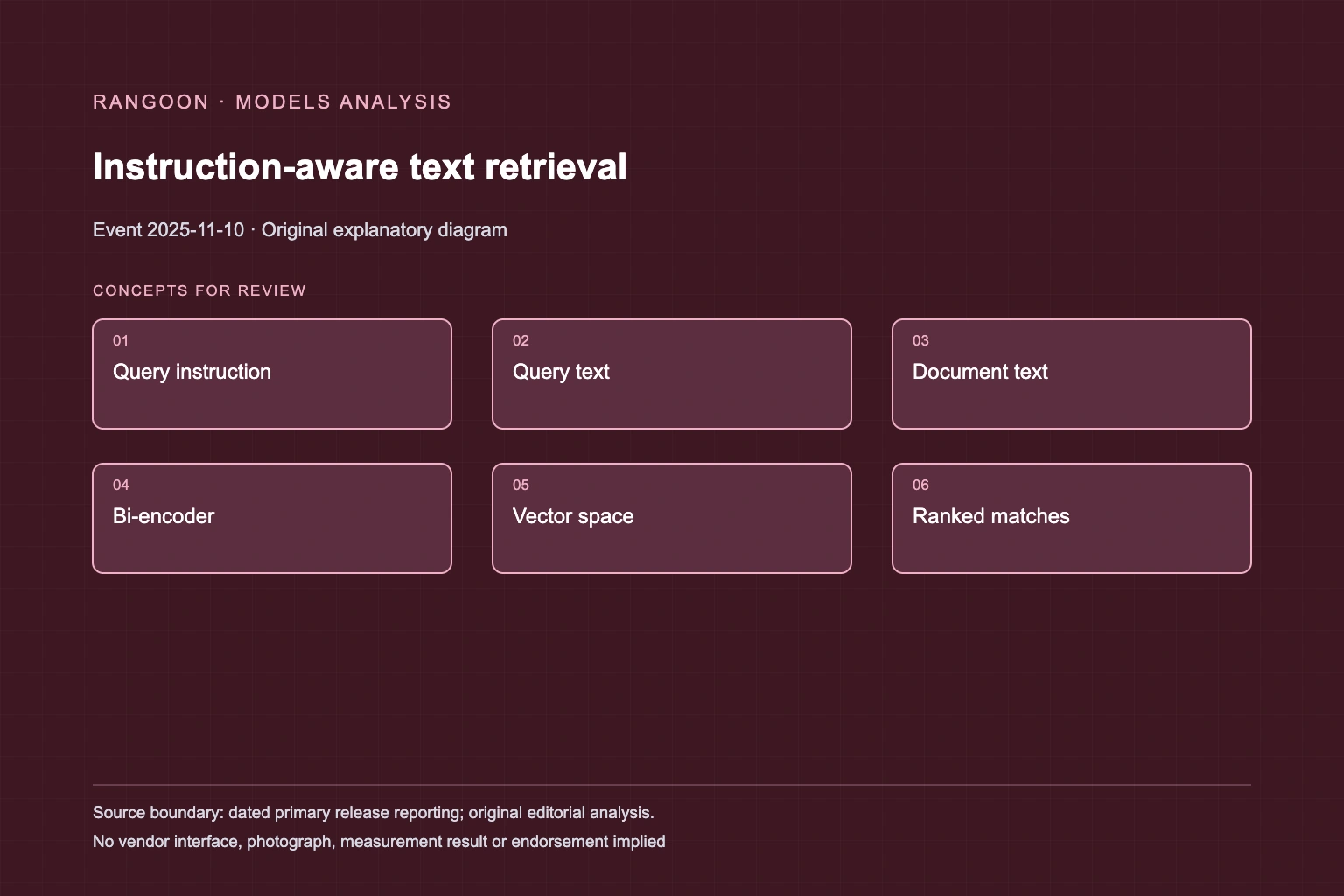
The paper says the authors began with Llama 3.1 8B and replaced causal attention with bidirectional attention for embedding use. It also describes task-specific instructions for queries, while documents do not receive the same prefix. These are architectural and input-format choices aimed at representation learning. They do not eliminate the need to select a query instruction, normalize documents or test language coverage. A model can encode text well in a reported benchmark and still behave differently with short support tickets, long filings, code snippets or domain-specific vocabulary.
The reported multilingual ranking belonged to a stated evaluation date[source 1][source 2]
The report placed the model first on the MMTEB leaderboard as of October 21, 2025 and supplied aggregate scores across its stated tasks. The date matters: leaderboards change when models, datasets, implementations and scoring rules change. The paper’s numbers are evidence of the authors’ reported evaluation, not a permanent rank or an independent guarantee for every language. A retrieval buyer still needs to test its own queries and judgments, especially where low-resource languages, transliteration or document formatting dominate the workload.
Earlier open weights did not mean unrestricted production use[source 1][source 2]
NVIDIA’s model card records an October 21 weights release, labels the model research-only and links governing terms alongside the report, training data and code. That is an operational boundary, not a minor footnote. A team considering the earlier artifact must distinguish access to weights from license terms, hosting requirements, model safety review and its own data-handling controls. The November paper documents the model’s stated retrieval design; it does not newly release the weights or support claims of general commercial availability, legal fitness for a particular use or measured performance in an undisclosed enterprise environment. The paper reports a 512-token maximum for both query and document inputs during its listed training setup. That technical detail does not override a deployment’s own truncation or chunking decisions, which can materially affect retrieval behavior. The model card also distinguishes retrieval, reranking, similarity and classification as stated uses, so one benchmark position does not define suitability for all four tasks.
Sources
Continue reading
Related reading
 News analysisVoyage’s 3.5 embedding release put dimensions and quantization beside retrieval scores3 min read
 News analysisNVIDIA Riva 2.18 added Canary NIM options for offline multilingual speech work3 min read
 News analysisNVIDIA released Parakeet-TDT-0.6B-v3 for 25-language speech-to-text3 min read