

Kyutai released Hibiki’s French-to-English voice-translation research artifacts with a narrow language boundary
Kyutai’s February 6, 2025 release described Hibiki as French-to-English speech translation with voice preservation; it did not establish broader coverage or deployment outcomes.
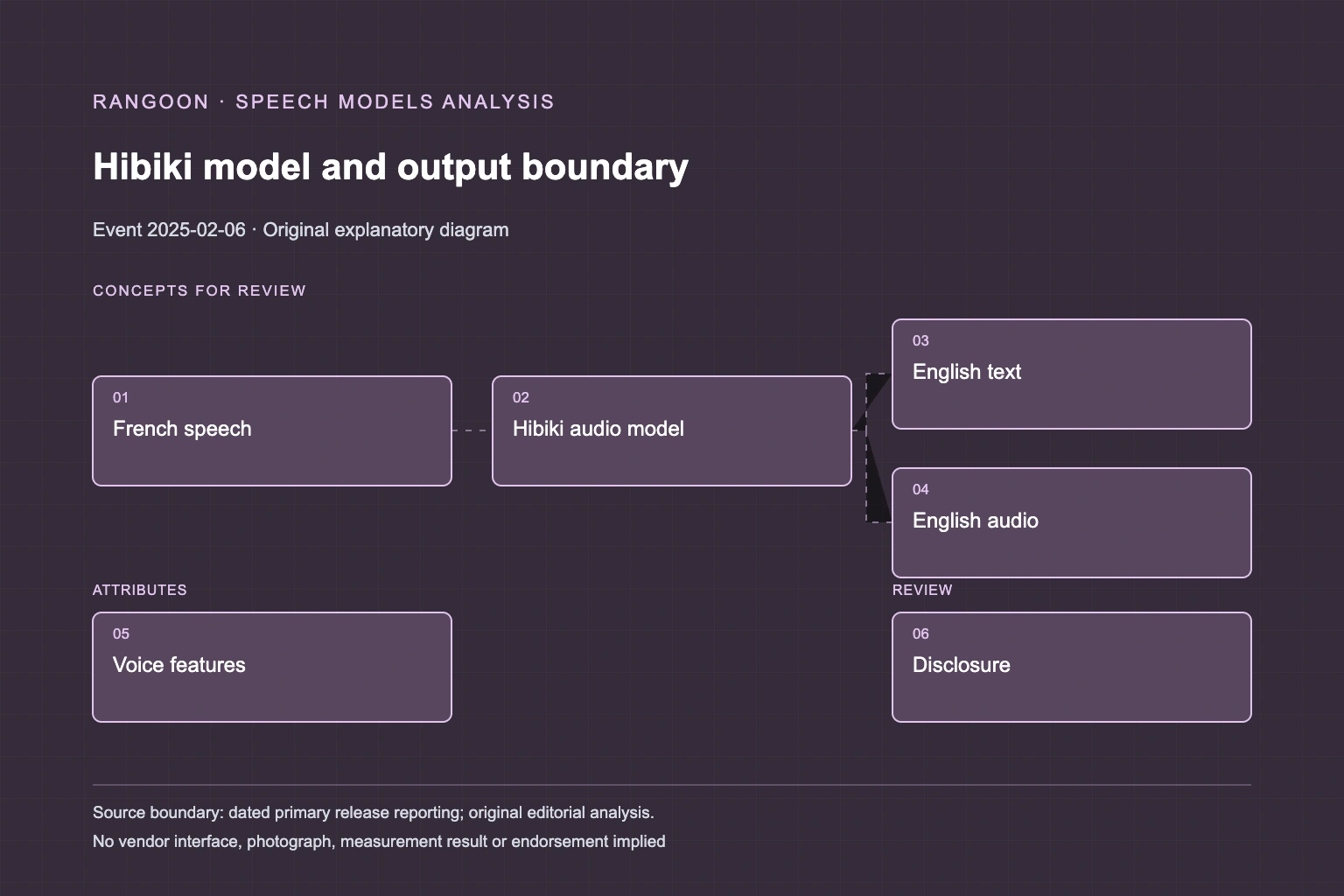
Historical reporting: Kyutai’s February 6, 2025 press release says it released Hibiki, a speech-to-speech translation model trained for French-to-English translation, alongside inference code, weights for that language direction and a technical report. The release describes real-time oral and written output, speaker-voice preservation and potential batched or on-device use. Its state-of-the-art, fidelity, naturalness and deployment statements are Kyutai’s own claims. The source does not establish support for other directions, accuracy for a live conversation, consent to preserve a speaker’s voice or readiness for a particular product.
Key takeaways
- Kyutai’s dated release is specifically about French-to-English simultaneous speech translation and its accompanying research artifacts.
- Oral translation, written translation and speaker-characteristic preservation are separate outputs that need separate acceptance tests.
- Voice-preservation language does not prove identity, consent, accuracy or safe use in a consequential conversation.
The February release names one translation direction and its public artifacts[source 1]
Kyutai’s February 6, 2025 press release introduced Hibiki as an audio model targeting simultaneous speech-to-speech translation. The release says the model was then trained for French-to-English translation and that Kyutai shared inference code, weights for the French-to-English model and a technical report. Those details define both the event and its boundary. A public research release can allow others to examine, run or extend an artifact, but it does not mean every language pair, accent, device or service path is covered by the released model. The correct historical claim is therefore not that Hibiki solved speech translation generally. It is that Kyutai published a specific French-to-English research model and described associated materials on that date.
Simultaneous oral and written output creates more than one verification path[source 1]
Kyutai said Hibiki produced both an oral translation and a written one in the target language, while adapting pace to source semantic content. A system with those outputs should not assume they are interchangeable records. A written rendering can be reviewed, searched and corrected differently from a spoken rendering delivered while a conversation continues. Timing can also change the listener’s interpretation: an early spoken phrase may be refined by later context, and a user may act before a corrected sentence arrives. The press release supports a description of Kyutai’s intended output modes. It does not establish a synchronised transcript, a human-quality interpretation or a procedure for resolving a mismatch between spoken output and text.
Speaker-characteristic preservation is not a basis for identity or consent claims[source 1]
The release says Hibiki preserved the speaker’s voice. That is a model-design claim about the character of a translated audio output, not evidence that the listener can identify a person, that the source speaker approved reuse, or that the generated voice carries the legal or factual status of an original recording. In a multilingual meeting, a system should disclose that speech has been translated and give participants a way to access the original audio or verified transcript when the exact statement matters. Voice likeness can make an output more natural while also making it easier to mistake synthesis for a direct quote. Human consent, attribution and correction paths therefore remain application responsibilities outside the model release.
Research claims need local conversational evaluation before use[source 1]
Kyutai described its French-to-English task as state of the art in translation quality, speaker fidelity and naturalness, and noted potential batched and real-time on-device use. These statements identify the developer’s ambitions and evaluation framing. They do not certify performance for public services, regulated conversations or an individual device. A deployment should test code-switching, names, numbers, interruptions, overlap, regional variants, disfluencies and cases where a speaker corrects themselves. It should retain the original audio only under a clear consent and retention policy, and expose whether an output is machine-translated, edited or final. The 2025 record supports a focused release history; it does not supply those deployment controls or convert supplier test results into a general assurance.
Sources
Continue reading
Related reading
 News analysisNVIDIA positioned Parakeet v2 as an English speech-recognition research model, not a universal transcription result3 min read
 News analysisKyutai presented Unmute as a modular speech wrapper for text models, while deferring its open-source release3 min read
 News analysisMicrosoft’s VibeVoice release put long-form multi-speaker TTS into an open research framework, then exposed its misuse boundary3 min read