

Kyutai presented Unmute as a modular speech wrapper for text models, while deferring its open-source release
Kyutai announced Unmute on May 28, 2025 as modular real-time STT and TTS around a text language model; it said open sourcing would follow in coming weeks.
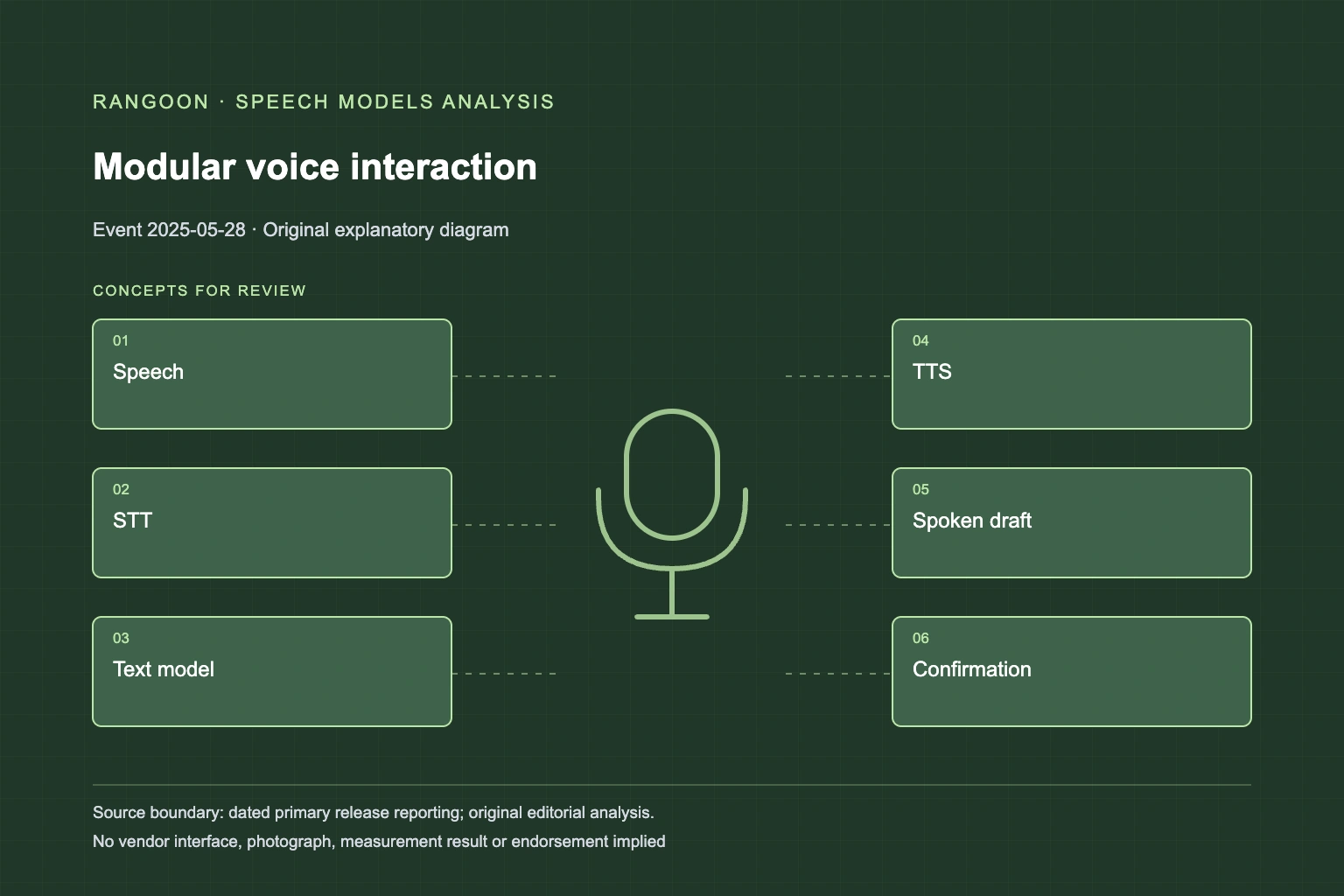
Historical reporting: Kyutai’s May 28, 2025 press release describes Unmute as modular real-time STT and TTS that can wrap a text language model. It says a prompt controls behavior and a few seconds of audio specify a voice, and it describes semantic voice-activity detection plus TTS that begins before the text response is complete. Kyutai said it planned to open-source Unmute in the coming weeks; that prospective wording is not treated as proof of code or weights being public on May 28. The release’s latency and interaction descriptions are supplier claims, not production assurance or voice-use authorization.
Key takeaways
- Kyutai framed Unmute as a modular speech layer around a text language model rather than a replacement for that model’s reasoning or policy.
- The announcement described a future open-source plan; it did not prove public code and weights were already available on the event date.
- Early speech generation can reduce perceived latency while increasing the need for interruption, correction and action-confirmation controls.
Unmute’s announcement separated a language model from speech input and output layers[source 1]
On May 28, 2025, Kyutai announced Unmute as a modular voice-AI design that could wrap a text language model with its real-time speech-to-text and text-to-speech components. The release describes behavior being controlled by text prompts and a voice being specified with a few seconds of audio. That architecture matters because it separates text-model behavior from the audio pathway. A prompt can affect what a system attempts to say, while speech recognition, turn detection and speech synthesis introduce their own errors and timing. The announcement does not mean that any language model has become safe, accurate or authorized merely because speech components are placed around it. Identity, data handling and action policy remain distinct system decisions.
Semantic turn detection is a prediction about a pause, not proof that a user has finished[source 1]
Kyutai said its speech-to-text component used semantic voice-activity detection to predict whether a person had finished speaking rather than merely paused. This is a useful distinction in conversational design: a conventional silence threshold can interrupt someone who is thinking, while a semantic detector can try to infer continuation. Yet the event record describes an intended capability, not a guarantee that every pause will be interpreted correctly. Accent, interruption, disability, connection delay and a user’s speaking style can change the signal. A live product should make it clear when a system has started processing, permit cancellation or correction, and avoid treating a provisional transcription as an instruction to take a consequential action.
Starting speech before a text response completes changes correction and confirmation requirements[source 1]
The press release says Unmute’s TTS could start generating speech before the text response was complete, a design intended to reduce total interaction latency. Streaming output can make a voice assistant feel more responsive, but it also means a listener may hear an incomplete qualification before the system has resolved its answer. If the response concerns money, health, identity or a tool action, the product must distinguish preliminary spoken material from a final confirmed result. It should log response identifiers and allow later text to supersede earlier output without silently changing what a user heard. The release supports Kyutai’s description of early audio generation; it does not establish end-to-end latency, safety or correctness for a particular agent.
A planned public release is not the same as a release-day artifact[source 1][source 2]
Kyutai said it would open-source Unmute in the coming weeks and that the system could already be tested through a named site. Those are different availability statements. A plan to publish may later result in code, weights, a demo, a paper or a changed scope, but none should be back-projected into the May announcement without a dated artifact. The historical record is strongest when it keeps that prospective language intact. For an evaluator, the important question is which exact model, checkpoint, prompt policy and voice samples were accessible at the time of a test. A modular voice wrapper may expose flexible composition, but it cannot supply consent for source audio, validate a model answer or authorize an external action. Those controls belong to the surrounding application and operator policy.
Sources
Continue reading
Related reading
 News analysisKyutai released Hibiki’s French-to-English voice-translation research artifacts with a narrow language boundary3 min read
 News analysisNVIDIA positioned Parakeet v2 as an English speech-recognition research model, not a universal transcription result3 min read
 News analysisMicrosoft’s VibeVoice release put long-form multi-speaker TTS into an open research framework, then exposed its misuse boundary3 min read