Langfuse v3 separated transactional metadata from high-volume LLM observations
Langfuse made v3 stable on December 9, 2024, moving trace data to ClickHouse and adding asynchronous event processing for self-hosted deployments.
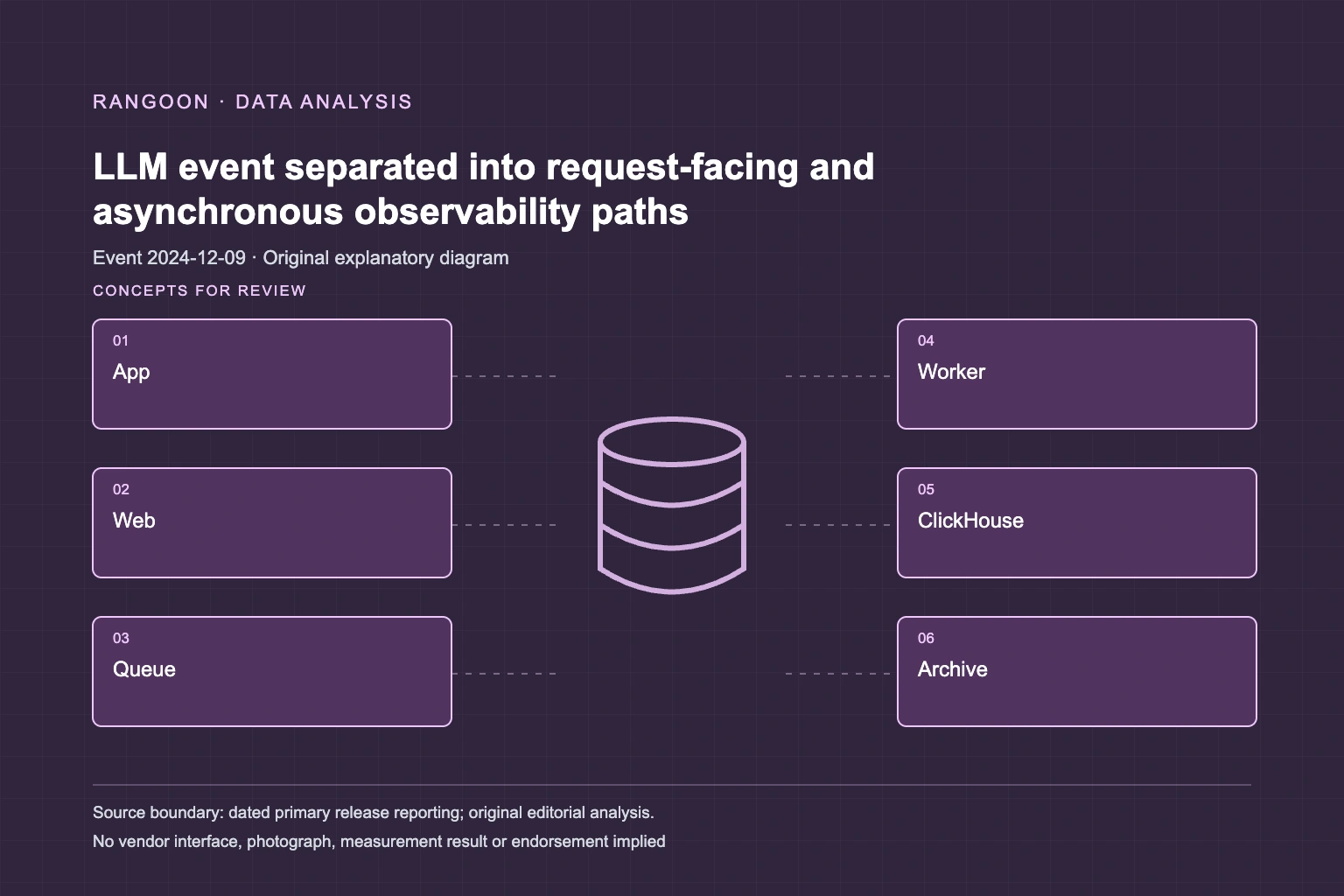
Historical reporting: Langfuse dated its v3 stable release to December 9, 2024. The company said self-hosted v3 added a worker, object storage, ClickHouse and Redis or Valkey, while PostgreSQL remained the transactional database. The linked migration material explains an upgrade path rather than proving every deployment will receive the same throughput, reliability or operating cost.
Key takeaways
- V3 put asynchronous event processing beside the request-facing web service.
- It assigned trace, observation and score storage to ClickHouse while retaining PostgreSQL for transactional work.
- The reported architecture is a deployment design, not a universal performance result.
Langfuse marked v3 stable for self-hosting on December 9, 2024[source 1]
Langfuse’s dated changelog says v3 became stable for production self-hosting on December 9, 2024. The release matters because it changed the operating shape of an LLM-observability deployment, rather than only adding a screen or SDK convenience. Langfuse described the earlier system as PostgreSQL-based and said v3 was designed for larger event volumes. The historical fact is the stable release and its stated deployment components. It is not a claim that every existing installation upgraded, that hosted and self-hosted users ran identical builds, or that a monitoring product by itself makes an application accurate.
The release split transactional records from analytical observation storage[source 1][source 2]
The v3 announcement assigns PostgreSQL to transactional workloads and ClickHouse to traces, observations and scores. It also adds S3 or compatible blob storage for incoming events, multimodal inputs and exports. That separation gives different data classes different persistence paths: a project or user record is not the same workload as a high-volume stream of spans and evaluations. It also creates a migration and operations boundary. Retention, access controls, backup plans, query behavior and incident investigation must follow the actual storage location and version. The source describes Langfuse’s design; it does not establish a suitable architecture for every telemetry system.
A separate worker made event processing asynchronous in the documented design[source 1][source 2]
Langfuse says v3 adds a worker container that processes events asynchronously, alongside the web application serving the interface and APIs. Redis or Valkey is listed for queueing and caching. This changes the path between an application emitting telemetry and an analyst reading it: acceptance, background work, storage and later query can be distinct steps. That can improve decoupling under load, but it also means operators need to observe queue health, retries and delays instead of assuming a submitted event is immediately queryable. The announcement describes components and intended scale; it does not publish a complete failure model, workload profile or service-level guarantee for every deployment.
The upgrade record treated infrastructure change as a data-migration task[source 1][source 2]
For self-hosted users, Langfuse’s release instructs teams to deploy v3, migrate v2 data through managed background migrations, then use v3. This is concrete release news because the data path changed with the application architecture. A safe comparison between versions needs the migration state, SDK version, deployment topology, event volume and retention assumptions kept visible. A v2-to-v3 upgrade is not equivalent to recreating a blank project on a new stack. The migration guide is implementation context, not independent evidence for the release date. It also cannot show that an organization’s historical traces, dashboards or integrations survived a particular upgrade without that organization’s own records.
Sources
- Langfuse: v3 stable release (December 9, 2024)
- Langfuse: v2-to-v3 migration guide
Continue reading