

ClickHouse acquired Langfuse while saying its open-source project and cloud service would continue
ClickHouse announced its acquisition of Langfuse on January 16, 2026, joining an LLM-observability platform to its analytics business alongside a financing round.
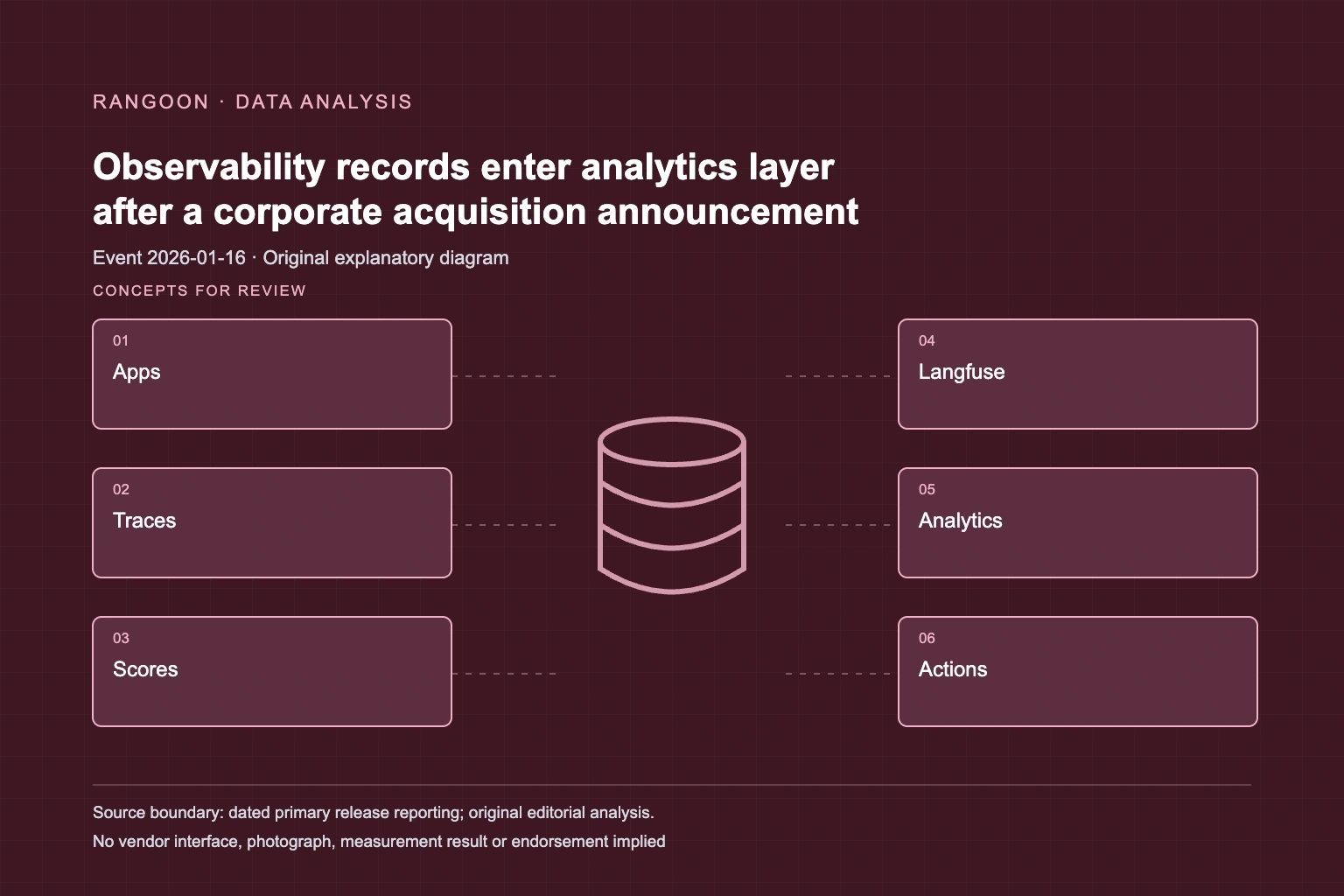
Historical reporting: ClickHouse announced on January 16, 2026 that it had acquired Langfuse, alongside its Series D financing and Postgres service announcement. A second ClickHouse post says Langfuse would remain MIT-licensed and that Langfuse Cloud would continue operating. These are acquirer statements at announcement time. They do not prove future roadmap delivery, pricing, personnel retention, service levels or integration performance.
Key takeaways
- The event was an acquisition announcement with stated continuity commitments.
- ClickHouse framed Langfuse as an LLM-observability addition to its analytics platform.
- License and cloud-service continuity are announced commitments, not permanent guarantees.
ClickHouse announced the Langfuse acquisition on January 16, 2026[source 1]
ClickHouse’s January 16, 2026 company announcement says it acquired Langfuse, an open-source LLM observability platform. The announcement appeared with a Series D financing round and a native Postgres service, but each is a separate event type. This article concerns the acquisition: an ownership and product-portfolio change. ClickHouse described the move as an entry into LLM observability, where teams trace, evaluate and improve AI applications. That framing identifies the stated business rationale. It does not establish that every ClickHouse customer adopted Langfuse, that every Langfuse deployment moved to ClickHouse services, or that a combined product was already available on the announcement date.
The acquirer said Langfuse would remain open source and its cloud service would continue[source 1][source 2]
In its dedicated acquisition post, ClickHouse said Langfuse would remain open source under its existing MIT license and that Langfuse Cloud would continue as a standalone service. Those statements are material because an acquisition can otherwise leave license, hosting and maintenance expectations unclear. They are commitments made by the acquirer at announcement time, not a substitute for future release notes, terms or service records. A user deciding how to run observability should still inspect the exact version, hosting agreement, support arrangement and current data path. The event evidence supports the stated continuity position on January 16; it cannot prove how every later product or commercial decision will unfold.
ClickHouse framed the deal as a data-layer addition for AI observability[source 1][source 2]
ClickHouse said Langfuse was built on ClickHouse and described a tighter path from data collection through analysis and action. That explains why the acquisition belongs in developer-data news: LLM observability creates high-volume records of prompts, responses, tool calls, traces, scores and evaluation results, which are then queried for debugging and improvement. A shared storage technology does not make the two companies’ products identical or make every observability task a database query. Model behavior, evaluator design, access controls, retention and incident response remain separate concerns. The company’s narrative establishes its intended product direction, not an independent architecture assessment or performance benchmark.
Financing, acquisition and future integration must remain separate records[source 1][source 2]
ClickHouse’s January release bundled several announcements, including financing, an acquisition and a Postgres offering. Reporting them as one undifferentiated “launch” would obscure what changed and what remained planned. The acquisition record proves a corporate transaction was announced; the dedicated Langfuse post records commitments around open source and hosted service continuity. Neither source proves a particular future integration, a new billing package or a specified reliability result. Later releases may provide that evidence, but should be dated on their own terms. This distinction protects readers from treating a corporate announcement as a deployment receipt, especially where observability data, customer access and production support are involved.
Sources
- ClickHouse: Series D, Langfuse acquisition and Postgres announcement (January 16, 2026)
- ClickHouse: welcomes Langfuse acquisition (January 16, 2026)
Continue reading
Related reading
 News analysisLangfuse v3 separated transactional metadata from high-volume LLM observations3 min read
 News analysisNVIDIA’s memory codesign post highlights a practical boundary between capacity and usable agent throughput3 min read
 News analysisNVIDIA supply-chain capacity plans make packaging, test and optics explicit infrastructure constraints3 min read