

LangGraph Platform’s general availability made durable agent deployment a separate product surface
LangChain announced LangGraph Platform general availability on May 14, 2025, framing deployment and management for long-running, stateful agents as distinct runtime work.
Historical reporting: LangChain announced LangGraph Platform general availability on May 14, 2025. This is not a claim about current service terms or suitability for every long-running workload.
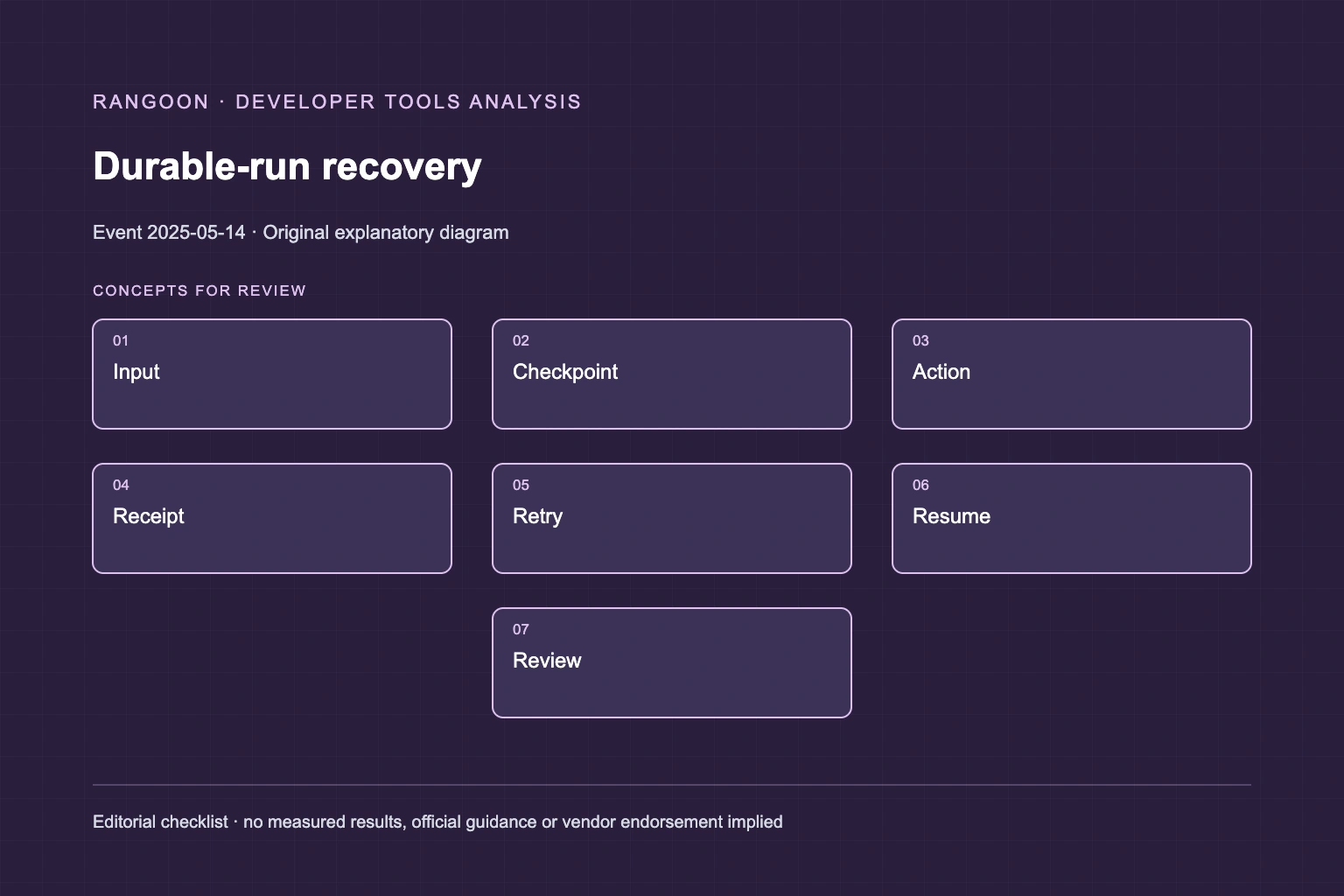
Key takeaways
- Platform general availability addressed deployment and management alongside graph code.
- Stateful agents need explicit persistence and resume tests.
- A hosted runtime does not remove ownership for retries or side effects.
The May announcement distinguished graph development from platform operation[source 1][source 2]
LangChain announced that LangGraph Platform was generally available on May 14, 2025, describing deployment and management for long-running, stateful agents. A later company announcement identifies deployment as the capability formerly called LangGraph Platform within a broader agent-engineering offering. Together the sources document a product milestone and a naming lineage. They do not say that every graph can safely persist, resume, scale or compensate after a side effect in every environment.
The May GA page specifically named one-click deployment, API endpoints, horizontal scaling, persistence and Studio visibility. Those are infrastructure features, not proofs that a graph is correct. The later rename note is useful historical context because it warns readers not to treat a 2025 platform name as a current product inventory.
Durability introduces state and idempotency into agent design[source 1][source 2]
A stateful graph needs more than nodes and edges. It needs a defined checkpoint boundary, state schema, retry classification, external-effect ledger and resume behavior. The difficult case is not a clean completion; it is a process that made an external request, stopped before recording its outcome, then restarted. Durable execution can make that case manageable only when calls have idempotency keys or reconciliation rules and operators can inspect the resulting state.
Human-in-the-loop waiting adds a second kind of persistence. The graph must preserve which question was asked, who may answer it, what input is valid and what deadline applies. If an approval arrives after the task’s assumptions changed, the workflow should revalidate before it resumes rather than treating an old answer as a durable authorization.
Long-running work requires a visible recovery contract[source 1][source 2]
For every run, store a stable run identifier, graph revision, input version, checkpoint pointer, pending action, elapsed time, retry count and terminal status. Exercise cancellation before a tool call, during a tool call and after a tool response. Then make the owner decide whether to resume, compensate, or require review. A replay that only reproduces text is insufficient when the workflow creates tickets, moves money, or changes a record.
Use a recovery dashboard that distinguishes queued, executing, awaiting input, failed before effect, effect unknown and reconciled. “Failed” alone is not an operator action. The status should link to the evidence needed to decide the next step, including any provider receipt, idempotency key or downstream record identifier.
Analysis: evaluate durable systems through interrupted runs[source 1][source 2]
A credible acceptance suite injects a crash, timeout, duplicate delivery and malformed persisted state. The pass condition should name the expected recovery state and whether an external effect happens zero, one or more times. Compare that result with the product’s service objective. This separates a framework’s durable-runtime claim from local evidence about a specific graph, integration and operating team.
Capacity evaluation for long-running agents should include abandoned tasks. Background workloads often accumulate sessions waiting for input or a remote service. Measure storage growth, checkpoint cleanup and queue fairness under that condition. This reveals whether a deployment can sustain operational ambiguity, not just complete an idealized stream of short tasks.
Sources
- LangChain Blog: LangGraph Platform is now generally available (May 14, 2025)
- LangChain Blog: Series B and agent engineering platform (October 20, 2025)
Continue reading
Related reading
 News analysisLangChain and LangGraph 1.0 separated fast agent assembly from lower-level control3 min read
 News analysisSalesforce announced Agentforce 2.0 with a staged availability plan for skills, Slack and reasoning3 min read
 News analysisAnthropic donated Agent Skills to AAIF: treat open governance as a new supply-chain input3 min read