Luma added Camera Motion Concepts to Ray2
Luma’s March 31, 2025 Camera Motion Concepts release added example-trained, composable camera controls to Ray2 in Dream Machine, distinct from its earlier menu of fixed motions.
Historical reporting: Source 0 is Luma’s dated Camera Motion Concepts release. Source 1 is a prior Luma technical guide documenting the fixed camera-motion controls that provide context, not date proof.
Key takeaways
- Luma dated Camera Motion Concepts for Ray2 in Dream Machine to March 31, 2025.
- Luma described Concepts as learnable from one or a few examples and composable through natural language at inference time.
- The release’s main distinction was customization beyond a fixed movement menu; it did not validate every composed camera move or replace output review.
A new way to specify movement[source 1]
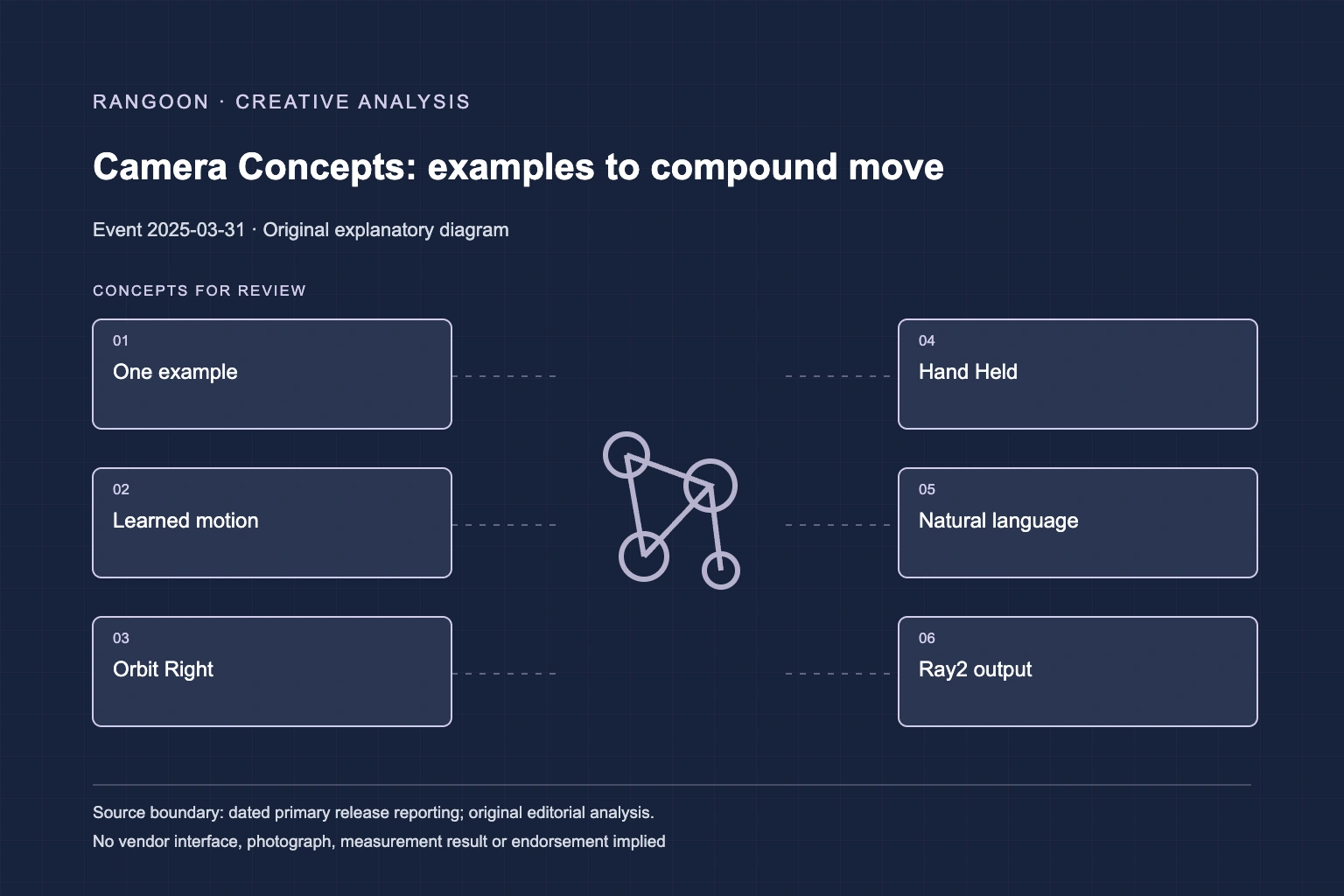
On March 31, 2025, Luma announced Camera Motion Concepts as the first set of Concepts for Ray2 and said they were available in Dream Machine that day. The company framed Concepts as a research-derived method for teaching generative models new ideas and controls from one or a few examples. The initial release focused on camera motion: Luma said a learned move could be reproduced across different shots and styles. That is a narrower claim than saying Ray2 understood all cinematography. It describes a customization layer placed on a video-generation model, with example material functioning as the route to a motion behavior rather than as a normal text prompt alone.
Composition was the technical change[source 1]
Luma emphasized that multiple Concepts could be combined in natural language at inference time. Its examples included Pull Out plus Tilt Down, Orbit Right plus Hand Held, and Elevator Doors plus Dolly Zoom. This matters because the company contrasted Concepts with LoRA or fine-tuning: it presented composition as a way to request a compound move even when there was no single training example for that exact combination. The announcement also said Concepts worked with image-to-video, start and end keyframes, and looping. In this account, those statements describe the vendor’s intended control surface. They do not demonstrate that arbitrary pairings stay physically plausible, preserve every subject, or require the same amount of source material in every case.
Concepts extended a prior fixed-control vocabulary[source 1][source 2]
A Luma guide published in November 2024 shows the older baseline. After generating or uploading an image, Dream Machine users could select named movements such as Pan, Orbit, Crane, Move and Push In or Pull Out on web and iOS. Those controls provide a useful contrast: they are predefined interface choices with simple descriptions of direction or rotation. Camera Motion Concepts did not erase them. Instead, the March release introduced a learnable and composable layer for Ray2. The distinction explains why the word Concepts matters in the announcement: it refers to a way of acquiring and combining a motion pattern, not merely a renamed list of camera buttons.
Creative control still needed verification[source 1][source 2]
For a creative team, the historical news value is the shift from selecting a fixed movement to attempting learned, compound direction inside Dream Machine. It could make a motion brief more expressive, but it did not make generated footage self-verifying. The cited release described reliability and no loss of model quality as Luma’s claims; it did not provide a public, task-independent acceptance test for a customer’s shot. A team still needs to inspect framing, temporal consistency, unwanted motion, visual artifacts and the rights to supplied examples and final material. The event record therefore supports a precise statement about availability and intended controls on March 31, while leaving production fitness, access changes and later Ray releases to their own evidence.
Sources
- Official Camera Motion Concepts release (March 31, 2025)
- Luma guide: How to use Camera Motion (November 6, 2024)
Continue reading