Luma launched Ray3 with Draft Mode and ACES EXR HDR output
Luma launched Ray3 on September 18, 2025, pairing Dream Machine access with Draft Mode, native HDR generation and 10-, 12- and 16-bit ACES EXR output.
Historical reporting: Source 0 is Luma's dated Ray3 announcement. Source 1 is Luma's Ray3 FAQ, used for documented feature behavior and limits rather than date proof.
Key takeaways
- Luma dated the Ray3 launch to 2025-09-18 and said it was available in Dream Machine.
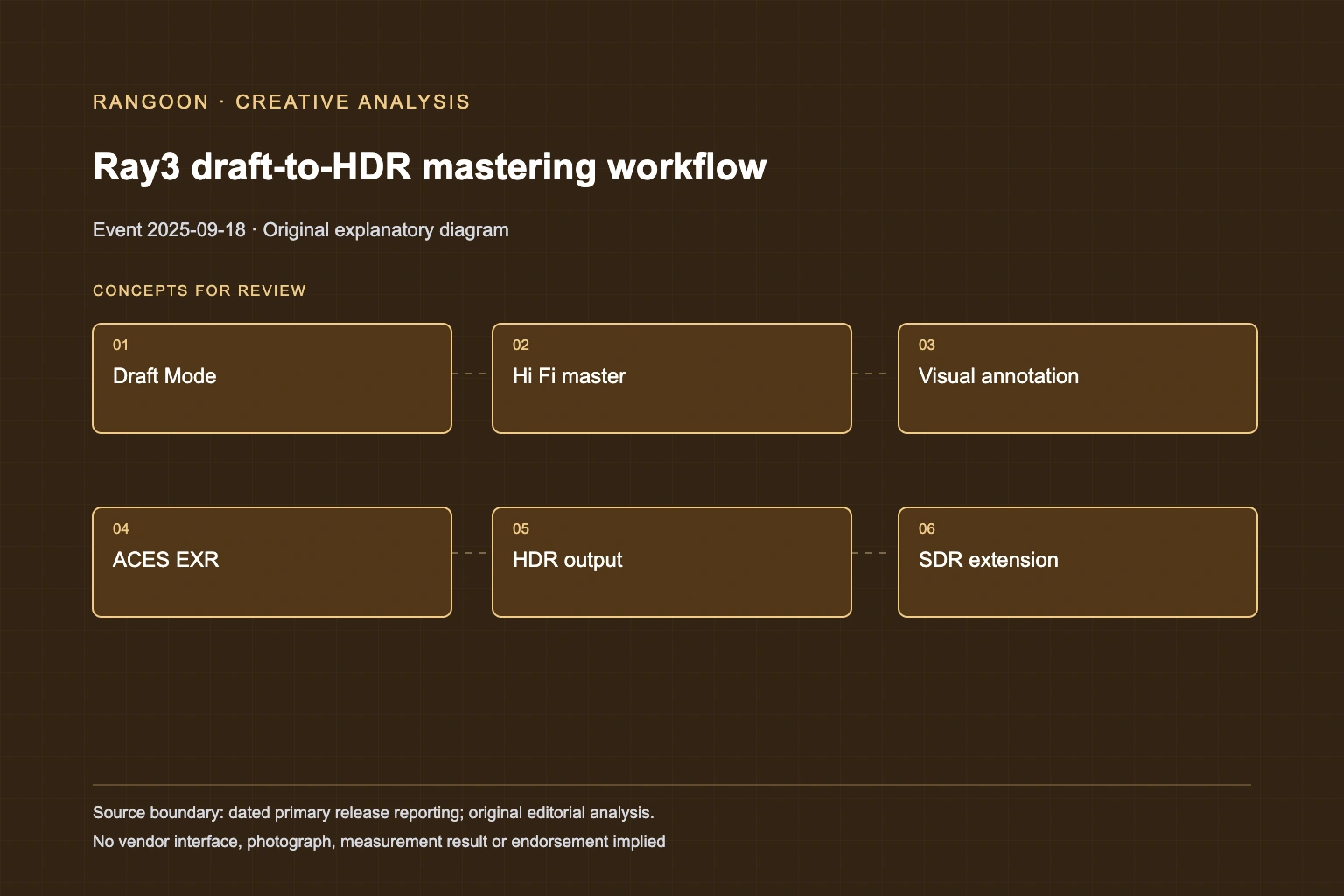
- Ray3 paired Draft Mode with a later Hi-Fi mastering step and named native 10-, 12- and 16-bit HDR ACES EXR generation.
- Luma's FAQ records limits including no launch-time audio support and a switch back to SDR when extending HDR video.
A launch built around two very different production stages[source 1][source 2]
Luma announced Ray3 on September 18, 2025 as a Dream Machine video model for film, advertising and game work. The release combined a fast exploration stage with a high-fidelity finishing stage. Draft Mode was presented as a way to generate test clips quickly, then select a promising version for a fuller-quality render. Luma's announcement said Draft Mode could create options up to 20 times faster; its published FAQ describes the workflow as up to five times faster and says a selected draft can be mastered into a detailed 4K HDR version through Hi Fi diffusion. These are supplier descriptions and the two figures should not be collapsed into one benchmark. What the event clearly changed was the product workflow: exploring variations and committing resources to a final treatment became separate actions within the Ray3 surface.
HDR output targeted a color-managed post-production path[source 1][source 2]
Ray3's other distinct claim was native high-dynamic-range generation in 10-, 12- and 16-bit formats using ACES2065-1 EXR. That matters because EXR is a frame-oriented working format for grading, compositing and exposure work, rather than a shorthand for any bright-looking video. Luma said the model could also turn generated or uploaded standard-dynamic-range video into generative HDR. Its release connects the format to post-production use, while the FAQ distinguishes HDR, EXR and SDR and names the EXR colorspace as ACES2065-1. The launch announcement says native 1080p was initially limited to selected early-access partners, with broader availability planned later. So the historical article records a format and pipeline claim, not universal availability of every resolution, export route or high-end workflow from the first day.
Reasoning and visual annotation were the control story[source 1][source 2]
Luma presented Ray3 as a multimodal reasoning system that could use text and visual tokens, plan scenes, assess outputs and refine them. That language is a company claim about model behavior. The more concrete user-facing control was Visual Annotation: the launch says users could add annotations directly to images, while the Ray3 support material records that Draft Mode and full-fidelity access were not equivalent account surfaces. The release also named image-to-video, Keyframes, Extend and Loop among the controls it made more expressive. It describes better instruction following, temporal coherence and identity preservation as model strengths rather than guarantees. For an operator, that distinction is important. A directable image may reduce the number of prompt-only attempts, but a feature description cannot establish that a complex scene, likeness or physical event is correct.
The documentation also recorded constraints that shaped use[source 1][source 2]
Luma's Ray3 FAQ supplies boundaries that the launch prose alone does not. It says Ray3 had no audio support at the time, listed a five-second maximum for image-to-video and HDR text-to-video, and said HDR extensions switch to SDR. The FAQ also says HDR and EXR downloads were then limited to 540p and 720p, despite the product's broader native-resolution claims, and that Modify Video and Reframe used Ray2 rather than Ray3. Those constraints make the release easier to read accurately: Ray3 expanded a particular text and image video pipeline, while some adjacent editing paths still relied on a different model. The September 18 record supports Luma's launch and stated technical direction. It does not prove that its reasoning labels match independent evaluation, that exports meet every delivery specification, or that a generated clip can substitute for reviewed footage in a professional production.
Sources
- Luma: Ray3 launch (September 18, 2025)
- Luma: Ray3 FAQ
Continue reading