

Marvell’s Celestial AI agreement put optical scale-up on a later-closing timeline
Marvell announced a definitive agreement to acquire Celestial AI on December 2, 2025, separating an optical-interconnect strategy from the transaction’s February 2026 completion.
Historical reporting: Marvell announced on December 2, 2025 that it had entered a definitive agreement to acquire Celestial AI and its Photonic Fabric optical-interconnect platform. Marvell later announced transaction completion on February 2, 2026. The December agreement, future revenue expectations and product-market statements were not evidence that a combined company had closed, shipped a new integrated product or delivered a measured customer-network result on the announcement date.
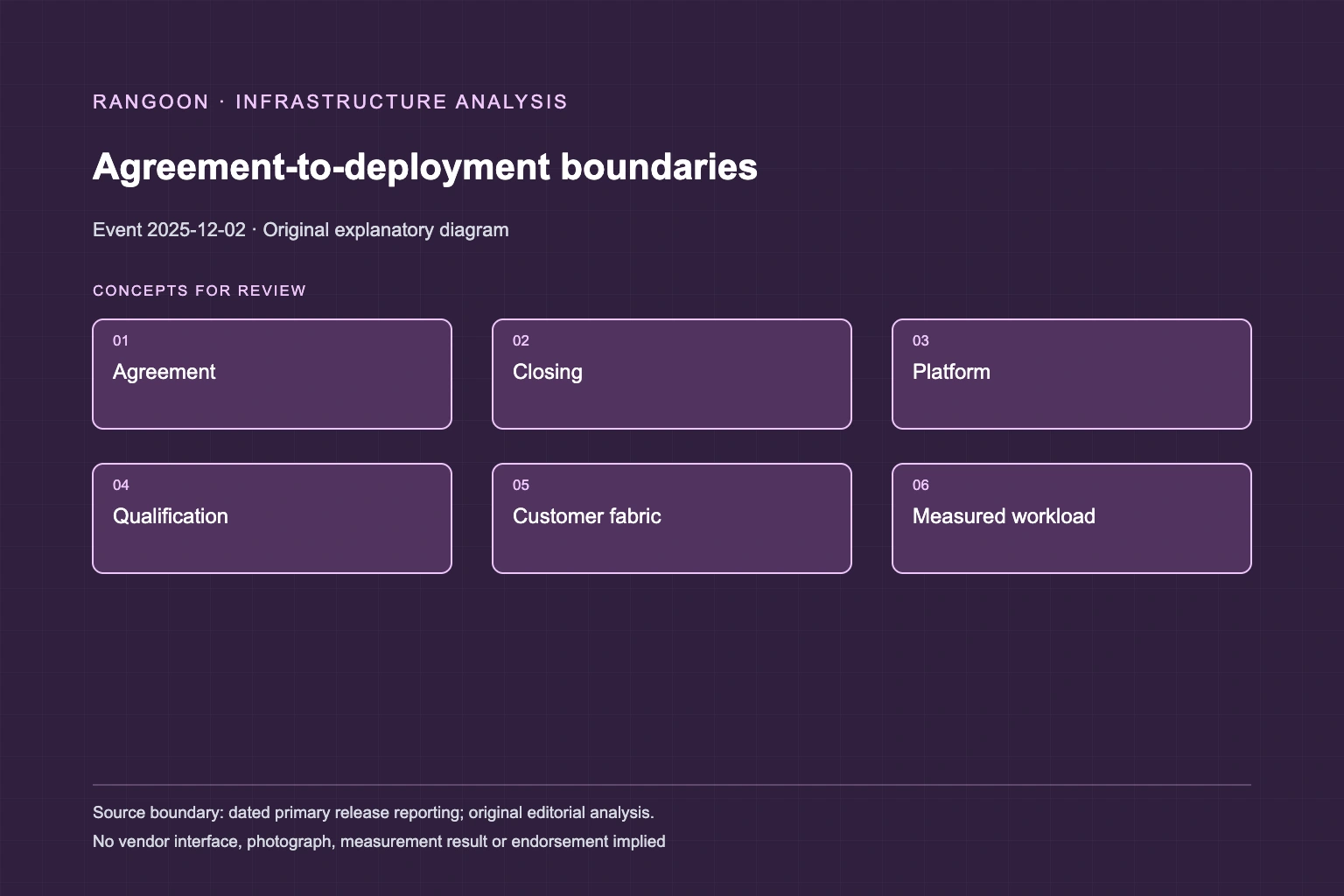
Key takeaways
- A definitive acquisition agreement was a transaction milestone; closing occurred later and needs its own date.
- Photonic Fabric was described as an optical-interconnect platform for scale-up connectivity, not a measured deployment outcome.
- Future revenue and synergy statements are company expectations, not current product revenue or customer-performance evidence.
The December event was an announced agreement, not a completed acquisition[source 1][source 2]
On December 2, 2025, Marvell said it had entered a definitive agreement to acquire Celestial AI. The company described Celestial AI’s Photonic Fabric technology as an optical-interconnect platform for package, system and rack-level connectivity in next-generation data-center infrastructure. A definitive agreement is a material corporate event because it identifies the proposed transaction and strategic direction. It does not establish that ownership had transferred, that products had been integrated or that a customer had deployed a combined Marvell and Celestial AI offering on that date.
Marvell’s February 2, 2026 completion announcement provides the later boundary. It said the acquisition had completed and set out its own forward-looking expectations for initial revenue contribution and later run-rate targets. That later statement does not rewrite December. The historical record should retain the agreement as an intention and legal transaction stage, then keep the completion as a separate event. Treating both as the same date would erase the interval where closing conditions, integration work and commercial execution still remained ahead.
Optical scale-up described a connectivity direction, not a finished fabric[source 1][source 2]
Marvell framed the planned acquisition around the shift from single-rack accelerated systems toward multi-rack configurations with high-bandwidth, low-latency, any-to-any scale-up fabric requirements. That identifies the architectural problem the company intended to address. It does not identify an installed topology, a customer cluster size, a cable or package configuration, or a measured latency result. Optical I/O can move part of an interconnect path into photonics, but a usable AI fabric still depends on switches, network interfaces, software, power, cooling, physical integration and workload behavior.
The Photonic Fabric name should therefore be read as a supplier platform description. A platform may span different physical layers and product generations; it is not a benchmark result by itself. A deployment claim would need a named system, hardware revision, link protocol, traffic pattern and measurement method. The December release did not supply that evidence. Its value is in documenting why Marvell saw optical connectivity as strategically relevant to larger AI systems, while leaving product qualification and operational performance for later technical records.
Transaction and revenue projections carried their own conditions[source 1][source 2]
The December announcement included transaction consideration and milestones, and it described expected future financial contribution. Those figures are part of the company’s transaction communication, not an investment recommendation or proof of realized revenue. Closing depended on the terms and conditions described by the parties, and revenue expectations depend on product development, manufacturing, customer adoption and market conditions. The announcement did not show future sales, market share, margins or a completed technology roadmap as present facts.
Marvell’s later completion release makes the distinction visible by describing future initial contribution and a subsequent expected annualized run rate. It labels such statements as forward-looking. That is useful context, but it still does not establish the later outcomes occurred. An archive should preserve announced terms and projections with their stated time frames, then require later financial results or product records before asserting delivery. This protects readers from turning a strategic transaction story into a claim that an optical product had already generated the projected value.
Closing a deal did not prove an AI-network deployment[source 1][source 2]
The February completion confirmed a corporate transaction stage, not the performance of every product the combined company might later develop. Optical interconnect hardware is tested across signal integrity, thermal behavior, packaging, firmware, error handling and interoperability before it can support a specific system design. At data-center scale, network behavior is also shaped by the surrounding accelerator, switch and software environment. A vendor claim about low latency or high bandwidth cannot substitute for a disclosed end-to-end test under a stated configuration.
The December 2025 event is therefore best described as an agreement to acquire a supplier of optical-interconnect technology for a stated scale-up strategy. The February 2026 source establishes that the deal later closed. Neither source alone proves capacity delivered to a named customer, successful integration into a particular accelerator platform or a broad improvement in AI job completion time. Keeping those layers separate leaves a clear evidence trail: agreement, closing, product development, qualification and measured deployment are related but distinct milestones.
Sources
- Marvell: definitive agreement to acquire Celestial AI (December 2, 2025)
- Marvell: completes acquisition of Celestial AI (February 2, 2026)
Continue reading
Related reading
 News analysisNVIDIA announced Spectrum-X Photonics with a later availability schedule3 min read
 News analysisAMD showed Helios as an Open Rack Wide reference platform, keeping its 2026 volume expectation separate3 min read
 News analysisOracle’s Stargate partnership tied a 4.5GW plan to named buildout milestones3 min read