

MatterSim v1 made an atomistic emulator release a reproducibility question
Microsoft Research released MatterSim v1.0.0 on December 18, 2024, making trained materials-simulation models available alongside earlier atomistic modeling research.
Historical reporting: the MatterSim v1.0.0 repository release is dated December 18, 2024; Microsoft Research had described the model and its paper in May. This is a software-release event, not experimental validation of a newly synthesized material.
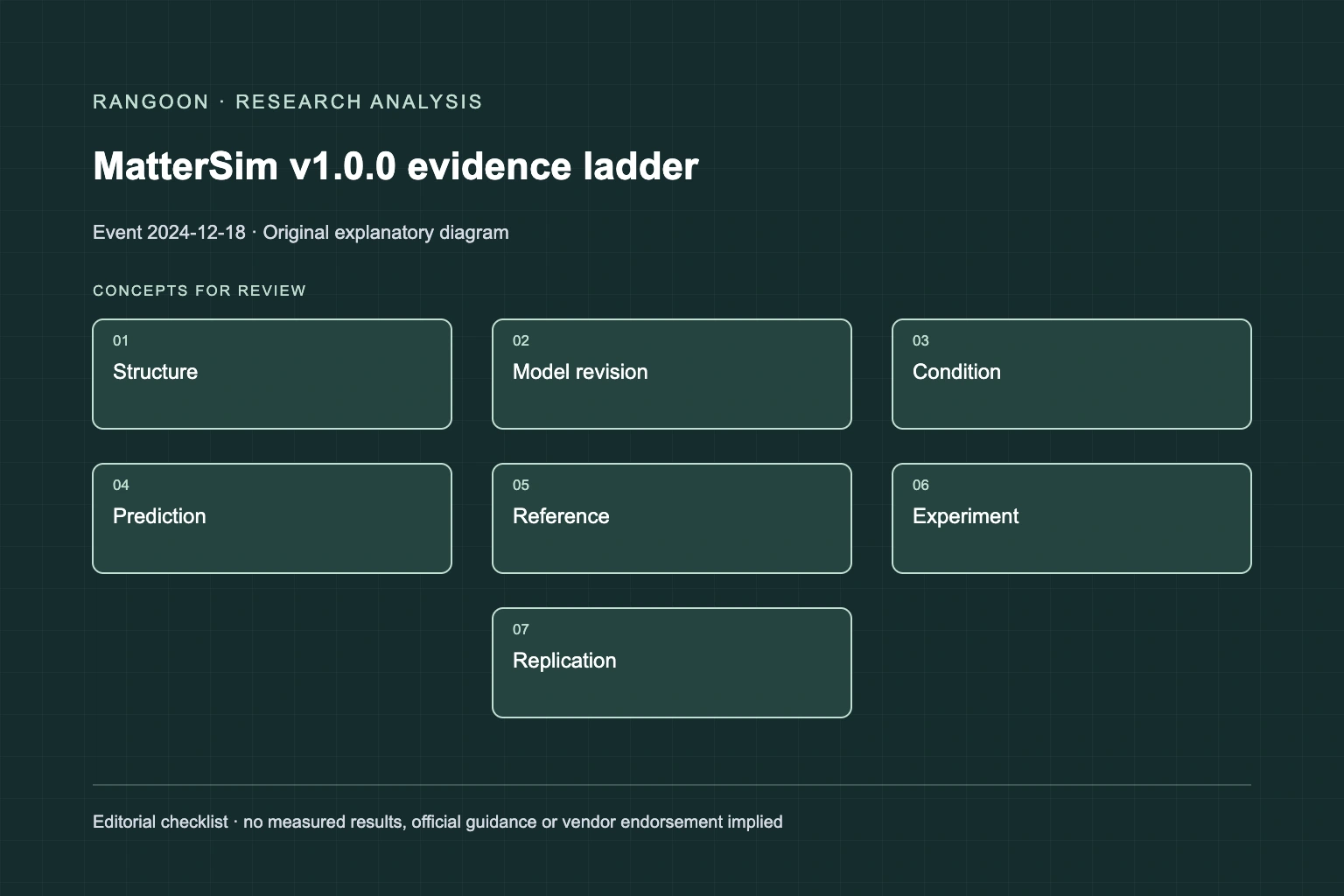
Key takeaways
- MatterSim v1 exposed a materials emulator and its model artifacts for inspection.
- Predicted energies, forces and properties need a stated structure, temperature and pressure domain.
- In-silico agreement does not substitute for synthesis and measurement.
The December record was a model-artifact release[source 1][source 2]
The MatterSim project records its v1.0.0 release on December 18, 2024, providing a concrete historical access event for Microsoft Research’s atomistic materials model. Microsoft’s May research post had described MatterSim as a deep-learning system for simulation and property prediction across elements, temperatures and pressures. The two records have different jobs: a repository release identifies a software artifact, while the research post explains the proposed scientific scope. Neither document says that a material generated or evaluated by a later user has been synthesized, measured or shown suitable for an application.
A force-field surrogate carries assumptions about its domain[source 1][source 2]
Atomistic machine-learning models estimate quantities used in materials calculations from structure and local environments. Their outputs can support screening or simulation much faster than a direct calculation in some settings, but they inherit choices in training data, reference methods, temperature, pressure and chemical coverage. A prediction for a relaxed crystal is not automatically evidence about defects, phase changes, interfaces or processing conditions. MatterSim’s materials-space framing makes those boundaries especially important: the periodic table is broad, while a specific composition, trajectory and physical condition remains a narrow test case.
Simulation evidence must not be relabeled as a measured property[source 1][source 2]
A calculated stability, force or transport-related property is a model output unless it is compared with an appropriately matched experiment. Even agreement with a reference quantum calculation answers a different question from manufacturability, durability or performance in a device. Model users should retain the input structure, composition, supercell, temperature, pressure, trajectory length, model revision and uncertainty treatment. Without those fields, a reported property can be impossible to interpret or reproduce. This distinction protects scientific reporting from turning a fast emulator into an unqualified experimental witness.
Release validation should exercise chemistry and condition shifts[source 1][source 2]
A local evaluation should use structures outside the training split and include a familiar composition, a composition near a coverage edge and a deliberately unsupported condition. Compare predicted forces and energies with a declared reference, then test whether a downstream molecular-dynamics trajectory remains physically plausible under the selected protocol. If the model is fine-tuned, preserve both the base artifact and added data lineage. For promising candidates, pre-register the experimental measurement that could confirm or reject the computational hypothesis rather than choosing an assay after viewing the output.
Analysis: a materials model needs an evidence ladder[source 1][source 2]
MatterSim v1.0.0 is best read as a reproducibility and screening event. The ladder after a model score is explicit: reproduce the calculation, compare to an independent reference, synthesize or obtain the material where feasible, measure the claimed property, and test the relevant operating environment. Each rung can fail for a useful reason. The December 18 repository release makes artifacts inspectable; it does not turn any generated material into a validated catalyst, battery component or product. The study record should preserve failures as carefully as positive candidates.
A materials release becomes scientifically durable when independent groups can reproduce both the calculation and the negative result under an explicitly matched physical condition.
Sources
- Microsoft MatterSim: v1.0.0 release (December 18, 2024)
- Microsoft Research: MatterSim under real-world conditions (May 13, 2024)
Continue reading
Related reading
 News analysisMatterGen separated conditional crystal proposals from material confirmation3 min read
 News analysisMicrosoft’s VibeVoice release put long-form multi-speaker TTS into an open research framework, then exposed its misuse boundary3 min read
 News analysisPrithvi-EO-2.0 expanded geospatial representation without becoming ground truth3 min read