

MCP’s November 2025 revision treated a protocol anniversary as a compatibility release
Model Context Protocol maintainers released the 2025-11-25 specification revision on MCP’s first anniversary, documenting a new version rather than a timeless protocol state.
Historical reporting: MCP maintainers published the November 25, 2025 specification-release account. This article distinguishes that revision from initial MCP coverage and makes no current standard-status claim.
Key takeaways
- A protocol anniversary did not eliminate revision-specific compatibility work.
- Specification change logs should drive client and server test matrices.
- Interoperability claims need negotiated-version evidence from both sides.
The first-anniversary release supplied a new dated specification[source 1][source 2]
MCP maintainers published “One Year of MCP: November 2025 Spec Release” on November 25, 2025 and described a brand-new specification version. The corresponding versioned changelog is a second primary record. This article intentionally covers the later revision rather than the November 2024 protocol introduction already recorded elsewhere. An anniversary narrative may describe adoption momentum, but the decisive engineering fact is the revision identifier and the behavior an implementation actually negotiates.
The maintainers’ choice to pair an anniversary retrospective with a new revision creates two reporting layers: community history and normative change. Engineers need the latter when updating code, while editors need both to explain why a new release mattered. This story does not reuse the initial-launch narrative because the event is a later specification milestone.
A revision is useful only when clients and servers expose it[source 1][source 2]
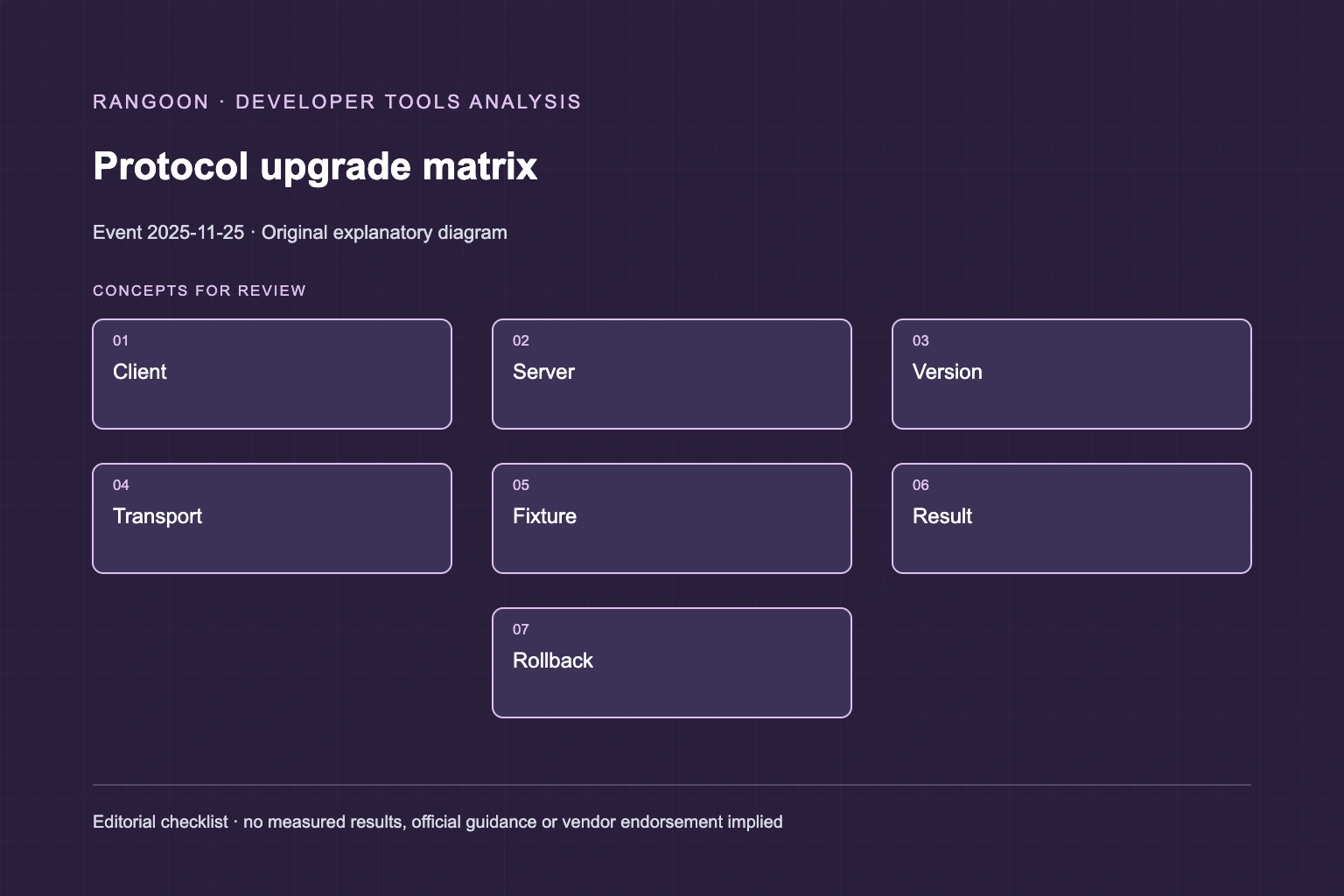
Interoperability needs a visible matrix: client version, server version, transport, authorization extension, supported capabilities and test result. A source tree can carry several historical documents while a deployed server exposes one negotiated version. Keep version negotiation, schema validation and capability discovery on the critical path. Do not infer compatibility from a common brand, a registry listing or a claim that a tool “supports MCP.”
A compatibility matrix should also record directionality. A client may parse a server capability but never invoke it, and a server may accept a protocol header while omitting a desired transport feature. This distinction helps teams avoid publishing a binary support label that conceals important partial interoperability limits.
Change logs should produce regression fixtures[source 1][source 2]
Read a revision change log and turn each relevant change into a fixture. Include successful initialization, a rejected unsupported version, optional capability absence, a tool result using the current schema and a token or authorization failure. Store wire-level test evidence without secrets. When an integration upgrades, run old fixtures where backward behavior matters and new fixtures where a deliberately changed rule is expected.
Release testing should run against a pinned server artifact, not a mutable image tag or public endpoint that may advance during the test. Keep the captured request and response shapes with the artifact reference. That provides evidence for the exact combination that passed, instead of only evidence that some current server responded once.
Analysis: standard governance and production governance are separate[source 1][source 2]
A neutral or collaborative protocol process can improve shared vocabulary and maintenance, but it does not become a production approval path for your server inventory. Teams still need release owners, vulnerability intake, artifact pinning, incident response and explicit deprecation decisions. The historical event is meaningful because it made the spec lifecycle visible; it should not be converted into a blanket trust claim for every MCP implementation.
The key historical lesson is version awareness. A protocol can gain adoption while its implementers remain distributed across clients, servers and intermediaries with different update cadences. Teams should report the negotiated revision in support tickets and incident records, because a feature name alone rarely identifies the behavior exercised on the wire.
Sources
- MCP Blog: One Year of MCP November 2025 Spec Release (November 25, 2025)
- Model Context Protocol specification: 2025-11-25 changelog (November 25, 2025)
Continue reading
Related reading
 News analysisMCP’s June 2025 revision made transport and authorization compatibility testable contracts3 min read
 News analysisAnthropic donated Agent Skills to AAIF: treat open governance as a new supply-chain input3 min read
 News analysisOpenAI introduced in-chat apps and an Apps SDK preview built on MCP3 min read