

Meta AI app launch made personalization and social discovery product-surface choices
Meta introduced the Meta AI app on April 29, 2025, describing a standalone assistant with voice interaction, a Discover feed and optional links to Meta accounts.
Historical reporting: primary documents record this event on 2025-04-29. Vendor statements, planned schedules and comparative figures remain attributed. This retrospective does not infer current availability, price, capacity, performance or support.
Key takeaways
- Meta introduced a standalone Meta AI app during LlamaCon on April 29, 2025.
- A vendor announcement, a plan, an installed system and a completed workload are different evidence states.
- Original analysis: retain configuration and outcome evidence before treating an infrastructure claim as an operating result.
The dated event has a bounded claim[source 1][source 2]
On 2025-04-29, the first primary document recorded this event. Meta introduced a standalone Meta AI app during LlamaCon on April 29, 2025. The company described voice conversations, image generation and editing through voice or text, a Discover feed for shared AI interactions, and optional Facebook or Instagram account connection for more personalized responses. A separate Meta LlamaCon post establishes same-day event context, not independent confirmation of app features.
Meta’s first app version combined a standalone voice-oriented assistant, web continuity, account-linked personalization and a Discover feed. Those are product-surface choices with different user expectations. The same-day LlamaCon grant post confirms the event setting only; the app feature record remains Meta’s dedicated announcement.
Engineering facts need a workload boundary[source 1][source 2]
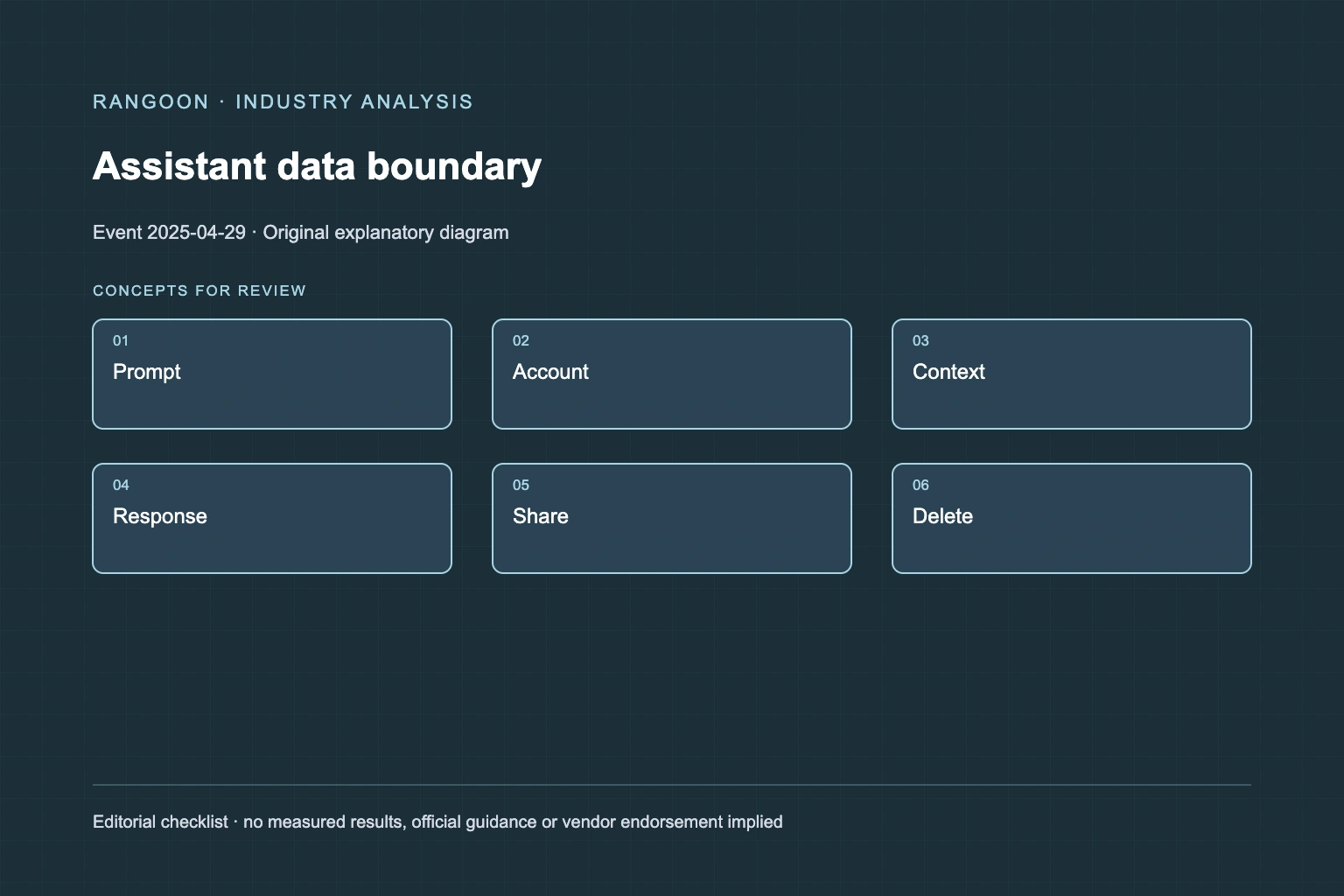
A standalone assistant, social feed and account-linked personalization create distinct data paths. A user needs to know whether a prompt stays private, is eligible for sharing, feeds personalization or becomes visible in a discovery surface before assuming a single product boundary.
Personalization changes an assistant’s input contract. Profile information, content a person has chosen to share and connected Facebook or Instagram accounts can affect a response. A meaningful product test needs to distinguish an answer based on the immediate prompt from an answer influenced by remembered or linked context.
Plans, delivery and use are separate states[source 1][source 2]
Discover introduces another path: a user can choose to share prompts, while others can view or remix them. Testers should inspect the publish control, audience state, history behavior and remixed content path independently from private conversation behavior. A social feed should not be treated as a generic chat transcript.
Consumer-assistant performance is not captured by response speed alone. Voice infrastructure, retrieval, image generation, account context, moderation and support each add operating costs. A public launch does not establish a sustainable per-user economics figure or prove engagement for every region and device.
Original analysis: make the operating evidence inspectable[source 1][source 2]
Design a product receipt for each interaction: account context used, source of personalization, sharing state, audience, retention control and deletion path. Test these choices with a new account and an account with connected services; interface labels can otherwise hide changed defaults.
The reporting boundary is the April 29 first-version launch. Current modes, country coverage and data settings can change, so they need present documentation. Keep the original product claims dated and test each data path directly before making a privacy or personalization conclusion.
A Meta AI app review should create separate test accounts for no account linkage, Facebook-only linkage and Facebook-plus-Instagram linkage. Ask the same question in each state, inspect displayed controls, then test an explicit Discover sharing action and a private conversation. Record the region and app version. This isolates the April product design from later policy or feature changes and avoids treating one personalized response as a general account-data conclusion.
Meta’s standalone app is best examined as several surfaces—voice, personal context, web continuity and social discovery—rather than one assistant. Each surface can have a different user control, data path and failure mode, so one favorable chat result is incomplete evidence.
Sources
- Meta: Introducing the Meta AI App (April 29, 2025)
- Meta: Llama Impact Grant Recipients at LlamaCon (April 29, 2025)
Continue reading
Related reading
 News analysisZoom released AI Companion 2.0 as a cross-Workplace context and action surface3 min read
 News analysisMistral’s February Le Chat refresh joined mobile access, code execution and enterprise preview4 min read
 News analysisMeta published PARTNR to test planning and coordination in simulated human-robot household tasks3 min read