

Micron’s 1-gamma DRAM shipment tied node claims to a product path
Micron announced shipment of 1-gamma DRAM on February 25, 2025. The node story made density, power, performance, yield, and product qualification separate measurements.
Historical reporting: Micron announced 1-gamma DRAM shipment on February 25, 2025. A later Micron MWC blog described the DDR5 samples and a planned 1-gamma LPDDR5X sample program; analysis below is editorial.
Key takeaways
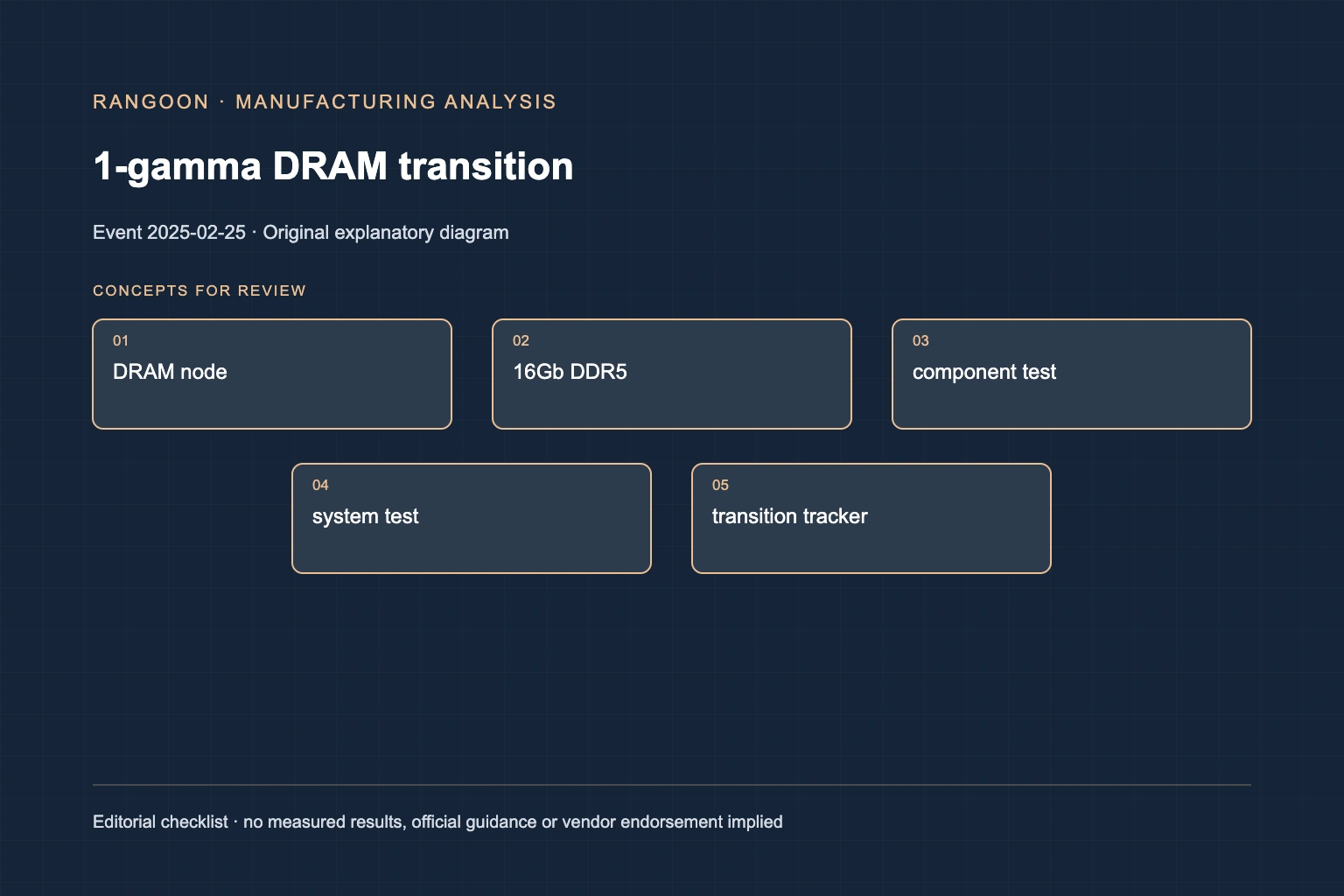
- Micron said its 1-gamma node would first be used in 16Gb DDR5 DRAM.
- A process-node shipment is different from broad portfolio transition or mature yield.
- Node comparisons need their measurement basis and product configuration beside them.
What Micron announced[source 1][source 2]
On February 25, 2025, Micron announced shipment of 1-gamma DRAM, which it called its first 10nm-class DRAM node using EUV lithography. The company said the node would first be leveraged in 16Gb DDR5 DRAM and then integrated across its memory portfolio over time. Its release described density, power, and performance claims relative to its prior 1-beta generation.
Micron’s MWC 2025 blog separately described the preceding DDR5 samples and said it planned to sample 1-gamma LPDDR5X 16Gb products to select partners in the second quarter. That roadmap context does not say every future memory product had already transitioned, that every customer had qualified a 1-gamma part, or that reported process characteristics would map directly to a complete module or server platform.
Editorial analysis: a node claim needs a basis
A node comparison can involve bit density, energy per operation, frequency, die area, yield, or cost, but those are not interchangeable. A density improvement does not automatically determine module availability; a laboratory power number does not describe rack consumption. Engineers need to know the tested product, operating point, workload, and predecessor used for every comparison.
Create a node evidence sheet that separates process facts from product facts. List the node, die organization, product type, tested voltage and speed, comparison baseline, measurement method, and confidence range. This helps reviewers identify whether a claimed advantage belongs to a memory cell, a packaged component, a DIMM, or a system-level configuration.
Editorial analysis: transition is not instantaneous
Memory-node adoption usually moves through product engineering, qualification, yield learning, supply allocation, and portfolio rollout. An initial shipment is a useful milestone, but it should not be read as a declaration that older nodes have disappeared. Different products can move on different schedules because their die designs, validation requirements, or customer platforms differ.
A portfolio transition tracker can state which product first used the node, which products are in qualification, which remain planned, and what evidence supports each status. It should avoid summing announced roadmaps into current capacity. That keeps a manufacturing record useful even when product timing changes.
Editorial analysis: test at the component and system levels
For a new DRAM node, test component behavior and system behavior separately. Component checks can cover timing, power, retention, error characteristics, and thermal response. System checks can cover controller training, firmware, module interoperability, sustained workloads, and failure recovery. A system error may arise at an interface even when a device-level test passed.
Micron’s February 2025 shipment is a precise event: a first product path for a new node. The practical lesson is to keep that precision when reporting downstream readiness, so a node announcement remains evidence rather than a shortcut around qualification.
Editorial analysis: define the product metric
Store performance, energy, and density results with the exact die, interface speed, voltage, temperature, and workload used. This is especially useful when a memory controller chooses timing or power states dynamically. It turns a broad node comparison into an engineering artifact that system teams can repeat when they select modules and tune platforms.
Sources
Continue reading
Related reading
 News analysisMicron’s Singapore HBM packaging groundbreaking set a future supply timetable4 min read
 News analysisTSMC’s Arizona expansion announcement separated a $100 billion plan from current fab output4 min read
 News analysisGlobalFoundries’ New York packaging center plan made onshore test a separate capability4 min read