Microsoft introduced Copilot Chat with web grounding and separately metered enterprise agents
Microsoft introduced Microsoft 365 Copilot Chat on January 15, 2025, pairing a secure GPT-4o web chat experience with pay-as-you-go agents.
Historical reporting: Microsoft introduced Microsoft 365 Copilot Chat on January 15, 2025. The launch described a free secure GPT-4o chat for Microsoft 365 commercial customers and pay-as-you-go agents, with enterprise-data protection and administrative controls. Current Learn documentation describes present protection terms, while a separate current Microsoft FAQ describes agent grounding, metering, and API boundaries; neither is evidence that every later feature or subscription condition existed on launch day.
Key takeaways
- Microsoft positioned Copilot Chat as a free GPT-4o web-chat entry point for Microsoft 365 commercial customers.
- Agents were a separately metered extension, making data grounding and billing configuration part of deployment design.
- Enterprise data protection does not make web queries or third-party agents subject to identical handling.
The January launch separated broad chat access from paid agent consumption[source 1]
Microsoft introduced Microsoft 365 Copilot Chat on January 15, 2025. The announcement described a free secure chat experience powered by GPT-4o for Microsoft 365 commercial customers, while adding pay-as-you-go agents to that chat surface. Microsoft also described enterprise data protection and IT controls for agent management.
This was a packaging and access announcement, not a claim that a chat automatically knew every organization’s internal material. The launch distinguished the chat experience from the separately metered agents that could be built for more focused business work. Metered agents require a configured consumption path rather than merely an employee opening the free chat.
Web chat and tenant-grounded work have different data paths[source 1][source 3]
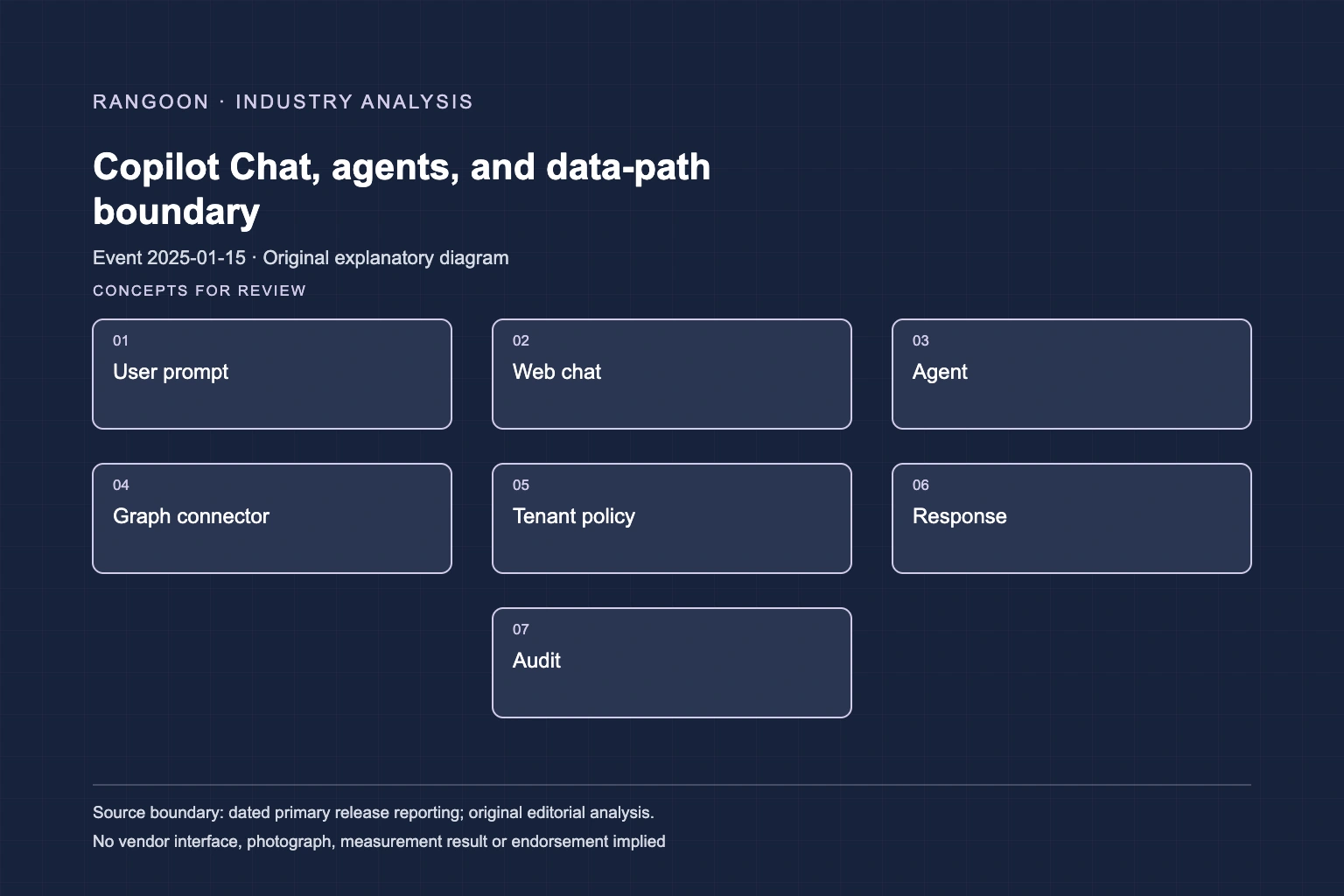
A general web-grounded chat responds from model and web information, whereas an enterprise agent may be configured with selected organizational or external sources. That distinction affects relevance, permissions, audit expectations, and the question a user can safely ask. A user cannot infer tenant-wide knowledge merely from the presence of a Copilot Chat window.
Current Microsoft documentation says access to shared enterprise data and external data indexed through Graph connectors is configured by IT administrators for agents. This is later operating context, not proof that a particular agent, connector, or knowledge source was available in January 2025.
Enterprise protection follows defined terms and has explicit boundaries[source 1][source 2]
Microsoft’s launch foregrounded enterprise data protection, but deployment still requires checking which product, user, data source, and action is in scope. A protection statement can govern prompts and responses under specified terms without making every connected service part of the same boundary. Configuration and retention choices remain material for an organization using the surface.
The current Microsoft protection page says web search uses a separate Bing service with different data-handling practices and tells users to check agent privacy statements and terms. Those current notes explain why an enterprise-AI label alone is insufficient evidence for a specific data-flow conclusion.
A product on-ramp is not an agent outcome or an organization-wide activation[source 1][source 3]
Microsoft’s January event supports a dated conclusion about a Copilot Chat offering and its announced agent model. It does not show that every commercial tenant had the same controls enabled, that an administrator configured an agent, or that a user’s prompts produced correct business results. Adoption and usage must be observed in the actual tenant and configuration.
The announcement also does not prove a fixed price, a particular model response, or a universal compliance status for third-party agent behavior. Those outcomes depend on the subscription, connectors, policies, agent implementation, and the information supplied to it. Later documentation also says the chat surface has no API, which is separate current context.
Sources
Continue reading