

BitNet b1.58 2B4T made ternary weights a runtime compatibility question
Microsoft released BitNet b1.58 2B4T on April 14, 2025 as its first official 2B-parameter model trained on 4T tokens, putting ternary inference paths under review.
Historical reporting: Microsoft’s BitNet repository records the April 14, 2025 release of its official 2B model; the publisher model card identifies the artifact. Supplier efficiency statements are not portable capacity figures for other hardware, engines, quantizations, or workloads.
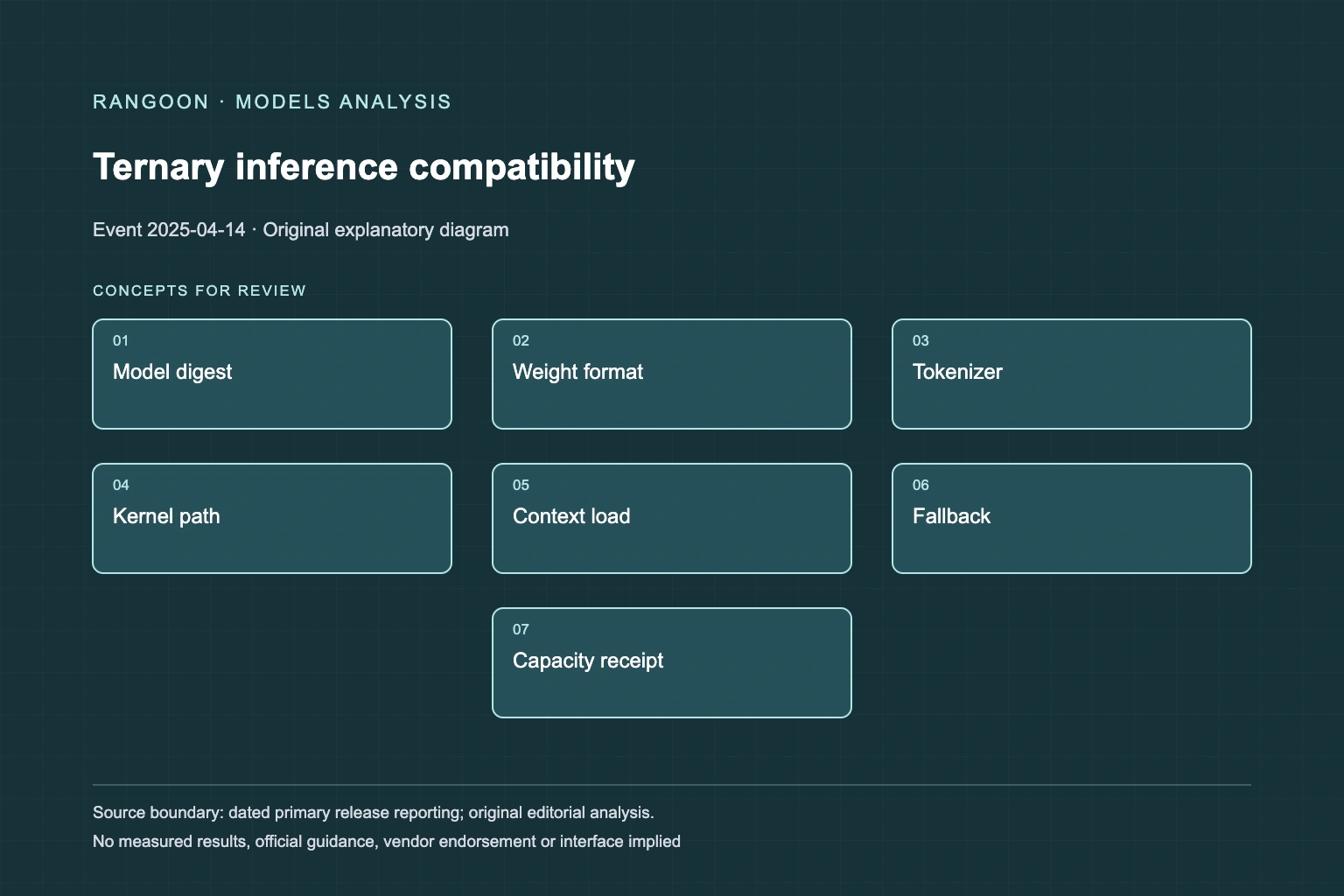
Key takeaways
- BitNet b1.58 2B4T made native ternary weights and compatible kernels part of the artifact boundary.
- A smaller memory claim must be tested across context length, concurrency, engine version and request shape.
- A converted or unsupported runtime is a different test subject from the official artifact.
The April repository record named an official 2B BitNet model[source 1]
Microsoft’s BitNet repository records an April 14, 2025 release of BitNet-b1.58-2B-4T on Hugging Face. It describes that artifact as the first official BitNet b1.58 model trained with four trillion tokens, and the repository’s release notes distinguish later GPU-kernel work from the April model event. This is a discrete artifact release, not a general claim that any 1-bit model has the same runtime behavior. Its date and named model provide a concrete starting point for compatibility review.
Ternary weights require the intended execution path[source 2]
The Microsoft model page identifies BitNet-b1.58-2B-4T as a distinct artifact and lists multiple weight representations. That distinction matters because an engine may load a master-weight form, an exported format, or a converted derivative with different memory behavior and numerical paths. Record the source revision, weight format, tokenizer, context limit, engine build, kernel set, precision, and hardware before comparing throughput or quality. A label such as 1-bit or ternary does not establish that a selected server actually executed the expected kernels.
Efficiency claims need a workload matrix[source 1][source 2]
Evaluate short prompts, long prompts, batch growth, simultaneous sessions, generated-token growth, and retrieval-expanded prompts separately. For each cell, capture peak host and accelerator memory, queue time, first-token delay, completion time, output validity, error class, and retry behavior. A model can look efficient while idle yet fail at a cache, allocator, scheduler, or context boundary under real traffic. Microsoft’s repository reports supplier results, but a service owner needs measurements from its own hardware and serving stack before setting capacity or cost expectations.
The ternary artifact made its execution path part of the story[source 1][source 2]
The April model matters because a ternary representation makes the serving engine part of the effective artifact. Microsoft’s model page lists multiple weight representations, so loading a master-weight form, an export, or a local conversion can select a different numerical and memory path even when the model name stays the same. The key tradeoff is portability against fidelity: a broadly supported representation may be easier to run, while a specialized path may be required to test the ternary design that the release made notable. Compare those paths on the same prompt lengths and generated outputs, then identify which one actually ran before attributing a result to BitNet b1.58. The April event supplies a fixed 2B model trained on 4T tokens; it does not make every subsequent format conversion or kernel implementation part of that published result. The repository separates later GPU-kernel work from the April model event, so framework changes should not be folded into the original release claim. That boundary defines the dated event.
Sources
Continue reading
Related reading
 News analysisMicrosoft announced a planned Pecos campus and dedicated power path, keeping its two-gigawatt figure separate from operation3 min read
 News analysisFairwater announcement made a data center an interconnected-system claim3 min read
 News analysisMicrosoft’s VibeVoice release put long-form multi-speaker TTS into an open research framework, then exposed its misuse boundary3 min read