Phi-4 reasoning releases made inference-time work a route policy
Microsoft introduced Phi-4-reasoning, Phi-4-reasoning-plus and Phi-4-mini-reasoning on April 30, 2025, making reasoning budget and evaluation policy explicit deployment choices.
Historical reporting: Microsoft’s April 30, 2025 Azure post records the three Phi-4 reasoning releases. Its linked technical report is a publisher research record for method context; Microsoft benchmark statements remain vendor-reported and do not measure another route.
Key takeaways
- The Phi-4 reasoning releases separated smaller-model reasoning variants from a generic model-family label.
- Reasoning selection needs a declared time, token, schema and tool-authority policy to remain testable.
- An extended response is not evidence of correct facts, justified action, or a safe tool call.
Microsoft named three reasoning variants on April 30[source 1]
Microsoft announced Phi-4-reasoning, Phi-4-reasoning-plus and Phi-4-mini-reasoning on April 30, 2025. The Azure post describes reasoning models as using inference-time scaling for tasks that require multi-step decomposition and internal reflection. It also reports Microsoft’s own comparisons on mathematics and reasoning tasks. Those statements identify the release and the supplier’s evaluation framing, while leaving any local task, model host, prompt, and latency result unproven.
Inference-time scaling creates an operating decision[source 1][source 2]
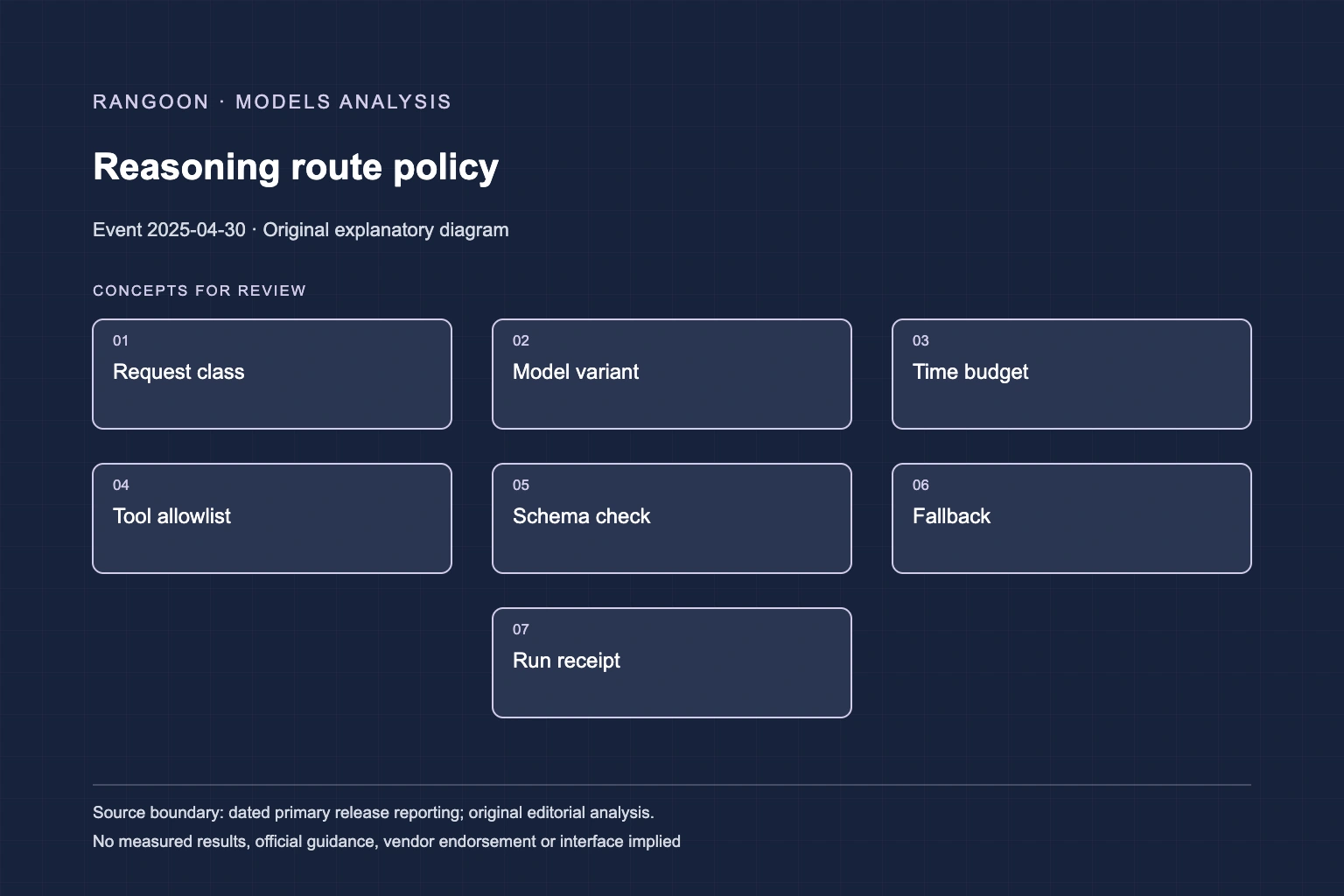
A reasoning variant can change total generated tokens, latency distribution, timeout risk, output formatting, and the chance that a tool call appears later in a run. Treat the variant selection as a route field, not a hidden provider default: retain model revision, thinking or effort setting, prompt version, token ceiling, tool allowlist, and termination reason. The publisher technical material is useful for understanding the release’s research context, but it does not supply a production policy for a different system. A local change to any of those fields creates a new evaluation subject.
Tests must distinguish useful deliberation from unsupported confidence[source 1][source 2]
Use the same held-out cases with a standard route and a reasoning route, then compare exact answer validity, cited evidence, structured fields, abstention, elapsed time, and token use. Add cases with a missing source, conflicting records, and an action requiring approval, because a longer internal process should not bypass an authority boundary. Preserve the final answer and tool trace permitted by product policy, plus the route receipt needed to replay the result. Vendor scores can inform candidate selection, but they cannot substitute for fixtures that represent the user’s actual language, documents, and decisions.
Reasoning-plus made inference budget a release tradeoff[source 1][source 2]
Phi-4-reasoning-plus was not merely another label in the April group. Microsoft says it was further trained with reinforcement learning to use 1.5 times more tokens than Phi-4-reasoning, while Phi-4-reasoning was supervised-fine-tuned on curated reasoning demonstrations. That makes inference budget the central release tradeoff: the additional route can spend more compute on a decomposition, but it can also change tail latency and the moment at which a tool-using application needs a final answer. An analysis should compare the same multi-step prompt through the standard, reasoning, and reasoning-plus variants, asking whether the added tokens improve the final evidence-grounded result or simply extend the process. The supplier’s benchmark framing gives a reason to run that comparison; it does not settle it for another route. Microsoft presents Phi-4-reasoning as a 14B open-weight model, so the comparison separates its post-training story from its shared family name. The 14B artifact also rules out treating the choice as a small configuration toggle.
Sources
Continue reading