

Ministral 3 made edge model choice a family, mode, and license decision
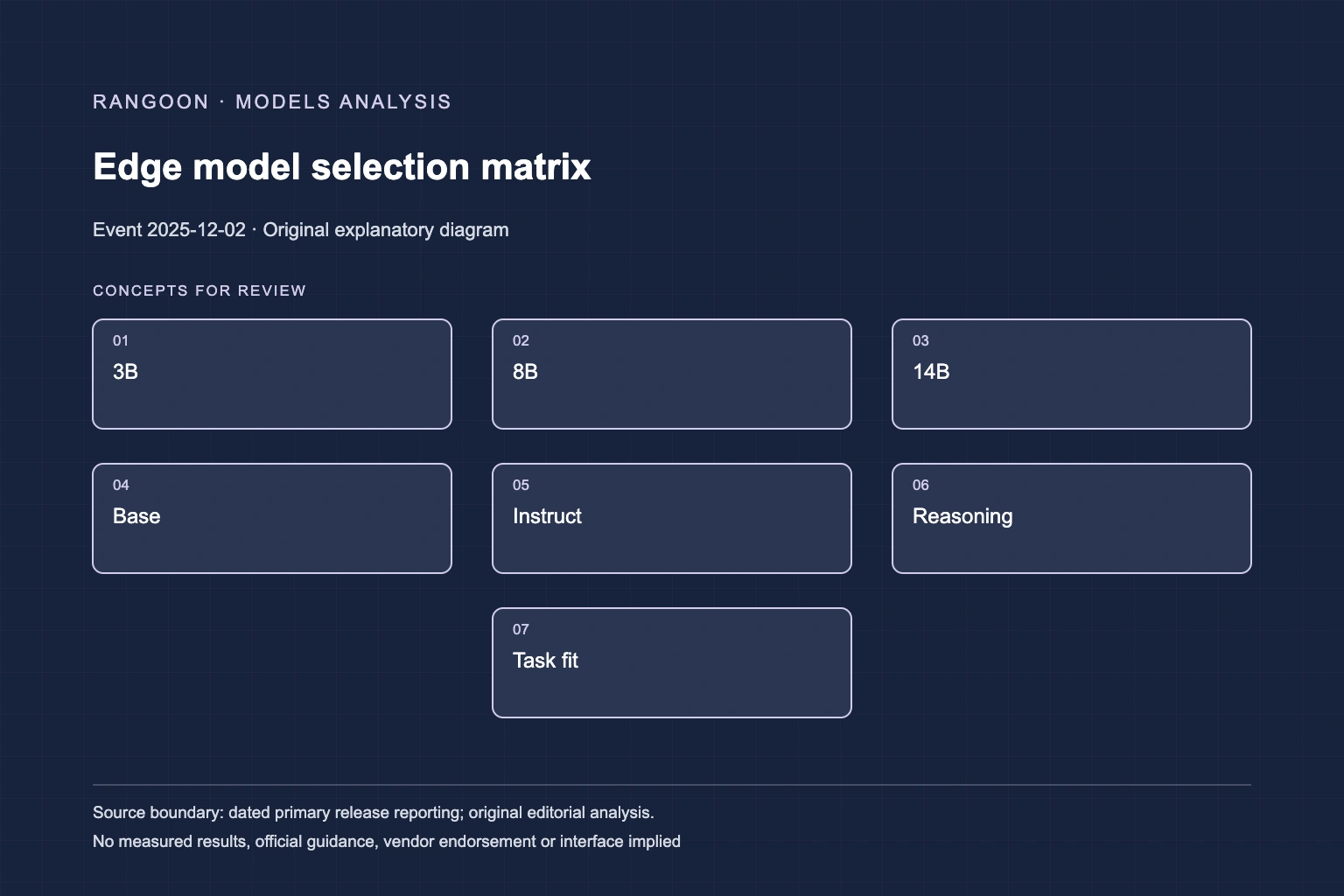
Mistral released Ministral 3 on December 2, 2025, with 3B, 8B, and 14B base, instruct, and reasoning variants under Apache 2.0.
Historical reporting: Mistral’s December 2, 2025 Mistral 3 announcement released the Ministral 3 family in 3B, 8B, and 14B sizes, each with base, instruct, and reasoning variants and image understanding capabilities, under Apache 2.0. The current Hugging Face collection provides later maintained artifact context and is not used as launch-date proof.
Key takeaways
- Ministral 3 shipped a matrix of size and behavior variants, so model selection needs an exact checkpoint and mode.
- Apache 2.0 resolves one weight-license question, while datasets, integrations, hosting, and output use retain separate obligations.
- Edge deployment claims still require local memory, latency, image-processing, and task-quality tests.
The December release delivered a matrix rather than one edge model[source 1]
On December 2, 2025, Mistral announced Mistral 3 and released the Ministral 3 series in 3B, 8B, and 14B sizes. The announcement said each size had base, instruct, and reasoning variants, with image-understanding capability, native multimodal and multilingual features, and an Apache 2.0 license. A family announcement is therefore not a result for one generic “Ministral 3” configuration: parameter size and response mode remain material choices.
Base, instruct, and reasoning checkpoints serve different roles. A base checkpoint can be a starting point for permitted adaptation, an instruct checkpoint can target conversational or structured tasks, and a reasoning variant can use a different response path and token budget. Those are deployment hypotheses to test against a defined task, not guarantees that one variant will be cheaper, faster, or more accurate in every runtime.
Apache 2.0 made weight reuse clearer without completing compliance work[source 1][source 2]
Mistral stated that all models in the Mistral 3 release were published under Apache 2.0 and described release in compressed formats. That is a concrete license statement for the model artifacts, which teams can preserve with the chosen checkpoint revision and its included notices. It does not automatically cover prompt data, fine-tuning data, external tools, hosted service terms, or the rights in documents and images sent to an application.
The current Mistral Hugging Face collection lists the 3B, 8B, and 14B base, instruct, and reasoning artifacts and their vision capability. It is useful for locating maintained variants, but its update timestamps are later than the announcement and cannot retroactively define the December 2 release state. Release records should keep the dated announcement, selected artifact, license file, and any deployment-specific obligations together.
Edge positioning brings multimodal resource choices into view[source 1][source 2]
Mistral positioned Ministral 3 for edge and local use while also describing image understanding. That combination makes image tokenization, input resolution, sequence length, batch size, accelerator memory, and response length part of the actual deployment envelope. A text-only smoke test cannot establish whether a chosen size can serve the intended image or document workload within a usable latency budget.
The announcement also made performance-to-cost and benchmark claims for the family. Treat those as supplier evidence under Mistral’s methodology rather than an independent estimate for a specific laptop, industrial device, or customer input set. Local evaluation should compare the exact permitted variants with fixed media, defined decoding settings, and visible failure handling before an edge claim becomes a service commitment.
Reasoning variants make output policy part of the integration[source 1][source 2]
Mistral described the reasoning variants as able to think longer when accuracy is the only concern. That statement implies a product tradeoff among latency, output budget, cost, and the distinction between internal deliberation and a user-visible answer. An application needs a clear rule for which mode serves which request, and it should validate the final answer format independently of any intermediate behavior.
For a bounded service, record the selected size, variant, weights revision, processor, serving engine, input limits, and evaluation result. This is not a generic rollout checklist; it is the minimal evidence needed to explain why a 3B instruct image task and a 14B reasoning task are different releases in practice. Without that distinction, later cost or quality observations cannot be attributed to a meaningful artifact.
Sources
Continue reading
Related reading
 News analysisMistral released Voxtral speech-understanding models in open-source and production sizes3 min read
 News analysisLiquid AI released LFM2-VL as compact vision-language models for edge deployment3 min read
 News analysisLiquid AI released LFM2 as a small on-device foundation-model family3 min read