Muse made action-conditioned world modeling a closed-loop evaluation problem
Microsoft Research introduced Muse on February 19, 2025, publishing a World and Human Action Model for gameplay ideation with a bounded game-data setting.
Historical reporting: Microsoft Research introduced Muse on February 19, 2025 with a Nature publication. A model trained on gameplay data is not a validated simulator of general physical environments or a robotic-safety result.
Key takeaways
- Muse modeled game visuals and controller actions in a named gameplay setting.
- World-model quality needs long-horizon state and action consistency tests, not only short clips.
- A game-data model does not establish physical-world transfer.
The release bounded Muse to gameplay ideation[source 1][source 2]
Microsoft Research introduced Muse on February 19, 2025 as a World and Human Action Model, or WHAM, for gameplay ideation. The announcement and Nature publication describe a model trained using data from a named game context, able to generate game visuals, controller actions or both. This is a specific research setting for interactive media. It is not evidence that the model understands arbitrary real environments, predicts physical outcomes reliably, or can provide a safety basis for a robot, vehicle or digital-twin decision outside the data and task scope described by the authors.
Action and world predictions must remain consistent over time[source 1][source 2]
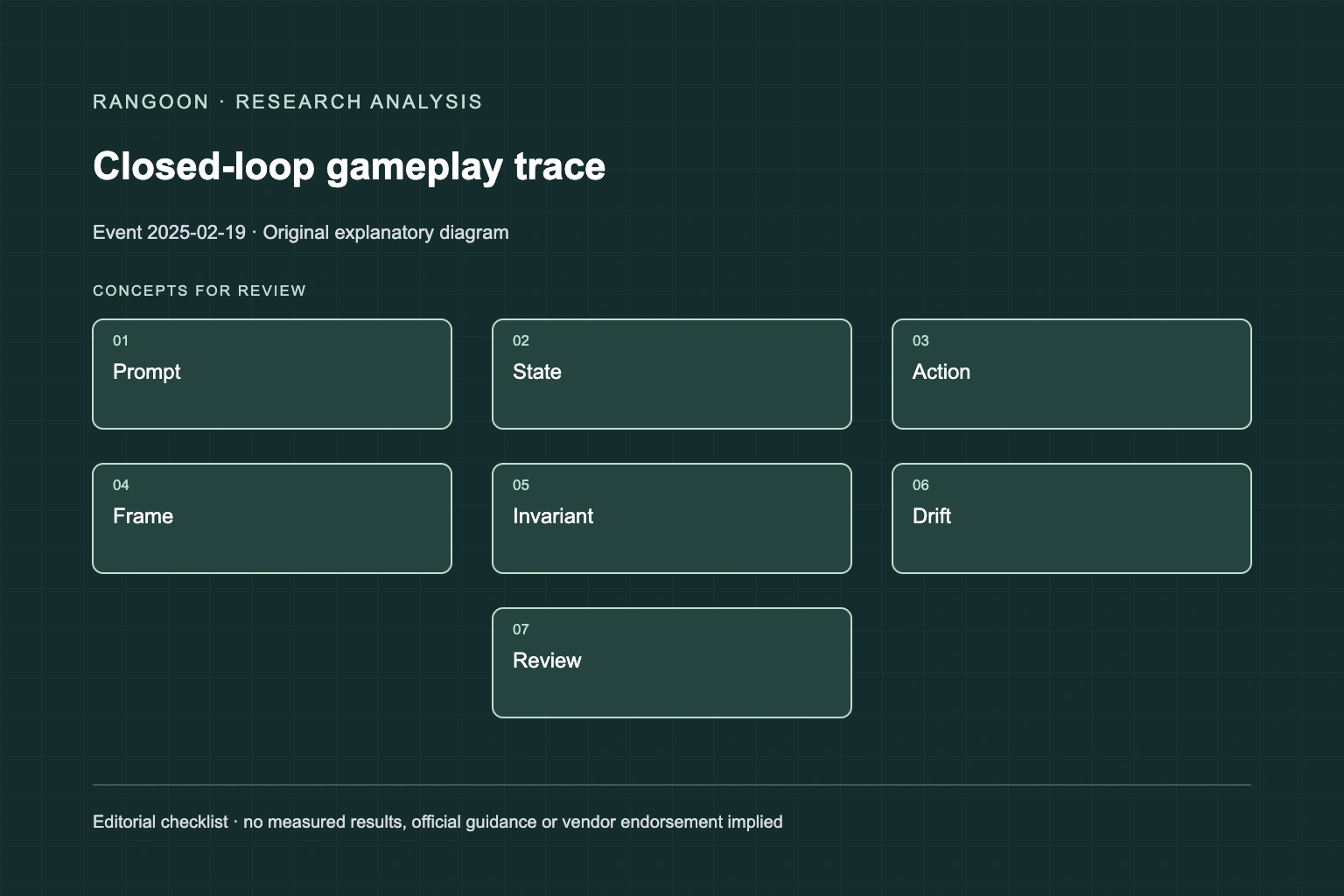
A world-and-action model is judged by more than frame quality. It must respond plausibly to actions, preserve relevant state and avoid collapsing when a trajectory revisits a prior location or reaches an unusual condition. The named game supplies rules, camera conventions, controller vocabulary and a data distribution that make the research task concrete. A short continuation can look coherent while the action channel diverges after more steps. Evaluation should separate visual resemblance, action plausibility, state retention, controllability and usefulness for the intended creative workflow.
A gameplay world is not a physical simulator[source 1][source 2]
Simulation language can be misleading when it crosses domains. Game states encode designed mechanics, not the full causal behavior of materials, people or machines. A controller action that works in generated gameplay is not evidence about friction, contact, safety margins or sensor failure in the physical world. The model can still be useful for ideation in its stated setting. Reports should label the training domain, generated modality and duration, and avoid reusing a game-model result as proof of embodied-system transfer or a claim about real-world reliability.
Closed-loop tests should target state drift and action recovery[source 1][source 2]
A useful test suite would freeze prompts and action sequences, then check object identity, scene continuity, action response and recovery after a deliberately unusual input. Run repeated trajectories to reveal stochastic drift, and compare both the visual sequence and the underlying task state where a reference is available. Include an intervention that a model should reject or render as impossible under the game’s rules. For creative tooling, have domain users assess whether a continuation is controllable and inspectable rather than grading only screenshot appeal.
Analysis: interaction claims need trajectory evidence[source 1][source 2]
Muse is a useful historical marker for action-conditioned generative models because it forces evaluation to happen along a trajectory. Editorially, a convincing demo frame cannot stand in for evidence that state and control remain meaningful after many decisions. The February release and Nature paper document an interactive-media research model. They do not establish a general-purpose world simulator or a route to physical deployment. Any transfer claim needs a separate test environment, a separate safety analysis and evidence from the domain where the consequence actually occurs.
The useful test for an interactive model is a trace: same start, same actions, known invariants, and a documented point where the generated world stops behaving coherently.
Sources
- Microsoft Research: Introducing Muse (February 19, 2025)
- Nature: World and Human Action Models towards gameplay ideation (February 19, 2025)
Continue reading